GPT-5.6 SOL Now Available to Plus Users: Analyzing the AI Subscription Market Competition

OpenAI opens GPT-5.6 SOL to Plus users, intensifying AI subscription market competition with Perplexity.
OpenAI has made GPT-5.6 SOL available to all Plus and Pro subscribers, departing from the practice of reserving flagship models for top-tier plans. This contrasts sharply with Perplexity, which limits the same capability to its Max tier. The move reflects a broader shift in AI market competition—from model capability to access strategy and pricing—as platforms face mounting pressure from user communities to democratize advanced AI features.
GPT-5.6 SOL Officially Available to Plus and Pro Users
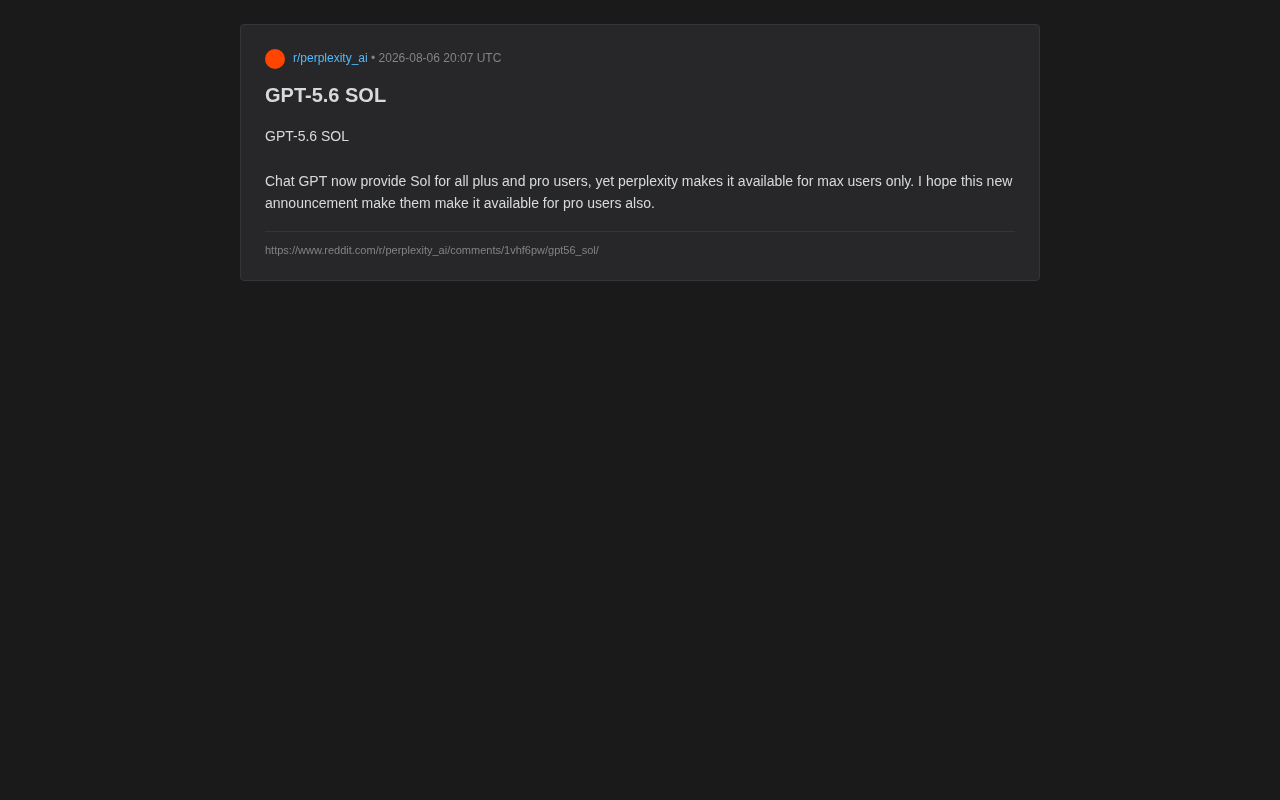
Recently, OpenAI announced that its latest GPT-5.6 SOL model is now officially available to all Plus and Pro subscription users. This news sparked heated discussion on Reddit, marking another significant adjustment in OpenAI's model capability tiering strategy.
OpenAI's model naming system has undergone multiple evolutions in recent years. From GPT-3 to GPT-4, and now the GPT-5 series, major version numbers represent architecture-level upgrades. The decimal number (such as 5.6) represents incremental optimization within the same generation architecture. The SOL suffix typically points to a specific optimization direction or training configuration. In the AI industry, such suffix naming conventions (similar to Google's Ultra, Pro, and Nano tiers) have become a common practice for differentiating capability configurations within the same generation of models.
Based on Reddit user feedback, this rollout means more paying users can immediately experience the performance improvements brought by the SOL version. Compared to the previous approach of restricting flagship models to the highest subscription tier, OpenAI's decision to open SOL to Plus—its entry-level paid tier—demonstrates its intent to balance user experience with market competition.
Core Features of the SOL Version
SOL typically represents an iterative version of the model optimized in specific directions, often with enhancements in reasoning capability, response speed, or specific task processing. While OpenAI has not yet published complete technical details for SOL, judging from the naming and release cadence, GPT-5.6 SOL is likely a further optimization built upon the GPT-5.6 base model, with a focus on improving complex reasoning and long-context processing capabilities.
From a technical perspective, reasoning capability refers to a model's performance when facing complex tasks requiring multi-step logical deduction, mathematical proofs, code debugging, and similar challenges. In recent years, reasoning-enhanced models represented by OpenAI's o1 series have significantly improved this capability through techniques like Chain-of-Thought. Long-context processing refers to the effective input text length a model can handle—from GPT-3's early 4K token context window to today's 128K or even million-token processing capabilities. Longer context means the model can analyze entire books, large codebases, or lengthy conversation histories in a single pass, which is particularly critical for enterprise applications. SOL's optimizations in these two areas directly impact the quality of user experience in real-world work scenarios.
For subscription users, whether they can access the latest models immediately is often a key factor in their willingness to pay. OpenAI's decision to bring SOL down to the Plus tier undoubtedly enhances the value proposition of its subscription service. OpenAI's current subscription system is divided into three main tiers: Free, Plus ($20/month), and Pro ($200/month). Plus, as the entry-level paid tier, targets everyday users with general AI assistance needs; Pro targets heavy users and professional developers, offering higher usage quotas and priority access to new models. Bringing a flagship model down to the Plus tier means OpenAI is investing more value in the middle layer of its subscription pyramid—a typical strategy for SaaS companies pursuing scale growth.
Comparing OpenAI and Perplexity's Capability Access Strategies
Notably, Reddit users highlighted a stark contrast in the discussion: the same model capabilities have entirely different access strategies across platforms.
According to user observations, while ChatGPT offers SOL to all Plus and Pro users, Perplexity only makes this capability available to its Max-tier users. This difference reflects divergent approaches to commercialization among different AI product companies.
Perplexity is a company focused on AI search, with its core product being an intelligent search engine that combines large language model capabilities to provide comprehensive answers with source citations, rather than the traditional search engine's list of links. Perplexity's subscriptions are divided into Pro ($20/month) and Max (a higher price tier). Unlike OpenAI, Perplexity doesn't train its own foundation models but provides services by calling model APIs from companies like OpenAI and Anthropic. Therefore, when Perplexity restricts certain advanced models to Max users only, part of the reason lies in the higher API call costs it must bear—its tiering strategy partly reflects the constraints of its cost structure.
OpenAI's Inclusive Strategy: User Growth First
OpenAI's choice to bring advanced model capabilities down to lower subscription tiers is fundamentally a user acquisition-first strategy. By letting more users experience flagship models, OpenAI can:
- Expand its paying user base and improve overall subscription conversion rates
- Collect broader user usage data to accelerate model iteration
- Gain an experience advantage over competitors
As the direct trainer and owner of its models, OpenAI's marginal cost structure is fundamentally different from Perplexity's. The cost of each additional user utilizing its model is primarily reflected in inference computing resource consumption, rather than external API call fees. This gives OpenAI more room to implement an inclusive strategy.
Perplexity's Tiered Protection: Premium User Monetization First
In contrast, Perplexity's restriction of SOL to the Max tier reflects a high-value user monetization-first approach. This approach protects the differentiated value of premium subscriptions but may also lead to churn among mid- and lower-tier users—as the Reddit user hoped: "Hopefully this announcement from OpenAI will push Perplexity to open it up to Pro users as well."
This user demand actually reveals an important dynamic in the current AI subscription market: capability openness across platforms creates mutual pressure. When one company relaxes access restrictions, users naturally develop the same expectations for other platforms. The major players in today's AI subscription market include OpenAI (ChatGPT), Google (Gemini), Anthropic (Claude), Perplexity, and others. These companies form close mutual reference points in pricing, model capability access, and usage quotas. The economic concept of "competitive pricing pressure" is particularly evident here—when one company lowers the access threshold for a certain capability, the churn risk for other companies immediately rises.
AI Subscription Market Competition Enters a New Phase
This discussion around model access permissions reflects new characteristics of competition in the AI subscription market.
Competition Focus Shifts from Model Capability to Access Strategy
In the early days, competition among AI companies primarily centered on model capability itself—whose model was stronger, had more parameters, or scored higher on benchmarks. However, as leading models' capabilities gradually converge, the battlefield is shifting toward access strategy, subscription value, and user experience.
This shift in competitive focus is not unprecedented in the tech industry. Similar evolutions have occurred in cloud computing (from compute competition to service ecosystem competition), streaming media (from exclusive content competition to pricing and user experience competition), and other sectors. Once foundational capabilities reach a certain level, product packaging, distribution, and pricing strategies often become the key variables determining market dynamics.
The rollout of GPT-5.6 SOL to lower tiers is a textbook example of this trend. When model capability is no longer the sole selling point, whoever can offer stronger capabilities at a more reasonable price wins user preference.
User Community Feedback Is Influencing Vendor Decisions
You may not have noticed, but discussions like these on Reddit are themselves influencing vendor decisions. Users' public demands regarding access permissions create a form of public pressure that forces platforms to re-examine their subscription tiering strategies. In today's highly transparent information environment, any company's strategic adjustment is rapidly disseminated and compared. Social platforms like Reddit serve as information amplifiers—users' public comparisons and demands can create public pressure within hours, forcing vendors to respond more quickly to market changes. This user community-driven market dynamic was unimaginable in the traditional software era.
Summary and Outlook
The full rollout of GPT-5.6 SOL to Plus and Pro users is not just a product strategy adjustment by OpenAI—it's a microcosm of the intensifying competition across the entire AI subscription market.
For everyday users, this is undoubtedly good news—increasingly more flagship AI capabilities are becoming accessible at lower thresholds. For the industry, this battle over "capability access strategy" has only just begun. In the future, we may see more platforms adjusting their tiering strategies under competitive pressure, with end users ultimately being the beneficiaries.
Whether it's OpenAI's inclusive approach or Perplexity's tiered protection, both are essentially exploring the optimal solution for AI service commercialization. And that answer will likely become clearer through intense market competition and user feedback.
Related articles

Why Does the Tesla Roadster Need to Fly? A Deep Dive into Musk's Wild Demo
Tesla's Roadster launch showed wall-climbing, upside-down driving, and flying stunts—but The Vergecast notes the demo car may lack a battery, the Rocket version is invite-only and not street-legal, and the website terms don't guarantee delivery. After nine years of delays, why does this car still need to exist?

AI Is Not a Replacement: Human-AI Collaboration Through the Lens of Factory Root Cause Analysis
Starting from factory root cause analysis, this article explains how AI accelerates evidence chain construction rather than replacing human experts, exploring the pragmatic implementation logic and business value of 'AI supporting people rather than replacing them.'

AI Agent Decision Auditing: Building an Evidence Chain in Regulated Workflows
Starting from a Reddit discussion, this article analyzes three core issues in AI agent decision auditing within regulated workflows: what fields audit records should contain, how to handle feedback latency for erroneous decisions, and how to continuously calibrate LLM judge consistency with human judgment.