GPT-5.6 Value Maxing Practical Guide: From Token Stacking to Output Optimization Methodology

A practical guide to GPT-5.6's Value Maxing approach: optimizing Token spend for maximum output.
This article breaks down OpenAI's GPT-5.6 Value Maxing methodology, shifting focus from raw Token consumption to measurable business output. It covers the Sol/Terra/Luna model tier selection, programmatic tool calling, prompt caching, context compression, and real-world KV cache optimization techniques from startup Ploy that achieved up to 89% Token reduction in production.
In an era where AI programming and Agent development are entering deep waters, OpenAI raised a thought-provoking topic during their first Build Hour after the GPT-5.6 release: Value Maxing. This isn't merely a product feature introduction—it represents the industry's collective rethinking of "how to measure AI value." This article distills the most practically valuable methodologies from the sharing by Charlie from OpenAI's Developer Experience team and engineers from the startup Ploy.
From Token Maxing to Value Maxing: A Paradigm Shift in Measuring AI Value
Earlier this year, a term gained traction in the industry: "Token Maxing"—measuring a team's AI application progress by the volume of Tokens consumed, number of Prompts sent, and number of Agents managed simultaneously. Some companies even built internal leaderboards tracking employees' daily Token usage.
It's worth explaining the concept of Tokens and their economic significance here. Tokens are the basic unit of measurement for large language model text processing, roughly corresponding to 4 English characters or 1-2 Chinese characters. API service providers like OpenAI charge based on input and output Token counts, so Token consumption directly equals AI usage cost. The Token Maxing phenomenon has its historical context: from late 2024 to early 2025, enterprises were generally in an exploratory phase of AI adoption, and management tended to use quantifiable metrics (like Token usage) to measure team AI adoption levels. This mirrors early internet-era thinking of measuring website value by "page views"—simple and quantifiable, but not necessarily reflective of true value.
But the wind shifted quickly. Charlie pointed out that some companies burned through their entire annual AI budget within a few months, many began limiting AI spending, and even AI company CEOs stated bluntly that "some companies have gone overboard with Token leaderboards"—what should truly be measured is output and value generated.
Thus the concept of Value Maxing emerged: the standard for measuring progress is no longer "how much AI you used" but "what AI actually helped you accomplish"—how much work was completed, how much time was saved, how much quality improved. Charlie posed a highly illuminating self-check question: If you doubled your Token spending tomorrow, how would you know if that money was well spent?

You might not have noticed, but Value Maxing doesn't equal "saving money." In certain scenarios, spending more Tokens is actually more valuable: upgrading reasoning levels to ensure high-quality results, accelerating to reduce real-world latency, completing large-scale migration projects in weeks instead of months, or using LLMs as judges to manage risk and cover edge cases. The key is linking Token investment to specific business outcomes and using Evals (evaluation frameworks) to define "what good looks like." Evals here refers to a systematic evaluation framework, typically comprising test cases, scoring criteria, and automated pipelines for quantifying model performance on specific tasks—it's the measurement bridge between "Token investment" and "business output."
GPT-5.6 Value Maxing Strategies in Codex
The GPT-5.6 family introduced three new models, forming a differentiated capability tier:
- Sol: Flagship frontier model, targeting the most complex coding and specialized tasks
- Terra: Balanced "daily workhorse," balancing intelligence, cost, and latency
- Luna: For high-throughput scenarios where intelligence requirements are lower but cost and latency are critical
On coding benchmarks like SWE-bench, the 5.6 family performs best on the "performance relative to Token consumption" dimension. SWE-bench is a software engineering benchmark released by a Princeton University research team in 2023. It extracts hundreds of real bug-fix tasks from actual GitHub open-source projects, requiring AI models to autonomously generate correct code patches given problem descriptions. This benchmark has been widely adopted as the gold standard for measuring AI coding ability due to its proximity to real development scenarios. The "performance relative to Token consumption" dimension matters because on SWE-bench, models can improve pass rates through repeated attempts and generating more intermediate reasoning steps—but this also means higher Token costs—thus requiring finding the optimal balance between effectiveness and efficiency.
Charlie emphasized a counterintuitive insight: a less intelligent model, as long as it's willing to spend more Tokens, can often achieve results comparable to a stronger model. Therefore, evaluation shouldn't only consider per-Token cost but also the total cost of completing the entire task. The essence of this insight is that models with weaker reasoning capabilities can compensate for their intelligence gap through more trial-and-error and self-correction, but these extra steps consume Tokens; while stronger models might "get it right the first time" with lower total Token consumption. True cost optimization requires finding the sweet spot between model tier and reasoning depth.
Practical Tips Checklist
Start with Sol Medium, don't default to maximum. Charlie specifically wanted to dispel a misconception: many developers habitually set all tasks to Extra High. In reality, most daily work can be handled well with Sol Medium—increase only when needed, and for low-intensity coding tasks, you can even drop to Terra.
Trade Tokens for time. Fast mode can speed up output by 1.5x (at the cost of consuming quota faster); Auto Approval is recommended as the default mode, balancing efficiency and safety (Full Access is not recommended); the new Chronicle feature can build memory for repetitive tasks through screen recording.
Audit your AGENTS.md and Skills. As model capabilities improve, many of those detailed instructions written six to twelve months ago are now redundant—trimming them directly saves input Tokens. AGENTS.md is a configuration file in Codex projects for storing Agent behavior instructions, similar to a "work manual" for an AI assistant. As models become smarter, many behaviors that once required explicit instructions are now default model capabilities—keeping them not only wastes Tokens but may actually reduce model performance through over-constraining.
API-Level Value Maxing: Four Key Features
If Codex targets individual developers, then for teams building products on the OpenAI API, there's a set of key API features worth mastering:
Programmatic Tool Calling
This is a major feature launched with 5.6. In traditional tool calling (Function Calling), the model decides in its chain of thought which tool to call and what parameters to pass, then pauses reasoning to wait for the tool's response before continuing—meaning each tool call consumes expensive reasoning Tokens. Programmatic Tool Calling introduces a lightweight JavaScript sandbox environment where the model can write code to orchestrate multiple tool calls and execute intermediate computations (like data format conversion, conditional logic), offloading this "mechanical" work from the expensive reasoning process. This is analogous to the architectural approach of moving stored procedures from the application layer to the database layer—placing deterministic logic in a more efficient execution environment.
In Charlie's demo, this feature delivered a 24% reduction in input Tokens, while output Tokens also decreased since the model spent less reasoning on the final answer.
Prompt Caching
Prompt caching is a money-saving powerhouse. One technique: if your Prompt contains dynamic information (like the current date), make sure to append it at the end rather than the beginning, so the large unchanging content block can be effectively cached. In the demo, caching reduced input costs by 90%.
The principle behind this technique is that cache matching is prefix-based: the system compares character by character from the beginning of the Prompt until it finds a difference. If dynamic content is at the beginning, even if the remaining 99% of content is identical, the entire Prompt cannot hit the cache. Placing dynamic information at the end maximizes the cacheable prefix length.

Persistent Reasoning and Context Compression
Persistent Reasoning allows saving the reasoning process across turns, improving both answer continuity and performance while enhancing cache efficiency. In multi-turn conversation scenarios, models typically need to "recall" previous reasoning chains at each turn. Persistent Reasoning saves these intermediate reasoning states, allowing the model to continue directly from the previous turn's thought state without reasoning from scratch.
Compaction targets scenarios with lengthy Prompts and numerous tool calls—in the demo, compression reduced input Tokens from 24,000 to just over 4,000, an 82% reduction. Compression works by having the model summarize and distill previous conversation history and tool call results, retaining key information while drastically reducing raw text volume—ideal for long-running Agent sessions.
Ploy's Practical Experience: Caching Is the Underrated Ace
The sharing from marketing platform Ploy was the most hardcore segment of the session. This company accumulated extensive optimization experience while migrating production Agents to GPT-5.6 Sol, and their migration guide even reached the front page of Hacker News. Engineer Lorenzo stated plainly that among compression, tool calling, programmatic calling, and caching, caching is the most important yet most easily overlooked.
KV Cache Principles and Common Pitfalls
KV Cache (Key-Value Cache) is a core optimization mechanism in the Transformer architecture. When the model processes input, each attention layer computes Key and Value vectors for every Token. If subsequent requests share the same prefix as previous ones, these already-computed KV pairs can be directly reused without recalculation. This is why the context window must be "append-only"—any modification to existing content invalidates all subsequent Token KV pairs because attention computation is position-dependent.
In a typical Agent loop, each decision requires reprocessing all previous input Tokens. An Agent calling ten tools across ten steps actually produces N²-level Token processing volume. Specifically, step 1 processes M Tokens, step 2 processes 2M Tokens (including step 1's tool call results), and so on, with step N processing NM Tokens, for a total processing volume of M×N(N+1)/2, approximately N² level. With caching enabled, the cost of already-processed Tokens can drop to one-tenth—because you only pay for cache reads rather than full computation.
But caching is easily invalidated—the context window must be "append-only." Lorenzo highlighted two common cache-breaking operations: dynamically modifying tool lists (tool definitions sit at the beginning of context, and any addition or removal invalidates all subsequent cache entries) and updating current time in system prompts (even changing a single character forces recalculation of all KV pairs after that position).
Three Techniques to Maintain Cache Hit Rates
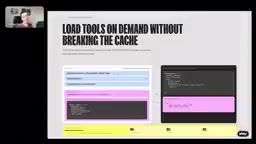
Technique 1: Load tools on demand without breaking cache. Ploy divided tools into "resident tools" (core tools used in 70%+ of sessions) and "on-demand tools." When needed, a dedicated tool appends the schema to the end of context, avoiding cache invalidation at the beginning. This strategy reduced tool schema Tokens by 45% and costs by 33%. The elegance of this design lies in using a "meta-tool"—a tool specifically for registering other tools—to achieve dynamic tool loading while maintaining context prefix stability.
Technique 2: Use Breakpoints to set cache checkpoints. Breakpoints is a fine-grained cache control feature provided by the OpenAI API, where developers can mark specific positions in the Prompt to tell the system "content up to this point should be cached." For multiple conversations created by the same user, system prompts and tools are shared—setting breakpoint caches allows reuse across subsequent conversations; workspace memory can also have a second breakpoint set, enabling layered caching. The result: 89% Token reduction for the first message in new conversations, and a 5% reduction in overall production Token spending.
Technique 3: Batch tool calls. Guide the Agent to consolidate independent tool calls (e.g., editing file A, reading files B and C) into a single step, or even design tools capable of executing multiple operations at once. This achieved a 14% cost reduction with unchanged pass rates and slightly improved speed. Batching works because each independent tool call produces a full "request-response" cycle, and each cycle requires resending the complete context; consolidating into one cycle significantly reduces redundantly transmitted Tokens.
Additionally, Lorenzo shared clever tool optimizations: web search provider EXA's highlights feature compressed response volume by 70% (highlights is a retrieval mode that returns only the most query-relevant paragraphs from a webpage rather than the full text), with estimated annual savings of approximately $37,000; extracting deterministic logic from the Agent reduced a single tool's Token overhead by 54%.
Sub-agents and Reasoning Mode Clarifications
The Q&A session cleared up several concept confusions. Charlie explained three easily confused tiers:
- Max: A new reasoning tier in 5.6, above Extra High, "fully unleashing" the model to allow extremely long deep reasoning
- Pro: Has been moved into the new reasoning mode parameter (thus there's no separate slug for 5.6 Pro in the API), spends more Tokens and takes longer, suitable for scenarios requiring the highest quality output
- Ultra: On top of Max reasoning, further modifies system prompts to push the model toward greater use of sub-agents—essentially an orchestration strategy rather than purely increased reasoning depth

Regarding sub-agents, both parties offered pragmatic advice. Sub-agents are an Agent orchestration pattern where a "main Agent" decomposes complex tasks into subtasks, delegating them to multiple "sub-Agents" for parallel or sequential execution. The advantage of this architecture lies in task isolation and parallel acceleration, but each sub-agent requires an independent context window, and the main Agent's instructions and context information need to be "translated" to sub-Agents—information loss is unavoidable in this process, worsening with each additional layer, similar to the "information decay through hierarchical levels" phenomenon in organizational management.
Charlie believes effectiveness degrades after more than two layers of delegation due to context loss, and sub-agents are better suited for tasks that can be effectively parallelized without shared state. Lorenzo added that three months ago, models using sub-agents actually performed worse in cost, performance, and time—the key depends on the orchestration capability of the model being used. If it's Sol-Sol-Sol, it might work, but a progressively descending combination like Sol-Terra-Luna might sacrifice efficiency. His advice: "proceed with caution."
Notably, both experts expressed evolved views on "starting new conversations vs. compression": they no longer start new conversations as frequently as they did a year ago to avoid context pollution. Charlie even mentioned working in the same thread for days or even weeks consecutively. Starting a new conversation is only more economical when personal configurations load numerous plugins, skills, or files. Behind this attitude shift is the significant improvement in model context handling—early models easily "lost" key information in long contexts, while the 5.6 family has achieved a qualitative leap in long-context fidelity.
Conclusion: Turning "Using More" Into "Doing Better"
The Value Maxing narrative around GPT-5.6 is fundamentally a signal that AI applications are moving from an "arms race" to "lean operations." When model capability is no longer the sole bottleneck, how to leverage fewer Tokens for equal or greater output is becoming the new dividing line in team engineering capability. Whether it's tier selection in Codex, API-level caching, compression and programmatic tool calling, or the "hiding in plain sight" caching techniques Ploy demonstrated, the core logic remains consistent: build good Evals and trace every Token investment back to real business value.
This also means AI engineers' core competitiveness is undergoing a subtle shift: from "can you make AI work" to "can you make AI work efficiently." In an era where model capability is becoming abundant, engineering optimization, cost awareness, and evaluation system building will become the key factors distinguishing excellent AI applications from mediocre ones.
Related articles

Researchers Claim AI Agents Being Tested by OpenAI Were Involved in a Cyberattack
Security researchers allege OpenAI-tested AI agents were involved in a cyberattack. We analyze the security risks, accountability gaps, and safeguards the industry needs.

James Webb Telescope Reveals: Extreme Star-Forming Galaxies Masquerading as Faint Quasars
JWST finds some objects mistaken for faint quasars are actually extreme star-forming galaxies, potentially revising estimates of early-universe supermassive black holes.

Why So Many AI Researchers Fear Machines Could Destroy Humanity
Why do so many AI researchers fear machines could destroy humanity? This article breaks down the alignment problem, capability leaps, and interpretability issues driving existential AI risk debates.