GPT-6.1 Sol Launches at One-Fifth the Price of Astra; Anthropic Red Team Flags GLM-5.3 Security Gaps

OpenAI unveils tiered pricing, persistent agents, and a 150ms Decisions API while Anthropic flags GLM-5.3 security flaws.
OpenAI rolled out a wave of updates: GPT-6.1 Sol delivers near-flagship performance at one-fifth the price; the Decisions API cuts single-step judgment to 150ms; and Ultra-Fast offers 300 tokens/sec at a 6× premium. The persistent Docs agent introduces a cloud-PC-backed long-running architecture, signaling AI's shift toward autonomous execution. Commercially, ChatGPT surpasses 1.2B weekly actives with a reported $1.4T valuation. Anthropic's red team flagged GLM-5.3 for critical safety gaps, highlighting the industry's lack of unified security standards.
OpenAI dropped several major announcements in this latest wave of updates: a more cost-efficient GPT-6.1 Sol, a low-latency Decisions API, and a persistent Docs agent designed for long-running tasks. Meanwhile, Anthropic's red team turned its sights on GLM-5.3's security weaknesses, intensifying the competition across the industry. This article breaks down 8 key developments from today's AI news digest, analyzing the product logic and market signals behind each one.
GPT-6.1 Sol: Near-Flagship Performance at One-Fifth the Price
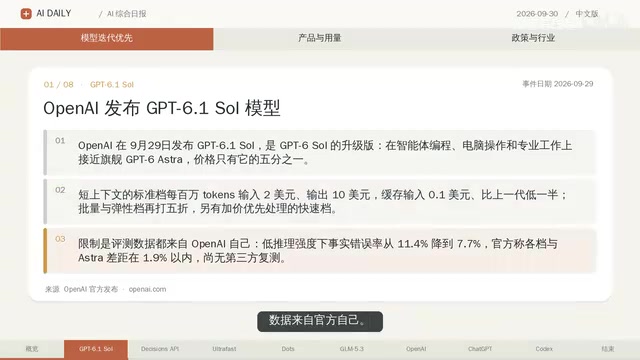
OpenAI has positioned GPT-6.1 Sol as a high-value alternative to its flagship Astra model. According to official benchmarks, Sol's performance approaches Astra's, yet input/output pricing is just one-fifth of the flagship's, with caching costs cut in half compared to the previous generation.
The pricing strategy is clear: offer near-top-tier capability at a cost structure that enables large-scale deployment. For enterprises and developers making massive numbers of API calls, a five-fold price difference can determine whether AI is truly viable in production workflows. That said, these benchmarks come from OpenAI itself — independent third-party validation is still lacking, and real-world performance remains to be seen.
Low Latency and Ultra-Fast: Decisions API and the New Speed Tier
The Decisions API is a highly targeted product. Powered by GPT-6 Luna for single-step decisions, it returns answers in 150 milliseconds — roughly 10 times faster than standard calls — and is currently in limited preview.
The use cases are well-defined: risk control, content moderation, routing decisions — anywhere millisecond-level responses are critical. By splitting complex reasoning and rapid judgment into separate product lines, OpenAI is clearly building out a fine-grained tiered offering based on latency and cost.
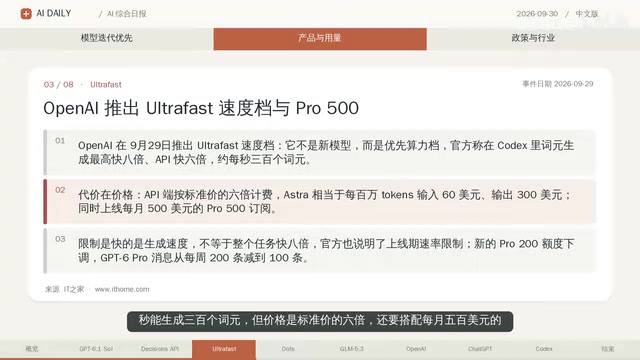
Complementing this is the Ultra-Fast speed tier in Codex: it generates 300 tokens per second, but at 6× the standard price and requiring a $500/month subscription. Speed and affordability now sit at opposite ends of the spectrum, and OpenAI clearly intends for users with different budgets and latency sensitivities to self-select into the appropriate tier.
What is a token? A token is the basic unit that large language models use to process text — roughly half to one Chinese character, or about three-quarters of an English word. 300 tokens per second translates to approximately 225 English words per second, which is quite substantial for use cases like code completion or real-time streaming. It's worth noting that while token/s is the standard speed metric in AI, actual user experience is also affected by network latency, concurrent load, and other factors — lab benchmarks and production performance can diverge significantly. The 6× premium for Ultra-Fast also illustrates a broader industry pattern: in cloud inference, speed and cost are inversely related. Faster responses typically require more parallel compute resources, not just a more capable model.
Persistent Docs Agent: Your AI Gets Its Own Cloud PC
The Docs persistent agent is arguably the most imaginative update in this batch. Each agent has its own cloud computer and browser, can connect to over 4,000 apps for long-running tasks, and requires user approval before taking action.
The word "persistent" is the key here. Traditional AI interactions are short-lived question-and-answer sessions. A persistent agent, by contrast, can run continuously in the background, retain context across sessions, and orchestrate a large number of external tools. The "approve before acting" mechanism reflects OpenAI's attempt to balance autonomy and control — enabling long-horizon task execution without losing oversight.
What makes a persistent agent different? The core distinction between a persistent agent and a traditional AI assistant lies in state management and lifecycle. Standard API calls are stateless: each request is independent, context must be manually passed in by the caller, and everything is "forgotten" when the session ends. A persistent agent maintains a durable runtime environment in the cloud — it can remember task progress across sessions, save intermediate files, and subscribe to external events as triggers. This architecture is conceptually closer to a background service or daemon process in traditional software. Giving each agent its own cloud computer and browser essentially allocates an isolated sandbox to every AI instance, preventing cross-task contamination and making it easier to audit operation logs. This aligns with the broader "AI Agent" paradigm emerging in recent years — the goal being to shift models from answering questions to independently completing complex, multi-step, long-horizon tasks.
Anthropic Red Team Flags GLM-5.3 Security Gaps
On the other side of the competitive landscape is a security battle. Anthropic's red team singled out Zhipu AI's GLM-5.3, reporting that it can autonomously write complete exploit code and has a bypass success rate against its own safeguards of up to 100% — significantly weaker than comparable Claude models.
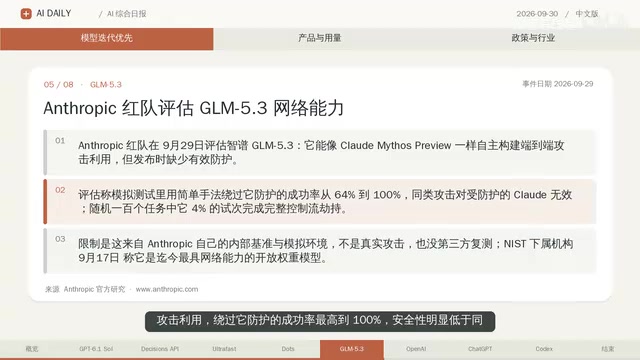
A 100% bypass rate is a striking number. Still, it warrants a measured take: red team evaluations are adversarial by design, and this one was conducted by a direct competitor, Anthropic, which introduces inherent bias. This also reflects a broader reality — the lack of unified standards for AI safety evaluation means that findings from different organizations using different methodologies are rarely comparable apples-to-apples. Security capability is becoming a new competitive frontier.
What is red teaming? Red teaming originates from military and cybersecurity contexts, where dedicated teams simulate an attacker's perspective to proactively probe system defenses and uncover vulnerabilities. In AI safety, red teams craft adversarial prompts designed to test whether a model can be induced to generate harmful content, bypass safety filters, or be manipulated into executing dangerous operations. Red team evaluations conducted by a competitor carry an inherent conflict of interest, which doesn't invalidate the findings but does mean transparency in methodology and reproducibility of results are paramount. The AI safety field currently lacks a unified scoring framework analogous to CVSS (Common Vulnerability Scoring System) in cybersecurity — testing methods, scoring criteria, and disclosure practices vary significantly across vendors, making cross-model comparisons deeply contested.
Commercial Acceleration: Funding, Valuation, and Usage Data
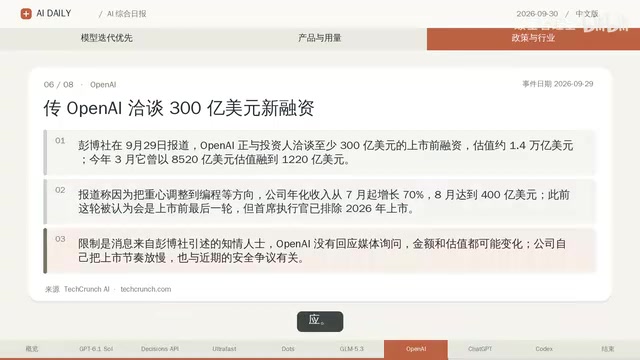
The business numbers are equally striking. OpenAI is reportedly in talks for a new funding round of at least $30 billion, at a valuation of approximately $1.4 trillion, with annualized revenue reaching $40 billion as of August — the company has not commented on these reports.
User-side data supports the confidence: OpenAI says ChatGPT now has over 1.2 billion weekly active users, with ChatGPT Work and Codex exceeding 35 million weekly actives, and enterprise customers reaching 2.5 million.
From 1.2 billion weekly actives to 2.5 million enterprise customers, OpenAI's user base has moved decisively from consumer to enterprise. The gap between a $1.4 trillion valuation and $40 billion in annualized revenue signals that the market is still pricing in future growth potential rather than present-day profitability.
Codex Gets a Major Update: Cloud Collaboration and Security Scanning
Codex also received a significant update. Tasks can now continue running across devices in a shared cloud environment, and new code review and security scanning features are included — when vulnerabilities are found, Codex prepares fix proposals in the cloud before presenting them to the developer.
Cross-device continuity and cloud-based remediation effectively upgrade the coding assistant from a "completion tool" to a "continuous collaborative development partner." Combined with the persistent agent trend discussed above, OpenAI's vision for developer tools is converging around a consistent theme: giving AI the ability to work independently, persistently, and in an auditable way.
Conclusion
Several clear threads run through today's developments: OpenAI is extracting more commercial value through tiered pricing and specialized APIs, pushing AI toward autonomous execution through persistent agents and Codex upgrades, and leveraging a massive user base to sustain a trillion-dollar valuation. The GLM-5.3 security controversy, meanwhile, is a reminder that as capability races forward, building robust safety guardrails is equally urgent. Most of the data cited here comes from vendors themselves or single sources — readers should maintain appropriate skepticism.
Related articles

NVIDIA's 30,000 Developers Use Cursor, Code Commit Volume Triples
Cursor engineer Chris Diaz breaks down five organizational gaps blocking enterprise AI coding scale—strategy, risk tiering, governance, metrics, and operating model. NVIDIA's 30,000 developers use Cursor daily, tripling code commits while defect rates stay flat. The key: rewrite the SDLC, not add tools.

Ponytail: Giving AI Coding Agents a Senior Engineer's Mindset
Ponytail is a free GitHub tool that injects a senior engineer's mindset into AI coding agents, making them ask whether code is even necessary first. According to TamilDeck, it can compress 200 lines of AI-generated code to 30, cutting token costs, with support for Cursor rules and Claude Code skill integration—though security review still requires human oversight.

Complete Guide to Connecting Cursor AI to the GitHub MCP Server
A step-by-step guide to connecting Cursor AI to the GitHub MCP server: create a personal access token, configure mcp.json, store the token in the ENV block, and verify with a PR query.