GPT-6.1 Terra In-Depth: Positioning a Mid-Tier Model for Vision and Computer Use

OpenAI releases mid-tier GPT-6.1 Terra, focused on visual reasoning and computer use, positioned between Sol and Luna.
OpenAI has released GPT-6.1 Terra, a mid-tier model priced at roughly half the flagship Sol and ten times the lightweight Luna, similar to Sonnet in Anthropic's lineup. It's officially focused on visual reasoning and precise computer use, and is significantly faster than models at the same tier. OpenAI's Ted Sanders says API developers get a cost-effective middle option, but subscribers have little urgency to upgrade. Simon Willison tested reasoning levels with the "pelican riding a bicycle" prompt; the max tier took 4 minutes 11 seconds and cost 11.3161 cents, with accurate rendering. The article argues that the announcement's emphasis on vision and computer use rather than general intelligence shows Terra targets everyday office tasks, not frontier capability breakthroughs.
OpenAI has released GPT-6.1 Terra, with official messaging centered on visual reasoning and computer use capabilities. The model's positioning is carefully considered—it's the mid-tier option, priced at roughly half the flagship Sol but about ten times more than the lightweight Luna. Understanding this positioning matters more than memorizing the model name.
The Product Logic Behind Mid-Tier Pricing
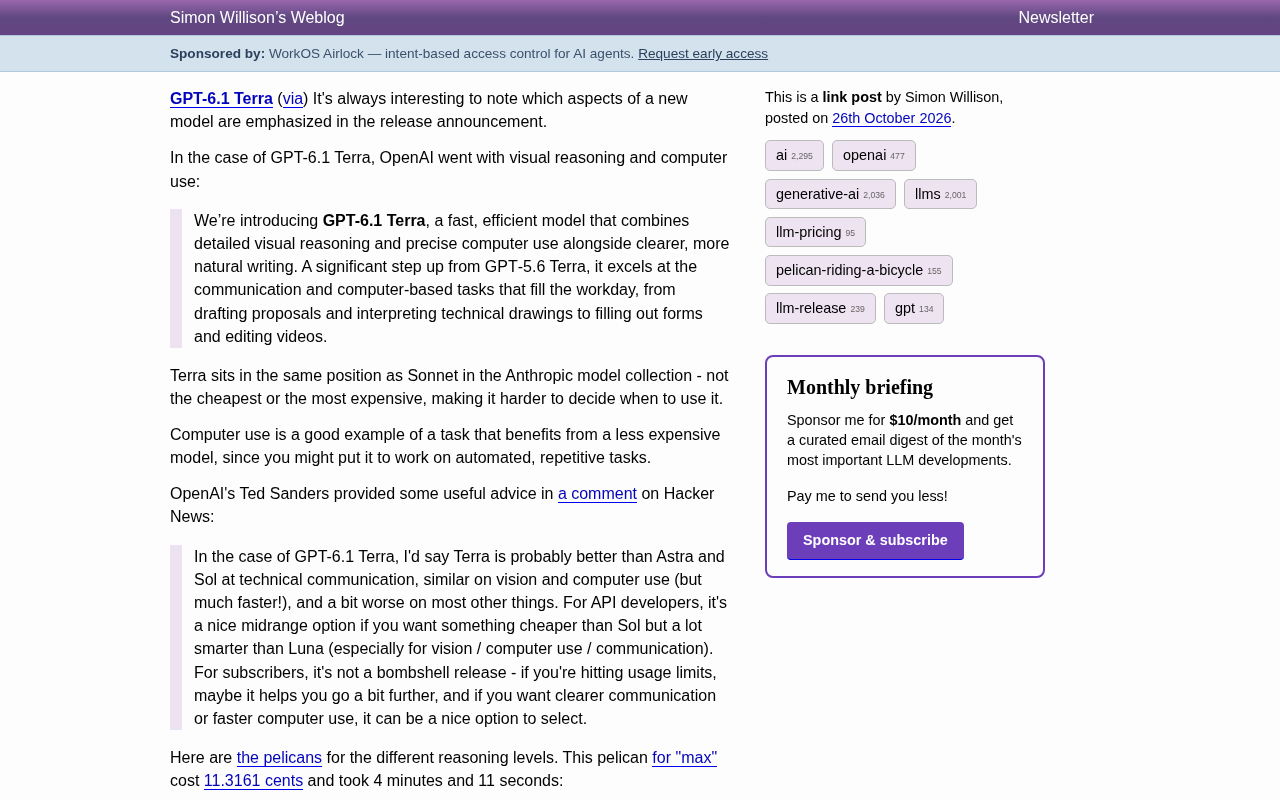
According to the release announcement, GPT-6.1 Terra is described as a "fast, efficient" model that combines detailed visual reasoning, precise computer use, and clearer, more natural writing. OpenAI explicitly states it's a significant upgrade over GPT-5.6 Terra.
On pricing, Terra costs $1 per million input tokens and $5 per million output tokens. That's about half the price of GPT-5.6 Terra and GPT-6.1 Sol, and roughly ten times that of GPT-6 Luna. In his analysis, Simon Willison notes that Terra's position in OpenAI's lineup is analogous to Sonnet in Anthropic's model collection—neither the cheapest nor the most expensive, which actually makes choosing harder.
This "middle ground" pricing strategy is a test for developers: when should you use Terra, when should you step up to Sol, and when is Luna good enough?
Per-million-token pricing is the basic unit for understanding LLM API costs. Large models bill by volume of text processed, and a token is the smallest semantic unit between a character and a word—roughly 0.75 words in English, though this varies in Chinese depending on tokenization. Input refers to the prompts and context the user sends, while output refers to the model's generated response, which usually carries a higher unit price because it involves autoregressive token-by-token generation. For Terra, at $1 per million input tokens and $5 per million output tokens, processing a million-character prompt costs just $1, but having the model generate equivalent content costs $5. This pricing structure causes cost differences between models to be dramatically amplified in high-frequency calling scenarios, which is why the article emphasizes that cheaper models are more economical for automation tasks.
Computer Use: The Main Battleground for Low-Cost Models
Computer use happens to be the scenario where low-cost models deliver the most value. These tasks tend to be automated and repetitive—filling forms, clicking through workflows, handling batch interface operations—and calling the most expensive model every time would quickly send costs out of control.
Terra's strategy in this scenario is straightforward: performance comparable to Sol, but "much faster." For automated workflows that require frequent interface operations, the speed advantage is often more practically meaningful than minor capability gaps.
OpenAI's Ted Sanders offered a more specific positioning description in a Hacker News comment: Terra may outperform Astra and Sol on technical communication, performs comparably on vision and computer use but much faster, and is slightly weaker in most other areas.
Computer use refers to a model's ability to directly operate computer interfaces by visually recognizing screenshots and simulating mouse clicks and keyboard input. Unlike other API capabilities, it doesn't rely on dedicated interfaces but instead "sees" the screen and "acts" like a human, making it usable for legacy software without open APIs, web forms, and internal enterprise systems. These tasks are typically characterized by many steps, high repetitiveness, and the need to fully read the screen and generate action sequences on each execution, with token consumption growing linearly with the number of operation steps. Precisely because of this, a model's per-call cost and response speed directly determine whether an automation workflow is economically viable—which explains why cheaper, faster models are actually competitive in this scenario.
Who Should Use Terra, and Who Can Skip It
Sanders' recommendation splits into two categories by user type.
For API developers, Terra is a solid middle option—cheaper than Sol but much smarter than Luna, especially in vision, computer use, and communication scenarios. If you need these capabilities without bearing flagship-model prices, Terra is a reasonable landing spot.
For subscribers, this isn't a "blockbuster" release. Sanders candidly admits that if you're hitting usage limits, Terra might help you stretch a bit further; if you need clearer communication or faster computer use, it's a worthwhile option. In other words, ordinary subscribers have no urgent reason to upgrade.
Reasoning Levels and Hands-On Observations
Simon Willison used the classic "pelican riding a bicycle" test to compare various reasoning levels, and compiled a comparison grid covering all reasoning levels across OpenAI's current frontier lineup, including GPT-6 Astra, GPT-6.1 Sol, GPT-6.1 Terra, and GPT-6 Luna.
The pelican generation at the "max" reasoning level took 11.3161 cents and 4 minutes 11 seconds. Based on the results, both the pelican and bicycle were rendered correctly—the frame shape was accurate, the feet and pedals were on opposite sides of the frame, and the color scheme was consistent with other models in the GPT-6 and GPT-6.1 series.
The point of such tests isn't the pelican itself but observing the model's reasoning stability on complex spatial relationships. Visual reasoning is one of Terra's officially highlighted capabilities, and these kinds of image generation tasks serve as a rough indirect reference.
Reasoning effort is an adjustable parameter offered by the new generation of reasoning models, allowing developers to choose how deeply the model "thinks" based on task difficulty. Common levels from low to high include minimal, low, medium, high, and some products also offer max. The higher the level, the more internal reasoning tokens the model generates before producing a final answer—accuracy typically improves, but latency and cost rise in tandem. This mechanism lets a single model handle both fast-response everyday tasks and complex problems requiring deep thought. The article mentions that max-level pelican generation took over four minutes and cost more than 11 cents, which directly illustrates how high reasoning levels trade time and cost for quality—and shows that this tier isn't suited for high-frequency or real-time scenarios.
The Release Announcement's Wording Is Telling
Simon Willison offers an interesting angle: when interpreting a new model release, it's worth noting what the official messaging emphasizes. OpenAI chose visual reasoning and computer use as Terra's keywords—not general intelligence or reasoning depth.
This emphasis itself conveys product intent. Terra isn't a model meant to push the leaderboard ceiling but one meant to fill gaps in everyday office tasks: drafting proposals, interpreting technical drawings, filling out forms, editing videos. These tasks occupy most of the workday but don't demand extreme reasoning capability from the model—what matters more is speed, cost, and visual understanding.
From this perspective, GPT-6.1 Terra's positioning is clear: it serves "weekday communication and computer tasks" rather than frontier capability exploration. For developers, the criterion for adopting it should be whether your workload is concentrated in these types of tasks, not whether it's smarter than other models.
One-line Summary
OpenAI releases the mid-tier GPT-6.1 Terra, focused on visual reasoning and computer use, positioned between Sol and Luna.
Paragraph Summary
OpenAI has released GPT-6.1 Terra, a mid-tier model priced at roughly half the flagship Sol and ten times the lightweight Luna, similar to Sonnet in Anthropic's lineup. Officially focused on visual reasoning and precise computer use, it's significantly faster than models at the same tier. OpenAI's Ted Sanders says API developers get a cost-effective middle option, but subscribers have little urgency to upgrade. Simon Willison tested reasoning levels with the "pelican riding a bicycle" prompt; the max tier took 4 minutes 11 seconds and cost 11.3161 cents, with accurate rendering. The article argues that the announcement's emphasis on vision and computer use rather than general intelligence shows Terra targets everyday office tasks, not frontier capability breakthroughs.
Related articles
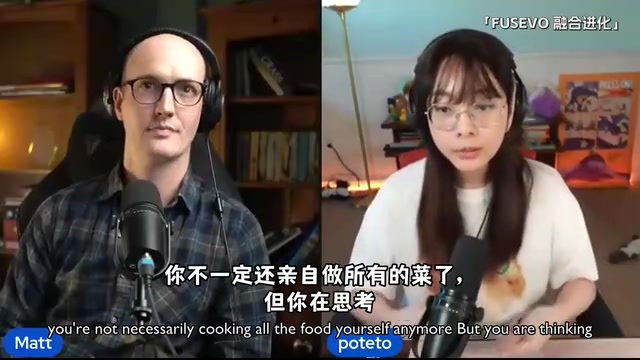
Building a Lights-Out Factory with a Dozen Agents: Lauren Tan's Trust Ladder and the Michelin Kitchen
Lauren Tan shares how a dozen coordinated agents merge 2,500+ PRs monthly: the trust ladder, Michelin kitchen metaphor, verification skills, and inner/outer loop connections reveal the environment engineering philosophy behind the lights-out factory.
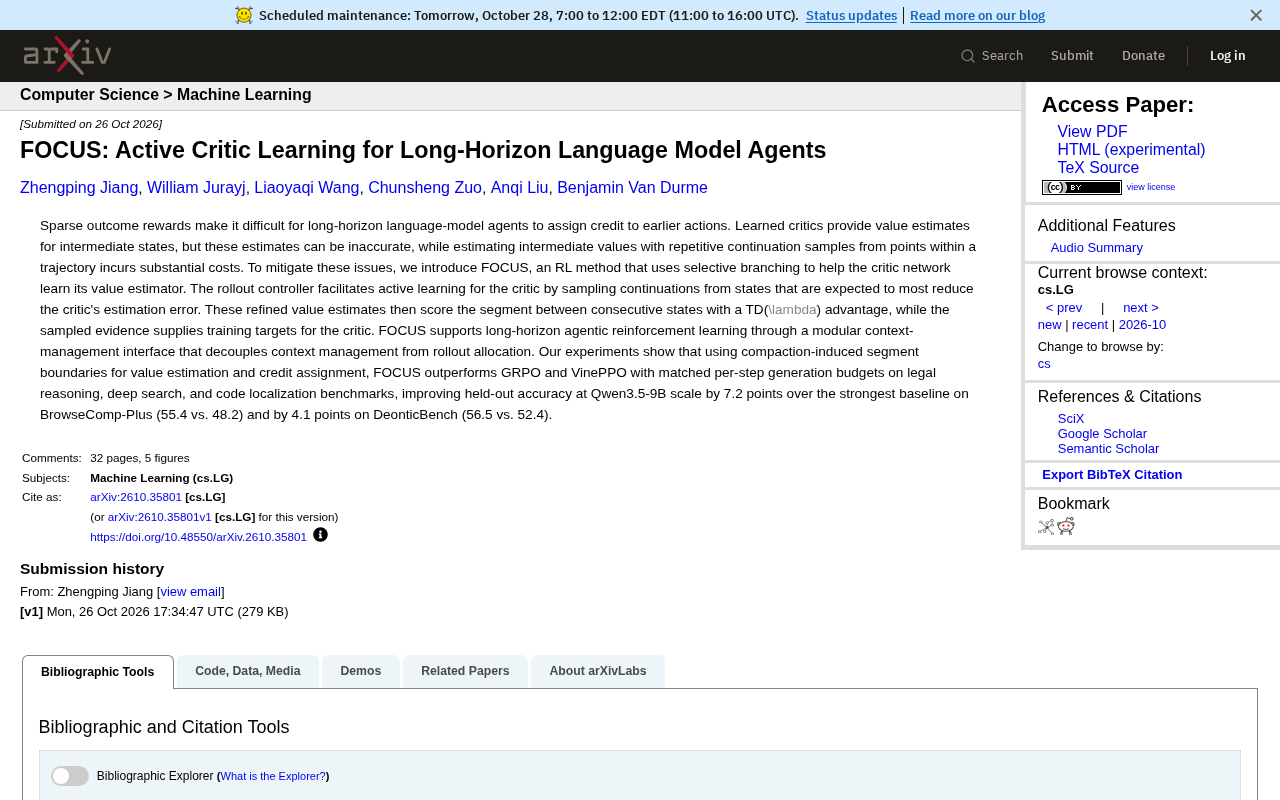
FOCUS: Active Critic Learning Solves Long-Horizon Agent Credit Assignment
FOCUS introduces selective branching and active critic learning to ease credit assignment in long-horizon LM agents, surpassing GRPO and VinePPO on BrowseComp-Plus and other benchmarks under matched budgets.
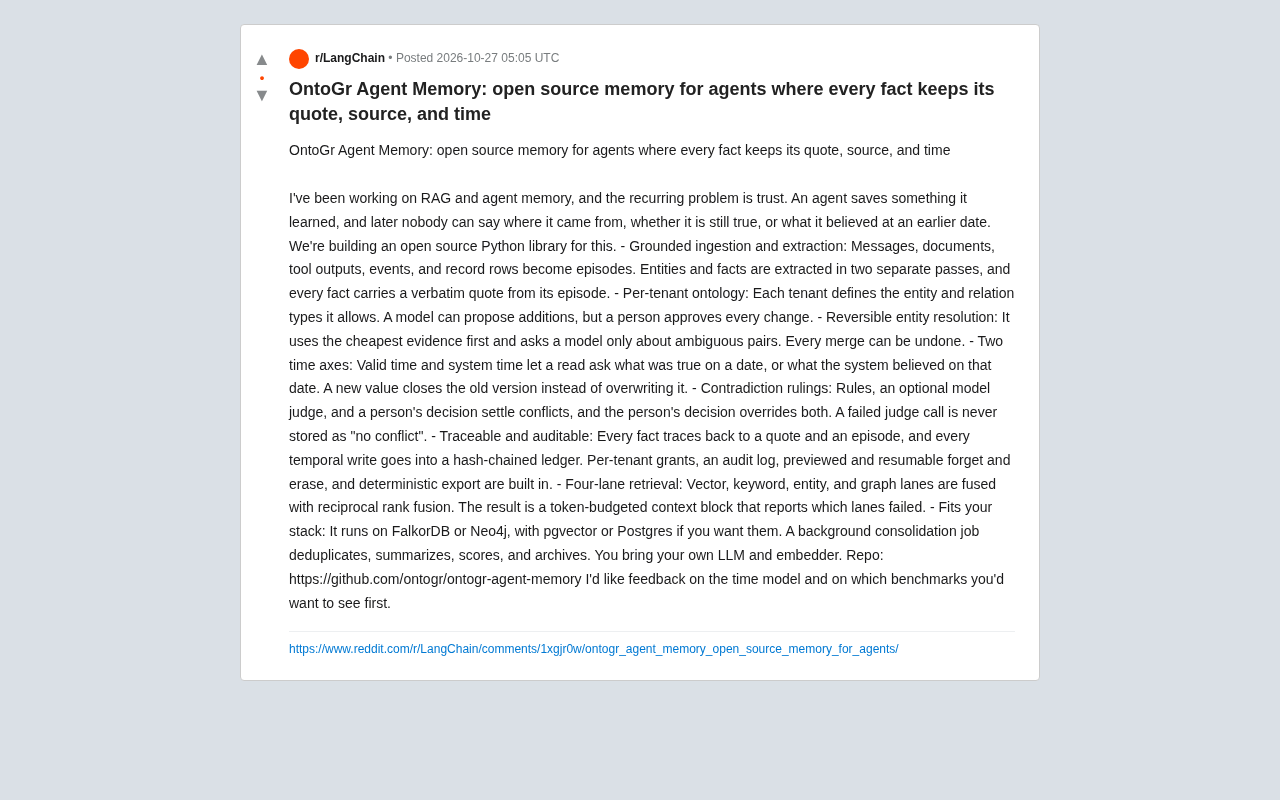
OntoGr: Adding Citation Traceability and Bi-Temporal Axes to Agent Memory
OntoGr Agent Memory is an open-source Python library that keeps verbatim quotes, sources, and bi-temporal axes for every fact in AI Agent memory, supporting reversible entity resolution, conflict adjudication, and four-way recall retrieval to solve Agent memory trust and traceability issues.