GPT-6.2 Astra Demo Leak and OpenAI Safety Evaluation: Decoding the Signals of a New Model Generation

GPT-6.2 Astra rumors and benchmark doubts coexist as Google and Tencent make moves and AI tool stability becomes the new battleground.
The article rounds up recent AI industry developments. 3D demos and an 89.0% benchmark screenshot for OpenAI's GPT-6.2 Astra are circulating but are not official and cannot be verified. Meanwhile, OpenAI signed four independent institutions for deep safety evaluation, fueling unconfirmed delay speculation. Google's Gemini 4 codenames Neon and Oxygen surfaced densely, Tencent's Hunyuan 4 Flash entered the lightweight market at very low pricing, Hugging Face integrated Open Router routing, Codex's capacity error rate fell from 6.82% to 0.085%, and the Claude Code team revealed 90% of its code is AI-written.
Rumors Swirl: GPT-6.2 Astra Demo and Benchmark Screenshots Leak
Recently, rumors about OpenAI's next-generation model GPT-6.2 Astra have continued to build in the community. Although the official model identity and release date have not been confirmed, demo videos and benchmark screenshots bearing that name have already leaked. Bilibili creator "Evolutionary Achen" compiled several circulating materials, among which a 3D dungeon-crawler game demo stands out in particular.
This demo, called Emberfall, is claimed to have been generated from a single prompt. The footage includes full scene interaction: the character crosses a wooden bridge through the forest, battles skeletons and green monsters, picks up treasure chests, upgrades enchantment points, and features a complete set of UI elements such as a minimap, quest list, and health bar—even a boss fight with the Holo Warden. Another 3D harbor scene shows details like water reflections, cargo ships, and port cranes.
The comparison that best captures the generational gap is having the old and new models each draw "a pelican riding a bicycle." The white pelican drawn by the older GPT-6 Astra still looks like low-poly building blocks, while the new version labeled 6.2 Astra shows layered brown feathers and light-and-shadow detail on its long beak—a clearly noticeable difference. However, these demos are all secondhand accounts, and OpenAI has not officially claimed them.
The 89.0% Benchmark Mystery: Data Authenticity in Doubt
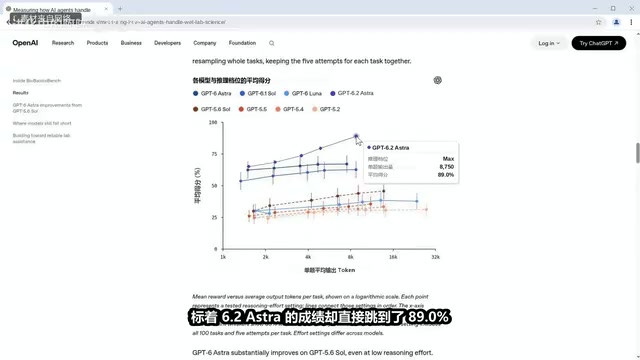
Alongside the demo videos, a benchmark screenshot has also been circulating. According to the creator's verification, OpenAI's official website did publish an evaluation called BioBasics Bench, designed to assess a model's ability to understand and analyze everyday biology lab materials. But the main text explicitly states that only 7 models were tested, and 6.2 Astra is not among them. In the official chart, the previous generation GPT-6 Astra has an average score of 66.7%, with the tooltip showing about 67%.
In the secondhand screenshot circulating online, however, an extra purple curve appears, labeled 6.2 Astra, with the score jumping directly to 89.0%. The source of this image, the accuracy of the data, and whether the page was subsequently modified cannot currently be verified. For benchmark results like these that lack official confirmation, the community should remain cautious and avoid spreading them as official scores.
BioBasics Bench is a domain-specific benchmark. Unlike general evaluations such as MMLU and GPQA, it specifically tests a model's reading comprehension and analysis of everyday biology lab materials, with samples drawn mostly from real documents such as experimental protocols, reagent instructions, and result records. Such benchmarks typically cover a limited number of models and offer less public transparency than mainstream leaderboards, so once screenshots are reshared, it is easy for mix-ups or post-added curves to occur. When judging whether a benchmark result is genuine, three things are worth checking: whether the official page lists that model, whether the tooltip values match the main text, and whether the screenshot includes a traceable URL or timestamp.
OpenAI's Safety Move: Four Institutions Step In for Evaluation
Just as the rumors were at their peak, what OpenAI released on November 16 was not a new model but a safety announcement. The company announced it had signed contracts with four independent institutions, opening up internal model checkpoints, source code, and monitoring systems for in-depth safety evaluation. The four institutions are Matter, a veteran evaluation firm; an independent organization specializing in detecting covert adversarial behavior in models; Goodfire, responsible for internal mechanism analysis; and Transluc, focused on alignment evaluation.
After the announcement, speculation immediately emerged, with rumors that OpenAI had encountered alignment and safety problems with 6.1, 6.2, and even 6.5, and that even the first-generation 6.1 Astra was said to have failed to launch. But none of these connections have official evidence—OpenAI has neither acknowledged a 6.2 delay nor officially confirmed the product identity of 6.2 Astra.
During the same period, in an on-site interview at Semaphore, Sam Altman was asked whether AI can improve itself, and used "we didn't have AGI before, and now we do" as a counterexample. His intent was to explain that AGI is hard to define in black-and-white terms, but the remark was clipped out of context and misread as an official announcement of a breakthrough. The full conversation shows he actually meant the opposite: OpenAI is indeed using its own AI to accelerate model R&D, but letting models autonomously design the next generation's safety with no human oversight has not yet passed muster.
A so-called "model checkpoint" refers to a snapshot of weights saved during training, not the final released model. Opening checkpoints to external institutions means third parties can observe a model's behavioral tendencies in its intermediate states before launch, which can reveal potential alignment problems better than evaluating only the API. Goodfire excels at using interpretability techniques to break down a model's internal representations, while Transluc focuses on alignment and risk evaluation. This combination of "external red teaming + internal mechanism analysis" is a common approach for frontier labs under pressure from safety regulators, and it also explains why outsiders linked the safety evaluation to a model delay.
Google's Codename Offensive: Gemini 4 Series Exposed in Quick Succession
While OpenAI held still, Google was busy stuffing new codenames into its model catalog. Monitoring tools pulled two more new codenames from the bundled code of the Gemini web client: Neon and Oxygen. The code shows that Neon not only occupies a model slot but also carries an independent subscription tier and quota alerts, billed separately from the high-end paid Ultra tier. Next to it, a Helium plan tied to the basic paid Plus tier is also visible, and pop-up prompts for exhausted video generation and deep research quotas have already been written. In the dark-mode web toggle menu, Carbon and thinking-level options can already be seen, and the configuration bar shows a "not yet available to the current account" prompt for Gemini 4 Neon.
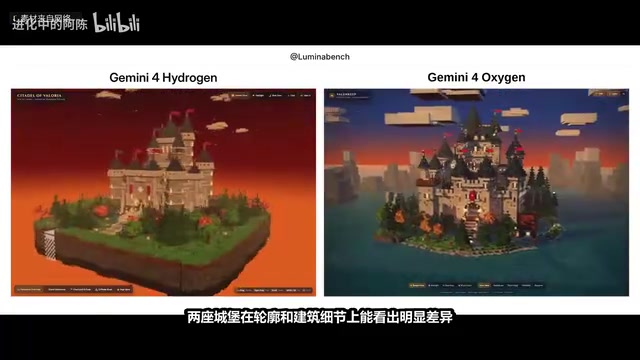
Oxygen is speculated to be a fast model in the Gemini 4 series. On a 3D voxel castle webpage labeled Gemini 4 Oxygen, users can fly from a moonlit tower into a sunlit city, freely switching perspectives and adjusting 24-hour day-night lighting. Compared with its own Hydrogen voxel castle, the Oxygen version is denser in silhouette and architectural detail. The previously surfaced Gemini 4 Krypton was also brought in for comparison, going head-to-head with Claude Fable 5.2 and Alibaba's Qwen Q1 4 Max in tasks involving four-panel house generation and photorealistic avatars. The periodic-table-style naming prompted netizens to joke: Google might as well paste a periodic table into the selection box and let people order by atomic number.
Lightweight Models and Toolchains: Updates from Hunyuan, Microsoft, and Hugging Face
On the domestic side, Tencent Hunyuan officially released the lightweight model Hunyuan 4 Flash on November 16, supporting image understanding and a context of roughly one million tokens, with a focus on speed and low cost. The official standard pricing is kept very low: 0.5 yuan per million input tokens and 2 yuan per million output tokens, with cached input hits at just 0.02 yuan. The model is already available on Tencent Yuanbao, Tencent Cloud Token Hub, and WorkBuddy, with WorkBuddy free for a limited time until November 30. In a side-by-side comparison with Alibaba's Qwen Q1 4 Max in Token Hub, the lightweight fast model is less stable than the flagship on local details, but for everyday batch office scenarios, saving money and speeding things up is its positioning.
The lightweight coding track is equally crowded. One day before the Ignite conference opened, tracking tools dug up an unannounced Mayi Code 2 Flash model card in Microsoft's cloud platform catalog; the catalog redirect format matches that of already-released models, leading outsiders to speculate that it may be unveiled during the conference.
On the open-source side, Hugging Face launched a new default-integrated feature that directly connects to Open Router's language model routing. Developers can call it with their existing accounts and original interfaces, and the system automatically picks providers based on price, speed, and stability, switching automatically if one fails. After enabling an optional feature, request logs can also be written to your own Hugging Face storage bucket for evaluation, bug hunting, or fine-tuning.
"One-million-token context" refers to the upper limit of text a model can process in a single pass—roughly hundreds of thousands of Chinese characters, enough to hold an entire technical manual or a long conversation history. "Cached input hits" means that when the prefix of a request repeats content called previously, the server directly reuses the already-computed results and bills only at a very low price—suitable for batch scenarios with fixed system prompts and repeated calls. Hunyuan 4 Flash pushes the cache-hit price down to 0.02 yuan per million tokens, precisely targeting the cost pain point of large amounts of repeated context in everyday enterprise office work. This is also a sign that competition among lightweight models is shifting from "unit price" to "effective unit price."
Tool Stability: Codex Error Rate Plummets, Claude Code Reveals 90% of Code Written by AI
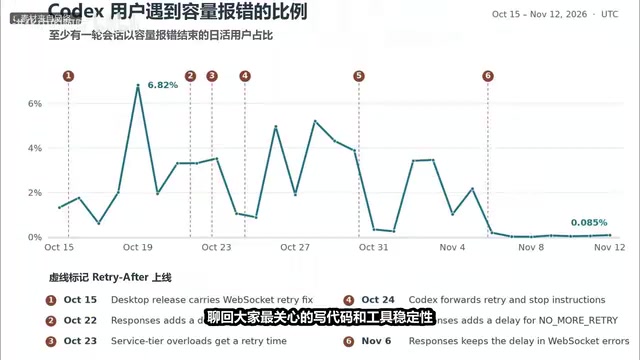
Around coding stability, several vendors have recently been grinding away at "fewer hiccups." OpenAI's Codex published a line chart of capacity errors: the share of daily active users with at least one round ending in a capacity error peaked at 6.82% on October 19. Then, from October 15 to November 12, the team shipped six rounds of changes targeting instruction wait times and WebSocket error handling, and by November 12 that share had dropped to 0.085%—nearly 99% below the peak. Although the chart mainly reflects optimizations in overload handling and cannot be used to infer how much compute was added in the backend, coding sessions interrupted by capacity errors are indeed much rarer now.
On Anthropic's side, the Claude Code desktop app on Mac opened public testing of a phone simulator panel. Simulating foldable screens requires Xcode 27.1 or later, and developers can directly simulate devices such as the foldable iPhone Duo in the panel, letting Claude automatically switch among closed, half-open, and unfolded postures to check layout. What made programmers smile knowingly even more: in an internal retrospective on November 16, the Claude Code team revealed that about 90% of the team's code is now written and reviewed by Claude. But they didn't pad the numbers by stacking up AI reviewers—they forced the AI to submit runtime evidence: if a unit test merely reports a 30-second timeout, that's too vague, so it runs the full flow and actually reaches the checkout page; when a payment form fails to load and can't be clicked, automated test scripts flood it with thousands of tricky inputs targeting edge-case vulnerabilities; meanwhile, pitfalls encountered are compiled into 39 reliability checks, with relevant items triggered on each change, combined with a project-custom Verify skill—only after three rounds of fixes still fail does a human engineer step in. Going forward, what matters is not just whether AI can spit out code, but whether it can produce solid runtime evidence.
The browser automation tool OpenCode Browse 0.1.0 has also officially shipped, entirely rewritten in Rust, completely shedding Node.js and PlayWrite dependencies. According to figures published by the developer, memory usage has dropped to one-25th of the original and size to one-23rd. Its browser extension lets AI agents read pages or interact directly within web pages, while sensitive operations such as login, two-factor verification, and payment remain under human control.

A capacity error is different from a model answering incorrectly: it means a request failed to complete due to server-side compute or concurrency limits, and what the user sees is a queue failure or timeout. For tools like coding agents that require many consecutive rounds of calls, a single capacity error can interrupt the entire task chain, so this metric directly reflects availability. WebSocket error handling relates to the stability of streaming output over long connections, and optimizing these two items can significantly improve the experience without adding compute—which is why the Codex team emphasized "overload handling optimization" rather than "scaling up."
Expanding Real-World Scenarios: Research, Healthcare, and Productivity Tools
OpenAI also rolled out two advances aimed at real work scenarios during the same period. A report for researchers analyzed data from 1,819 research participants and separately surveyed 251 people; respondents estimated that without AI's help, completing work of the same quality and volume would take about 1.9 times as long, and OpenAI also expanded free access for researchers. The other is GPT for Healthcare adding more than 20 plugins, focused on helping administrative and clinical teams at healthcare institutions collaborate, with partners including CVS Health. Official cases cover preparing insurance pre-authorization for patients undergoing MRIs, mainly for hospitals and insurers handling paperwork authorization, medical record organization, and discharge arrangements—not a personal consultation feature.
Google, meanwhile, upgraded and renamed Notebook LM to Gemini Notebook, rolling it out to users aged 18 and over on the web starting November 16, with mobile to follow later. After users drop in a pile of documents and type "make me a website," it can generate an interactive, shareable webpage—for example, a periodic table study site with a companion booklet, or a project progress dashboard. Its development tool AntiGravity also doubled the context window of the three main models in the Gemini 4 series from 256K to 512K; in the official same-workload illustration, context compressions dropped from 7 to 2, about one-3.5th of the original, so large codebases no longer need to frequently forget earlier content.
Two Voices on the Timeline
Regarding the pace of AI development, in an interview from Palisade Research, interviewee Tao Lin offered a bold personal prediction: it may be only about 1.3 years until AI catches up with or surpasses top human experts in almost all fields, including programming and filmmaking—or even within a year the landscape could change drastically. On the other side, on November 14, protesters took to the streets with signs calling for a pause in the race and a global AI treaty; meanwhile, on the giant spherical screen of the Las Vegas Sphere, an ad featuring a little blue robot lit up the entire ball, promoting Grokbot commercially. With calls to pause on the streets on one side and commercial ads filling the sphere on the other, the industry's sense of division is clearly visible.
Back to GPT-6.2 Astra: the leaked demos do represent a big step beyond the previous generation, but how much of these demos is real, and whether the official silence so far is because safety evaluation isn't finished or because the release window hasn't arrived, remain uncertain. No matter how well a new model can draw and write, it ultimately has to actually launch publicly and land safely and steadily before it counts as real capability.
One-line Summary
Rumors and benchmark doubts surround GPT-6.2 Astra, while Google, Tencent, and others make密集 moves, with AI tool stability becoming the new battleground.
Paragraph Summary
The article rounds up multiple threads of recent AI industry news. 3D demos and an 89.0% benchmark screenshot for OpenAI's next-generation model GPT-6.2 Astra are circulating in the community, but neither comes from official sources, and the extra purple curve in the benchmark screenshot cannot be verified. In the same period, OpenAI announced contracts with four independent institutions for in-depth safety evaluation, sparking delay speculation that remains unconfirmed. Google's Gemini 4 series codenames Neon and Oxygen have been密集 exposed, with an independent subscription tier already appearing in code. Tencent Hunyuan 4 Flash enters the lightweight market with extremely low pricing, and Hugging Face integrates Open Router routing. Codex's capacity error share fell from 6.82% to 0.085%, and the Claude Code team revealed that 90% of its code is written by AI. The article closes with divergent voices on the pace of AI development.
Related articles

Gemini 4 Neon Leak: A Potential Strong Contender Against Opus 5.5
A Hacker News thread suggests Gemini 4 Neon looks like an Opus 5.5 competitor. This article unpacks the product positioning behind this community signal, shifts in the top-model competitive landscape, and what it means for developers' model selection strategy.

Claude Fable 5.2's Self-Authored Short Film 'Fable' Sparks Discussion
A short film 'Fable,' credited to Claude Fable 5.2 for script, visuals, and directing, appears on Hacker News. This article analyzes the significance of full-pipeline AI creation, community reactions, and what it means for content creators.

Anthropic IPO Pricing: A Signal of AI Giants Going Public
Anthropic's IPO pricing draws attention. This article analyzes its potential impact on AI industry valuation, commercialization paths, and the competitive landscape, and highlights public-market expectations and challenges for AI companies.