GPT-6.2 Astra: Reconstructing 3D Video Scenes from Two Frames

GPT-6.2 Astra reconstructs editable, walkable 3D scenes from two frames.
A demo video shows GPT-6.2 Astra using just the first two frames of a green-screen video, combined with the codecs toolchain, to reconstruct the entire filming environment in Blender. Through multiple iterations it matches depth-of-field blur and professional lighting with pixel-level consistency. The reconstructed scene supports natural language editing—swapping artwork, expanding space, adjusting lights—and can be turned into a freely walkable interactive 3D space. Packaged as a virtual background camera app, it uses the Decisions API to match real webcam lighting in real time. The article argues this marks a shift for multimodal models from understanding images to reconstructing the world, greatly reducing the time and labor of traditional 3D scene building.
From Green Screen to Full 3D Scene: The Disruptive GPT-6.2 Astra Demo
A demo video from YouTube showcases GPT-6.2 Astra's breakthrough in 3D scene reconstruction. Standing in front of a green screen, the creator used only the first two frames of the video to reconstruct the entire shooting environment in Blender via GPT-6.2 Astra and the codecs toolchain. This isn't simple background replacement—it's an interactive, modifiable, even real-time-linked three-dimensional space.
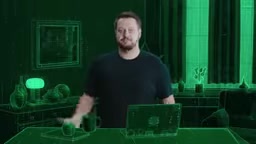
The most impressive aspect of the demo is the reconstruction accuracy. The creator asked Astra to match the camera's depth-of-field blur effect and recreate the professional lighting equipment. Through repeated iteration, Astra ultimately achieved pixel-level consistency between the reconstructed scene and the original video footage. This means the AI not only understood the semantics of a 2D image but also inferred the 3D structure, lighting conditions, and camera parameters.
Depth of Field is an optical phenomenon in camera imaging where only a specific distance range is sharp while the foreground and background gradually blur, determined jointly by aperture size, focal length, and focus distance. For 3D reconstruction, depth of field is a strong constraint: the degree of blur varies with depth, so the model must reverse-engineer the scene's depth layering and focal plane to make the reconstructed image's blur distribution match the original video. Astra's ability to match this effect in the demo indicates that it recovered not only object shapes but also estimated the relationship between camera optical parameters and scene depth—a rather stringent part of the pixel-level consistency test.
Iteration and Editing: From Pixel Matching to Scene Manipulation
After reconstruction, the creator demonstrated the flexibility of scene editing. By issuing instructions to codecs, one can swap the artwork on the wall, expand the room's sense of space, or even adjust the indoor lighting atmosphere. All of this is based on natural language prompts, with no manual modeling or parameter tweaking required.

This workflow has significant implications for the video production industry. Traditionally, building practical sets or creating high-quality 3D backgrounds requires a professional team and a great deal of time. Astra compresses this process into a simple interaction of "provide reference frames + describe requirements," allowing creators to quickly explore different visual options. The demo emphasizes that Astra's iteration is not simple one-shot generation but a step-by-step approach to the goal based on feedback—this "painstakingly iterated" process reflects AI's continuous optimization capability in complex tasks.
The codecs toolchain here does not refer to audio/video codecs (such as H.264/AV1) but to a set of instructions and asset pipelines for generative 3D workflows. It translates natural language requests into concrete operations on geometry, material nodes, lighting parameters, and camera properties in the Blender scene, while maintaining scene state consistency across multiple iterations. It is precisely because codecs handles the "intent → scene graph modification" mapping that creators can drive edits with high-level descriptions like swapping artwork, expanding the room, or adjusting lighting without manually operating modeling software.
Beyond Prompts: Walkable Scenes and Virtual Background Applications
The next step in the demo turned the scene into a walkable "video game." The creator asked codecs to convert the reconstructed environment into an interactive scene that can be freely walked through and modified, no longer limited to a fixed viewpoint. This hints that AI-generated content is shifting from static output to dynamic, explorable virtual spaces.

More practically, this technology has been packaged into a virtual background camera application. Traditional video conferencing backgrounds are static images, whereas the Astra-based solution can generate dynamic 3D backgrounds and use the Decisions API to match the webcam's lighting conditions in real time, automatically adjusting the virtual room's lighting. This means remote meetings, livestreams, or online teaching can have more natural and immersive visual presentation.

The Decisions API in the demo serves as a real-time condition adaptation layer: it reads information from the real webcam feed (such as brightness, color temperature, and key light direction) and dynamically adjusts the lighting parameters in the virtual scene accordingly, making the composite image's lighting consistent with the real person. Unlike offline rendering, this requires continuous updates under low-latency constraints, placing higher demands on inference efficiency and parameter stability. It is also a key component that upgrades virtual backgrounds from "static textures" to "3D spaces that respond to the real environment."
Technical Significance and Future Imagination
The 3D capabilities demonstrated by GPT-6.2 Astra mark a key step for multimodal models moving from "understanding images" to "reconstructing the world." It simultaneously handles 3D geometry, materials, lighting, and camera parameters, and integrates these elements into an editable Blender project file. The addition of the Decisions API allows AI-generated environments to link with the real world in real time, opening new possibilities for virtual production, game development, and real-time graphics applications.
At the end of the video, the creator admitted that this "only scratches the surface." As models deepen their understanding of physical laws and scene semantics, more complex interaction logic and more efficient generation pipelines may be achievable in the future. For content creators and technical developers, now is the time to explore the boundaries of this tool.
Blender project files are Blender's native project format, storing object hierarchies, meshes, material node trees, lights, cameras, and render settings in the form of a scene graph. Outputting AI reconstruction results as an editable Blender project means generating not just an image or a video but structured 3D assets: every object and every light can be individually selected and modified, and can be plugged into subsequent rigging, animation, and rendering pipelines. This allows AI output to be embedded into existing professional production workflows rather than creating a separate closed system.
Related articles

Gemini 4 Neon Leak: A Potential Strong Contender Against Opus 5.5
A Hacker News thread suggests Gemini 4 Neon looks like an Opus 5.5 competitor. This article unpacks the product positioning behind this community signal, shifts in the top-model competitive landscape, and what it means for developers' model selection strategy.

Claude Fable 5.2's Self-Authored Short Film 'Fable' Sparks Discussion
A short film 'Fable,' credited to Claude Fable 5.2 for script, visuals, and directing, appears on Hacker News. This article analyzes the significance of full-pipeline AI creation, community reactions, and what it means for content creators.

Anthropic IPO Pricing: A Signal of AI Giants Going Public
Anthropic's IPO pricing draws attention. This article analyzes its potential impact on AI industry valuation, commercialization paths, and the competitive landscape, and highlights public-market expectations and challenges for AI companies.