GPT-6.2 Astra vs Sol: A Model Selection and Cost Comparison Guide
Breaking down the benchmark scores and per-task costs of the four GPT-6 models, with task-based selection and cost-saving advice.
The article compares OpenAI's four models — flagship GPT-6.2 Astra, cost-effective GPT-6.2 Sol, and the previous-gen GPT-6 Astra and GPT-6.1 Sol. GPT-6.2 Sol scores only fractions of a point below the flagship in coding, computer use, and research, matches the old flagship on the composite index, yet costs about one-sixth per task. The article also notes that dropping reasoning tiers from max to medium loses only ~3 points while halving cost, and caching repeated context cuts prices to about 1/20 — the two biggest API cost levers — and ends with a task-layered selection checklist.
OpenAI is advancing two product lines within the same generation: one is a flagship pursuing maximum capability, and the other is a cost-effective model approaching flagship-level performance at a lower price. GPT-6.2 Astra, GPT-6.2 Sol, along with the previous generation's GPT-6 Astra and GPT-6.1 Sol — when these four models are put together, the differences in positioning, benchmark scores, and per-task costs are actually much larger than the model names suggest. This article breaks down and compares these four models to help you choose based on task type and budget.
Internal Positioning of the Four Models
GPT-6.2 Astra is the current flagship workhorse, handling the most complex tasks with the lowest tolerance for error. GPT-6.2 Sol is positioned to deliver near-Astra capability at a much lower price — according to OpenAI's published data, it approaches GPT-6.2 Astra in agentic coding, computer use, and professional work, while its standard input/output pricing is only a quarter of the latter's.
The previous generation follows the same logic: GPT-6 Astra remains an older flagship with strong complex reasoning capabilities, and GPT-6.1 Sol is the previous generation's cost-effective option, officially described as approaching GPT-6 Astra in agentic coding, computer use, and professional work. Understanding this dual-line structure of "flagship + cost-effective" is the foundation for all the selection judgments that follow.
Official Task Tests: How Small Is the Gap Really?
Looking at OpenAI's published results by task type, the gap between the cost-effective line and the flagship line is often small enough to ignore.
In coding, on the real-codebase test Frontier Code 2.0, GPT-6.2 Sol scores only 0.4 percentage points lower than GPT-6.2 Astra, at about one-fifth the cost. In computer use, on the long-workflow professional test Agent's Last Exam, GPT-6.2 Sol nearly matches GPT-6 Astra at less than 20% of the cost; compared to GPT-6.1 Sol, it scores 0.5 percentage points higher at about three-fifths the cost. In scientific research, on Terminal Bench Science 0.1, GPT-6.2 Sol is 0.1 percentage points below GPT-6 Astra, yet its per-task cost is less than one-tenth of the latter's.
These numbers reveal a trend: the new generation of cost-effective models is turning "near-flagship" from a marketing phrase into a measured result, while the cost gap remains an order of magnitude.
Third-Party Intelligence Index: Scores and Per-Task Cost
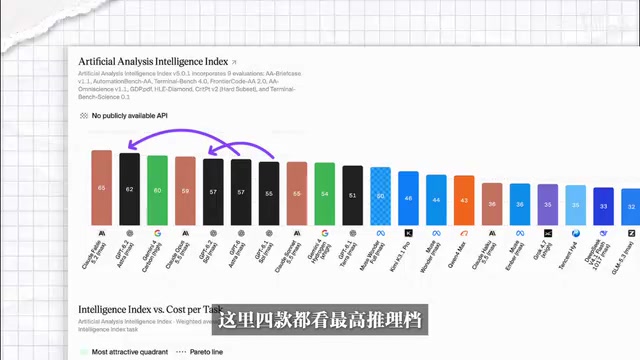
Third-party evaluator Artificial Analysis combines 9 tests into a single intelligence index, with all four models set to their highest reasoning tier. GPT-6.2 Astra rises from the previous generation's 57 points to 62, while its per-benchmark-question cost actually drops from $6.24 to $4. GPT-6.2 Sol scores 57, matching the previous-generation flagship GPT-6 Astra, at just $1.01 per question — about one-sixth of the old flagship's cost; compared to the previous Sol, it gains 2 points while per-task cost drops by about $0.2.
If you mainly use Codex for coding, you also need to look at the coding-specific benchmark: the two generations of Astra are tied, while GPT-6.2 Sol scores 3 points lower than GPT-6.1 Sol. So the conclusion depends on the scenario — looking only at the composite test, GPT-6.2 Astra has the highest score, and GPT-6.2 Sol matches the previous-generation flagship at about one-sixth the cost; but when mainly using Codex for coding, GPT-6.1 Sol deserves a place on your comparison list.
Artificial Analysis Intelligence Index is a composite leaderboard maintained by the third-party evaluator Artificial Analysis. It works by standardizing scores from multiple public benchmarks (covering knowledge Q&A, math, coding, instruction following, etc.) and weighting them into a single total score, while also tracking the average dollar cost of completing each benchmark question. Its value lies in comparing models from different vendors and price points on a unified basis, avoiding reliance on vendors' self-reported benchmarks. Note that a composite index can mask differences on individual dimensions — a model may be close to a competitor in total score but clearly behind on specific dimensions such as coding or long context. Therefore, the index is suitable for initial screening; final selection should still come back to task tests aligned with your own business.
Horizontal Competition: How It Compares to Peers in the Same Tier
Looking at the broader market, every tier of GPT-6 models has direct competitors from Claude, Gemini, and others.
In the flagship tier, Claude Fable 5.2 has the same input/output pricing as GPT-6.2 Astra but scores 3 points higher on the composite test, though it costs $26.54 per question versus Astra's $4. Claude Opus 5.5 has an official price half of Astra's, scores 59, and costs $10.04 per question. Gemini 4 Neon and Carbon both reach 60 points at their high tier, costing $3.74 and $7.76 per question respectively; Neon can gain 2 more points at its ultra tier, but that costs $6.44 per question — not a cost-effective trade. Paying 6x the price for 3 points doesn't hold up in most business cases.
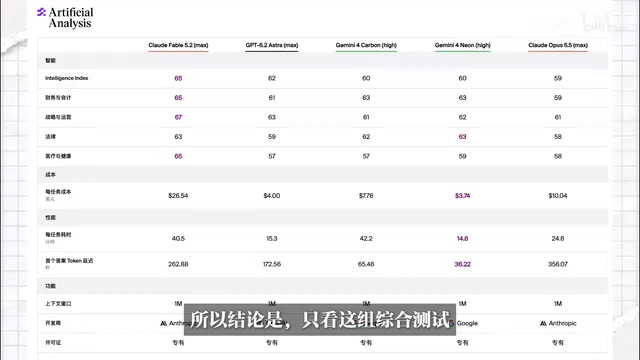
In the mid tier, looking at the two generations of Sol and Claude Sonnet 5.5: all three have the same input, cache-read, and output pricing. At their highest tiers, Sonnet and GPT-6.1 Sol both score 55, costing $10.02 and $1.27 per question respectively; GPT-6.2 Sol scores 2 points higher than the previous generation at just $1.01 per question — the lowest per-task cost in this group. If you're willing to spend more, Neon at its high tier scores 60, 3 points above GPT-6.2 Sol's highest tier, at $3.74 per question. For everyday coding, GPT-6.2 Sol is the more reasonable starting point.
In the entry tier for summarization, information extraction, and classification: GPT-6 Luna scores 28 at its highest tier on the composite test, at $0.15 per question; Claude Haiku 5.5 scores 37 at its highest tier, at $0.41 per question; Gemini 4 Hydrogen scores 27 at its low tier, at $0.29 per question; DeepSeekAd V4.1 Flash 1017 scores 33 at its highest tier, at $0.60 per question. Two cost caveats: Haiku's input and output pricing both increase to 5x the original when input exceeds 100K tokens; DeepSeek's API doubles its pricing on weekdays from 9 AM to 12 PM and 2 PM to 6 PM Beijing time, excluding Chinese statutory holidays. For bulk summarization and field extraction, GPT-6 Luna is the most economical in this group and you don't have to worry about input and caching issues; Gemini Hydrogen is also worth considering.
Caching and Reasoning Tiers: The Most Underestimated Cost Levers
OpenAI's own documentation states that the same model's effectiveness and cost are directly affected by context caching and tier configuration, and the combined impact can be far larger than you'd imagine.
On reasoning tiers, GPT-6.2 Sol has five levels — low, medium, high, ultra, and max — with the API defaulting to medium and not supporting disabling. Higher tiers cost more: according to Artificial Analysis's composite evaluation, moving from medium to max raises the total score from 52 to 57, but the per-question cost jumps from $0.41 to $1.01 — more than double the price. The same holds for Frontier Code 2.0 for code changes: dropping from max to medium takes the score from 44.4% to 41.4%, a difference of only three percentage points. For most everyday tasks, medium is sufficient; only raise it when results are genuinely unsatisfactory.
Caching has an even more direct impact. Suppose you use GPT-6.2 Sol as an agent, and each step reads the same 200K-token codebase. Counting only the input cost for that code, reading it once at full price costs 40 cents; a full cache hit costs just 2 cents — one-twentieth of the original price. Two practical tips: place frequently reused material at the beginning and append new questions after it; the cache is retained for 30 minutes by default, so after a long absence the expired content needs to be reprocessed and billed, and long tasks can opt for 12-hour retention (but the first write is more expensive); adjusting the reasoning tier up or down mid-task can now also automatically continue reusing the cache, saving API users a considerable amount.

Prompt Caching is a billing optimization mechanism offered by mainstream large model APIs: when a request's prefix (usually the system prompt, a long document, or a codebase) exactly matches a recent request, the server can directly reuse the already-computed KV cache instead of redoing the forward computation. As a result, cached input tokens typically cost only a tenth of the original price or even less, and time-to-first-token also drops noticeably. Caches generally have a time-to-live (e.g., 30 minutes), after which they must be rewritten and billed again.
Reasoning Effort refers to the budget of "thinking" tokens the model is allowed to consume before giving its final answer. Higher tiers make the model more inclined to unfold multi-step reasoning, self-checking, and backtracking, raising accuracy on complex tasks but also increasing output token count and latency; lower tiers respond faster and more cheaply, suitable for format conversion, extraction, and other tasks that don't require deep reasoning. Most APIs allow setting the tier dynamically per request, which effectively makes "same model, different tiers" a continuous price–capability curve.
Task-Based Selection: An Actionable Checklist
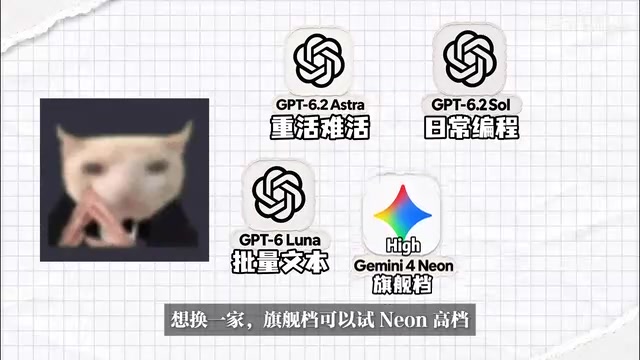
Consolidating the data above into recommendations: for the hardest scientific research tasks and demanding multi-application business workflows, prioritize GPT-6.2 Astra; alternatives in the same tier include Claude Opus 5.5 and Gemini 4 Neon. For everyday coding, Codex agents, and work requiring repeated reads of long contexts, GPT-6.2 Sol is the first choice, starting from medium — alternatives include Claude Sonnet 5.5, but when using Codex for coding, GPT-6.1 Sol scores three points higher than 6.2 Sol on the coding-specific benchmark and is worth prioritizing. For volume tasks like bulk summarization, information extraction, and batch classification, use GPT-6 Luna; if you're used to Gemini, start with Hydrogen's low tier; for direct use in China, choose DeepSeek V4.1 Flash 1017. For speed-sensitive legacy workflows or those requiring reasoning to be fully disabled, GPT-6 Sol remains suitable.
On the composite test, GPT-6.2 Sol has already matched the previous-generation flagship GPT-6 Astra while costing less. Most people's tasks aren't that hard — getting the job done at lower cost with 6.2 Sol and Luna is the most noteworthy change in this generation of models.
One-line Summary
Breaking down the benchmark scores and per-task costs of the four GPT-6 models, with task-based selection and cost-saving recommendations.
Paragraph Summary
The article compares the four models under OpenAI's dual-line strategy for the same generation: the flagship GPT-6.2 Astra, the cost-effective GPT-6.2 Sol, and the previous generation's GPT-6 Astra and GPT-6.1 Sol. Official task tests and the third-party intelligence index show that GPT-6.2 Sol scores only fractions of a percentage point below the flagship in coding, computer use, and research, matches the previous-generation flagship on the composite score, yet costs about one-sixth as much per task. After comparing with competitors like Claude and Gemini, the article notes that paying several times the price in the flagship tier for just a few points isn't worthwhile. In addition, dropping the reasoning tier from max to medium loses only about three percentage points while halving the price, and placing repeated context at the beginning can bring cache-hit pricing down to about one-twentieth — the two biggest levers on API spending. Finally, it provides a task-layered selection checklist.
Related articles
Why I Can't Sell You a €1 Email Inbox: The True Cost of Email Hosting
Hacker News author explains why a €1 email inbox is impossible, analyzing server, anti-spam, and compliance costs to reveal the unsustainability of cheap email and offer pricing insights for entrepreneurs.
How GoPro Built a Better Action Camera—Right on Time
GoPro's rise is as much a story of timing as of product. This article examines how Nick Woodman defined the action camera category from surfing footage needs, and how the rise of the internet and social media turned first-person content into a cultural phenomenon.

Building a Fine-Tuning Dataset from 23,000 Chat Messages: A Practical Case in AI Data Engineering
A developer shares how he built a fine-tuning dataset from 23,000 chat messages, using Sonnet 5.5 and logical rules to filter out ~3,600 high-confidence samples for training a target agent identification model.