GPT-6 Astra Hands-On: Which Model Tier Should You Actually Use? A Five-Scene Comparison

Five real tasks pit Astra Low vs. Astra High vs. Soul High — fast work goes to Astra Low, precision to Astra High.
Five real-world tasks — 3D interactive webpage, optical illusion game, teaching PPT, travel planning, and Pictionary — compare Astra Low, Astra High, and Soul High on the Codex platform across credit consumption, time, and output quality. Astra Low wins on speed (39-page PPT in 12 minutes) and suits everyday office tasks; Astra High leads on 3D fidelity, spatial logic, and fine detail; Soul High is consistently slowest with the weakest value for money. For most users, switching from Soul to Astra is enough — then choose Low for speed or High for precision.
After being bombarded with flashy Astra demo videos, let's come back to real-world daily office scenarios: do ordinary users actually need to switch to Astra? And if so, which reasoning tier should you pick? Bilibili creator "罐头" ran five real-world tasks to compare Astra Low, Astra High, and Soul High across 3D modeling, game development, PPT creation, and travel planning — measuring credit consumption, time spent, and final output quality.
All tests were conducted on a Codex Pro account (×5 credit multiplier), so all credit percentages below are relative to that baseline.
Task 1: 3D Interactive Webpage — A Clear Gap in Visual Fidelity
The first task started with a relatively simple 3D jelly interactive webpage, testing each model's ability to render physical motion and material texture.
Astra Low used just 1% of credits and finished in 6 minutes, producing a floating 3D jelly that bounced back naturally when dragged. However, under heavy dragging, the surface fractured into distinct "slabs" — lacking the smooth, translucent quality of real jelly. It felt more like a solid object than a gelatinous one.
Astra High also consumed only 1% of credits, but took 27 minutes. The difference was immediately visible: the semi-transparent gel texture was convincing, the rebound was snappy and lively, and background elements even refracted through the jelly's curved surface during motion — far more realistic.

Soul High performed the weakest — using 2% of credits and taking 40 minutes — and produced a jelly whose rebound was sluggishly slow, resembling a "water balloon." Cranking up the stiffness introduced visible triangular edge artifacts. The creator's verdict: those 40 minutes were "enough time for Astra Low to build six 3D jellies."
Takeaway: Astra High clearly leads on 3D fidelity; Astra Low wins on efficiency.
Task 2: Game Development — Only Astra High Achieved True 3D Space
The second task involved recreating an Monument Valley-style optical illusion puzzle game — a much higher bar for spatial logic.
Astra Low produced a basic scene with a rotation button, but characters could only move between fixed points rather than freely exploring the space. The spatial illusion mechanic wasn't truly implemented — the atmosphere was there, but the core mechanic wasn't.
Astra High was the only model to deliver a genuine sense of spatial presence. Characters could walk freely across grid tiles, and switching viewing angles caused the entire space to shift in sync. Multiple sliding-level puzzles were also designed in as a nice touch. The cost: 4% credits and 31 minutes — but the creator felt it was worth every second.
Soul High produced a 3D-looking background, but the game mechanics were disconnected from the rotation button, so the optical illusion logic never kicked in. It still cost 4% credits and took a full hour.
Takeaway: For complex spatial-logic development tasks, Astra High is the only viable choice.
The core mechanic of a Monument Valley-style illusion game relies on the principle of "impossible objects" — using isometric projection to flatten 3D space into a 2D image, making disconnected paths appear connected from certain viewpoints. Executing this requires the model to simultaneously handle scene geometry and topology, character collision detection across grid tiles, and dynamic path remapping when the view rotates. Any gap in this logic chain results in a "rotation happened but the path didn't change" failure state — which explains exactly why Soul High produced a 3D-looking background but lost the soul of the illusion game when the rotation button and game mechanics weren't properly wired together.
Task 3: PPT Lesson Plan — Solid Content, Limited Visual Appeal
The third task addressed a common request from educators: generate a 100-minute teaching PPT based on sixth-grade curriculum content.
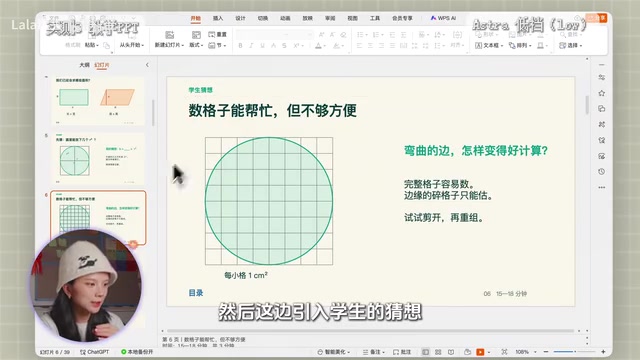
Astra Low produced a 39-page PPT in just 12 minutes using 2% credits — roughly 3 pages per minute. The content opened with a schoolyard lawn area problem, moved through cutting circles into sectors, student guessing interactions, hands-on paper cutting, a mid-class break, and practice exercises. Knowledge points were complete and pacing was solid, though illustrations were sparse and the overall feel was a bit dry.
Astra High delivered 47 pages in 22 minutes using 3% credits. The structure was similar, but added one key feature: interactive navigation buttons that let teachers jump back to the outline or skip between content sections (divided into 8/16/32/64 segments) whenever the pacing slipped.

Soul High added illustrations, but exposed a critical error: where the circle pieces should have formed a curved arc when assembled, it rendered them as triangles — a mistake that could easily mislead students in a real classroom. It took 51 minutes and 2% credits.
Takeaway: Codex-based PPT output is primarily text-driven. For visual polish, pair it with a dedicated PPT skill. For accuracy and rigor, Astra High is the first choice.
Task 4: Travel Planning — All Three Are Capable, but Attention to Detail Sets Them Apart
The final main task asked the models to scrape liked posts, plan an itinerary with transport and hotel info, and generate a 3D travel guide interface. This type of task requires controlling the browser to read content, so credit consumption across all models was notably higher.
Astra Low scraped 12 notes and 94 locations, prioritized them by like count, and planned a relaxed Chengdu itinerary that matched the city's laid-back pace — from breakfast budgets and People's Park to Citang Street, and then pre-departure logistics like checkout, luggage storage, catching a movie, and returning to collect bags. The detail level felt like a seasoned travel guide. Cost: 5% credits, 35 minutes.
Astra High scraped 12 notes but only 58 locations (less comprehensive coverage), yet folded in transportation, environment, and cost estimates for each leg of the trip. It also flagged unconfirmed locations proactively — behaving like "a more attentive personal assistant." Cost: 5% credits, 42 minutes.
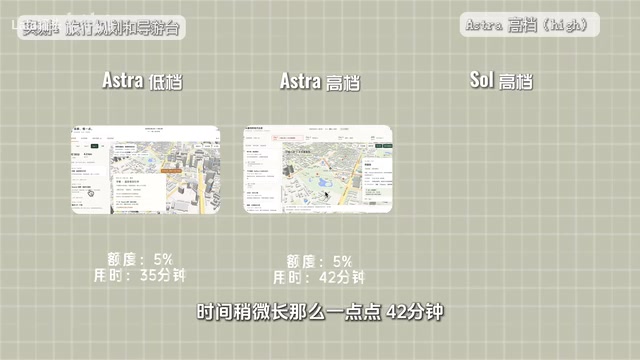
Soul High scraped 11 notes and hit the core locations, but the information cards were relatively sparse. The biggest issue remained speed — the whole process took well over an hour.
Takeaway: All three models are roughly comparable on text organization; the main differences are attentiveness and time. Soul High's time cost is simply too high.
Travel planning is a classic "computer use" task: the model must autonomously open web pages, scroll through content, recognize text and images, and extract structured information — essentially simulating a human operator working inside the user's account. Since each page load, screenshot analysis, and content extraction consumes inference resources, these tasks typically cost several times more credits than a standard conversation, and are more prone to stalling due to network latency or unexpected page layout changes. All three models hitting 5% credits in this test is a direct reflection of that mechanism — budget for it accordingly.
Bonus Test: Pictionary and Final Recommendations
When playing Pictionary on Canvas, all three models drew reasonably well — capturing a baker, a stick figure, a tiny house inside an ice cave, and more. The gap showed up in reaction time: with only a 3–5 second window to pick a drawing subject, Soul High failed to hit the button in time across four consecutive rounds. This mini-game also burned through nearly 3–4% of credits in just 10 minutes — a reminder that extended computer-use sessions require serious credit budgeting.
Which Tier Should Ordinary Users Choose?
After five tasks, the creator's conclusion is straightforward:
- Astra Low for everyday office work: Games, web pages, and PPTs done in minutes. Speed is its biggest advantage.
- Astra High for precision tasks: Whether it's travel planning or slide decks, it consistently picks up on "small-but-important" details that others miss.
- Soul High: Slower across the board, with some notable quality issues in certain outputs. Worst overall value for money.
In other words, for most ordinary users, switching from Soul to Astra is already a meaningful upgrade. From there, follow a simple rule: need it fast → go Low; need it right → go High.
The Astra and Soul names referenced throughout refer to different capability tiers within the Codex platform — not standalone products. Astra corresponds to a newer-generation base model with architectural improvements in multimodal understanding and code generation; Soul is the previous generation's flagship model. "Low" and "High" within each model refer to configuration differences in reasoning depth and iteration rounds — Low is faster but performs fewer internal reasoning steps per pass, while High does additional self-verification and correction before finalizing output, resulting in longer runtimes and more consistent detail, at the cost of higher credit consumption. Understanding this distinction helps you choose a tier based on how much the task can tolerate errors — rather than simply going with your gut.
Related articles

AI Is Not a Replacement: Human-AI Collaboration Through the Lens of Factory Root Cause Analysis
Starting from factory root cause analysis, this article explains how AI accelerates evidence chain construction rather than replacing human experts, exploring the pragmatic implementation logic and business value of 'AI supporting people rather than replacing them.'

AI Agent Decision Auditing: Building an Evidence Chain in Regulated Workflows
Starting from a Reddit discussion, this article analyzes three core issues in AI agent decision auditing within regulated workflows: what fields audit records should contain, how to handle feedback latency for erroneous decisions, and how to continuously calibrate LLM judge consistency with human judgment.

Apple Opens Multiseat Subscription Purchasing: App Subscriptions Can Now Be Sold in Bulk to Businesses and Schools
Apple opens multiseat purchasing for auto-renewable subscriptions: businesses and schools can bulk-buy via Apple Business and Apple School Manager, adding or removing seats anytime. Enabled by default in App Store Connect—developers should verify settings; group purchasing sandbox testing opens October 2026.