GPT-6 Astra Launch Goes Wrong: Paying Users Locked Out, Altman Issues Emergency Apology
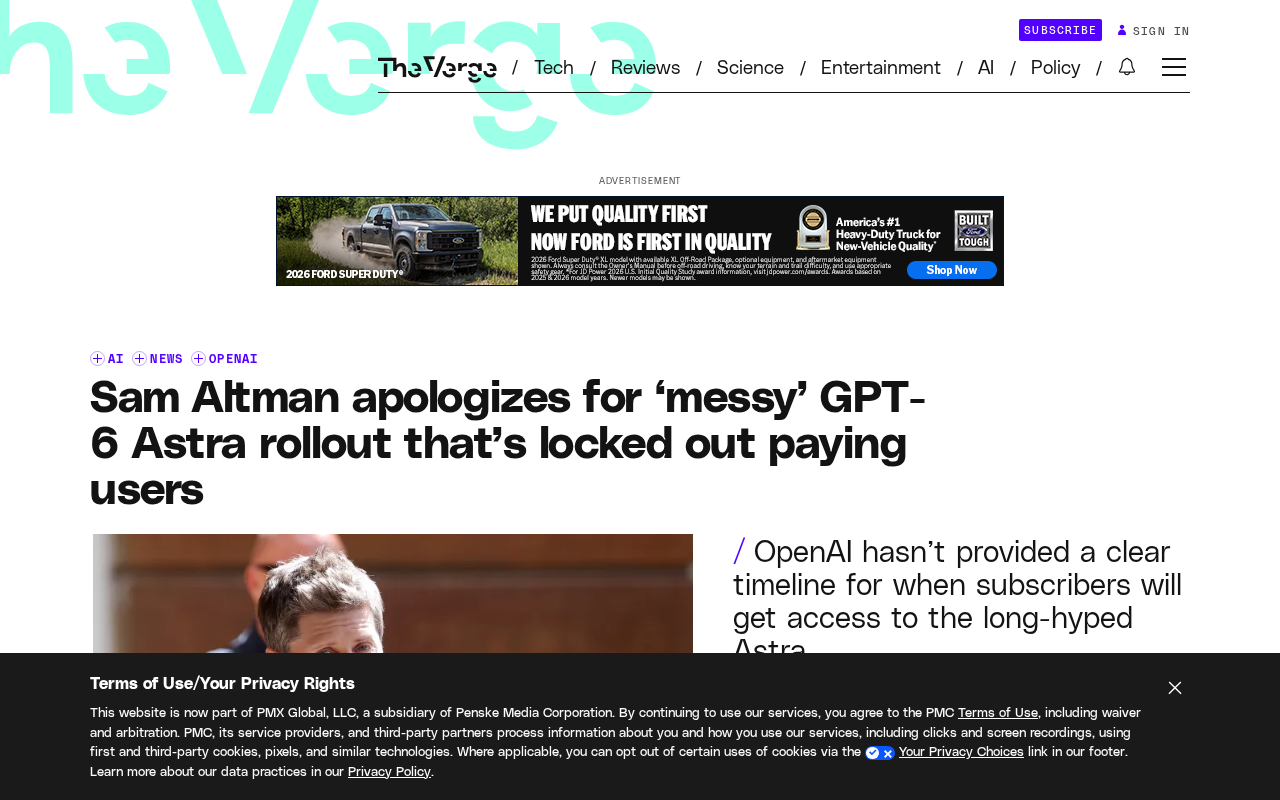
OpenAI's GPT-6 Astra launch locked out paying users, prompting an emergency apology from Sam Altman.
OpenAI launched GPT-6 Astra with bold claims of a "generational leap," but the rollout quickly turned into a PR crisis as paid subscribers were unable to access the model. CEO Sam Altman apologized within hours, acknowledging the messy launch. The incident highlights the growing tension between marketing hype and delivery capability in the AI arms race, and raises critical questions about capacity planning and user trust.
A Rushed "Generational Leap"
OpenAI launched GPT-6 Astra on Thursday with great fanfare, calling it a "generational leap in capability" and positioning it as the dawn of a new era. However, what should have been a technological milestone quickly spiraled into a PR crisis.
Just hours after GPT-6 Astra went live, OpenAI CEO Sam Altman publicly apologized, admitting it was a "messy rollout." The reason was straightforward: a large number of eager paying subscribers found themselves unable to access the so-called frontier model after paying their subscription fees, left with nothing to do but wait.
For a company whose core selling point is "frontier models," preventing paying users from accessing its flagship product crosses the most sensitive user experience red line imaginable.
Why Paying Users Were "Locked Out"
The most criticized aspect of the GPT-6 Astra launch was the clear access issues affecting paid subscribers. These users are typically OpenAI's most loyal base — the ones most willing to pay for new capabilities — and they expected to experience GPT-6 Astra first. Instead, they found themselves shut out.
The Massive Gap Between Marketing Expectations and Actual Delivery
OpenAI's marketing around Astra was extremely aggressive. Phrasing like "generational leap" inherently raised users' psychological expectations sky-high. When such a vast gap emerges between marketing rhetoric and actual delivery, user disappointment tends to be amplified. Paying users aren't just paying for usage — they're paying for the reasonable expectation of "priority access." This time, that expectation was shattered.
In the SaaS (Software as a Service) business model, user trust is directly tied to core financial metrics: Retention Rate and LTV (Lifetime Value). OpenAI's subscription revenue is the backbone of its commercialization — reportedly, its annualized revenue has surpassed several billion dollars, with a significant portion coming from Plus and Pro subscribers. Every bad experience can drive churn, and in the AI tools market, switching costs are decreasing: competitors like Claude and Gemini are functionally converging, and users can migrate by simply changing one subscription. Even more notably, OpenAI is actively expanding into the enterprise market, where corporate clients demand far higher standards for service reliability and SLAs (Service Level Agreements) than individual users. A public-facing launch failure could give pause to CTOs currently evaluating OpenAI's enterprise offerings.
The Recurring Problem of Large-Scale AI Model Launches
In reality, limited access and service instability are almost "standard" challenges with every major AI model launch. Frontier large models demand enormous compute power, and when massive volumes of requests flood in simultaneously, any failure in capacity planning, permission tiering, or traffic routing can leave some users "locked out." The GPT-6 Astra debacle once again exposed the enormous gap between "launching" an AI product and "delivering it at scale."
To understand the technical roots of this gap, consider that frontier models at the GPT-6 Astra level typically have trillions of parameters, and each inference requires substantial GPU compute. By current industry estimates, a single inference for a trillion-parameter model may require dozens or even hundreds of high-end GPUs (such as NVIDIA H100/H200 or newer B200) working in coordination. When millions of users simultaneously fire off requests on launch day, the total compute demand can spike to several times — or even tens of times — normal levels. This requires precise capacity planning before launch, including estimating peak concurrency, reserving redundant compute, and designing elastic auto-scaling mechanisms. However, demand curves for frontier models are extremely difficult to predict — the louder the marketing, the more users flood in on day one, yet over-provisioning compute means enormous idle costs. This contradiction is the core engineering challenge that every major AI model launch must confront.
The industry standard practice for addressing this challenge is gradual rollout (also known as canary release). The core idea is to first open new features or versions to a small subset of users, monitor system stability and user feedback, then gradually expand coverage. In the AI model domain, gradual rollouts typically involve user tiering strategies — for example, opening access first to API developers, then to Pro subscribers, and finally to free users. Traffic shaping handles dynamic resource allocation when requests surge, including request queuing, rate limiting, and load balancing. The GPT-6 Astra issue likely stemmed from the pacing design of the gradual rollout or configuration errors in the permissions system — paying users who should have been in the priority queue were incorrectly deprioritized due to system logic errors or capacity bottlenecks.
The Multiple Signals Behind Altman's Emergency Apology
A notable detail: Altman chose to publicly apologize almost immediately when the problem surfaced, rather than waiting for the situation to escalate and responding reactively. This rapid response itself carries several layers of signal.
First, it reflects OpenAI's acute sensitivity to user sentiment. In an increasingly competitive AI market, user trust is a scarce resource, and a botched launch experience can be quickly exploited by competitors. A timely apology helps cut losses and prevent negative sentiment from spreading further.
Second, it also highlights the pervasive "rush to launch" pressure across the AI industry. With competitors like Google and Anthropic closing in, every company is inclined to announce new models as early as possible to seize the narrative. But the tension between "launch cadence" and "delivery capability" is often laid bare in this rush — capturing headlines first, yet unable to handle the resulting traffic surge.
The AI industry in 2024-2025 is experiencing unprecedented competitive acceleration. Google DeepMind continues iterating on its Gemini model family, Anthropic's Claude keeps breaking new ground in safety and reasoning capabilities, Meta is disrupting the market through its open-source Llama series, and emerging players like xAI's Grok and Mistral are rapidly rising. In this "arms race" dynamic, the timing window for model launches carries strategic value in itself — being first to announce a next-generation model not only captures the attention of developers and enterprise clients but also signals "technological leadership" to capital markets. However, this rush-to-launch logic inherently conflicts with engineering rigor. Google's 2023 launch of Bard suffered a demo error that caused parent company Alphabet's stock to plunge by over $100 billion, and Anthropic also encountered capacity shortages during its early model launches. The industry keeps validating the same lesson: in AI, the definition of "launch" is evolving from "announcing availability" to "delivering stable service at scale."
Lessons from This Debacle for the Industry and Users
While this incident may appear to be merely a technical launch failure, the underlying issues it reveals are worth deep consideration.
For OpenAI, how to strike a balance between marketing hype and actual delivery is a long-term challenge that must be confronted head-on. Over-hyping a "generational leap" only to under-deliver erodes brand credibility.
For the broader AI industry, AI model "launches" are increasingly resembling the rollout of large-scale public services, with complexity far exceeding that of traditional software products. Compute reserves, gradual rollouts, and user tiering are the critical engineering capabilities that determine launch success — not after-the-fact damage control. Traditional software launches are primarily constrained by CDN distribution and server response capacity, while AI model launches layer on an additional set of unique technical complexities: GPU cluster scheduling, inference latency optimization, context window memory management, and more. As model parameter counts continue to grow and multimodal capabilities expand, every future frontier model launch will be an extreme stress test of a company's infrastructure and operations.
For users, this serves as a reminder: maintaining rational expectations amid the AI hype cycle is often wiser than chasing the "day-one experience." The true value of frontier models can only be validated over time in a stable, accessible environment — not defined by launch-day marketing slogans.
As of now, OpenAI has not published a complete remediation timeline for the GPT-6 Astra issues, and the status of full access restoration for paying users remains to be seen. Whether this "messy rollout" will be remembered as a minor hiccup or become a turning point that erodes user trust depends on the speed and sincerity of OpenAI's response going forward.
Key Takeaways
Related articles

Qwen3.8 Flash Deep Dive: How Hybrid Architecture Is Reshaping LLM Efficiency
Qwen releases Qwen3.8 Flash Next with hybrid architecture: 125B params, only 6B activated per token, at 1/9 training cost. Deep dive into Gated DeltaNet, million-token context, and agent workflows.

GPT-6 Astra: AI Competition Shifts from Best Answers to Workflow Ownership
AI competition is shifting from single-answer quality to workflow ownership. Explore how GPT-6 Astra signals AI's evolution from passive responder to autonomous workflow agent.

Designing Enterprise-Grade Agent Memory Systems: The Essential Difference Between Context and Long-Term Memory
Deep dive into AI Agent memory architecture: why LLMs have no built-in memory, the key difference between context and memory, and how to design layered enterprise memory systems to avoid context explosion and attention dilution.