GPT-6 Astra Meets Blender: Real-World Testing — 3D Design Revolution or Hype?

GPT-6 Astra + Blender MCP tested: AI nails pipeline automation but fails on structural detail — designers should become directors, not panic.
Creator Fei Chong's deep-dive testing of GPT-6 Astra and Blender MCP reveals that AI-generated 3D assets look impressive from afar but collapse under scrutiny — geometry interpenetrates, topology fails, and joints assemble backwards. AI's real value lies in automating tedious pipeline work like rigging and controllers, and serving as spatial scaffolding for video generation. Rather than replacing 3D designers, AI is shifting the role from hands-on technician to high-level director. Blender's open-source nature, unified pipeline, and mature Python ecosystem make it the prime target for AI adaptation — existing Blender expertise becomes more valuable, not less.
After GPT-6 Astra launched, Blender unexpectedly became the center of attention. A flood of demo videos showing 3D assets generated from a single sentence sent many industry designers — who had spent years honing their modeling, rendering, and animation skills — into collective anxiety. Was all that hard-won expertise now worthless?
Bilibili creator Fei Chong (肥虫) quickly ran a comprehensive deep-dive test on both GPT-6 Astra and the latest Blender MCP workflow. The conclusion is both impressive and a bucket of cold water on the hype: the AI's capabilities are genuinely remarkable, but those "industry-disruption" headlines don't need to be taken at face value.
Hard Surface, Characters, and Scenes: What Three Rounds of Testing Actually Showed
Fei Chong tested hard-surface modeling, character generation, and a full-pipeline scene build. The results showed a clear pattern: stunning from a distance, falls apart up close.
For hard-surface modeling, he fed Astra a car reference image and ran a lightweight model for 15 minutes. Reflections, lighting, and material quality were all respectable. But the moment you zoomed in or looked at the engineering internals, the problems appeared: widespread geometry interpenetration, hollow structures, and topology that doesn't hold up to scrutiny — all while burning through a significant amount of tokens. The one genuine surprise was that the AI's naming and organization of engineering collections and layers was more consistent than most junior artists manage.
Switching to high-power mode for a complex mech test, the rendered output fooled plenty of people — but comparing it against structural references revealed that even the finger joints were assembled backwards. This shows that a clear gap still exists between "looks right" and "is structurally correct."
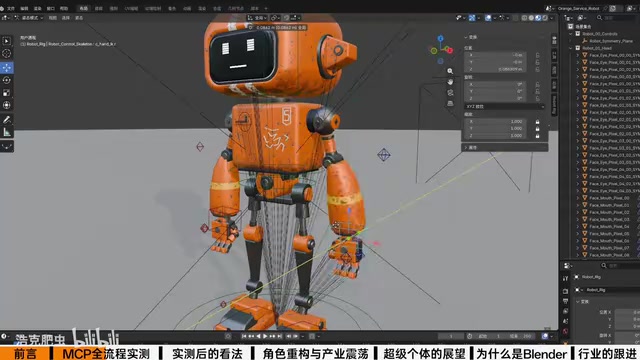
The genuinely valuable discovery was the AI's ability to automate tedious pipeline work. Using Codex to call Hive 3D's MCP protocol, a complete Blender asset — with skeleton rigging and motion controllers — was produced in just 19 minutes. While bone weight precision was still rough, the AI was already capable of taking over the tedious underlying logic of building controllers and linking constraints.
MCP (Model Context Protocol) is an open protocol proposed by Anthropic in late 2024. It allows AI models to directly invoke external tools, databases, and software APIs through a standardized interface, eliminating the need to manually copy and paste intermediate results. In a Blender workflow, MCP essentially gives the AI the ability to "operate the mouse" — it can not only generate code suggestions but directly execute commands inside Blender, read scene state, and modify node parameters. Codex is OpenAI's code-generation model capability, responsible for translating natural-language instructions into executable Python scripts that are then sent to Blender via the MCP protocol. The combination makes it possible to drive 3D software through conversation, rather than staying at the level of screenshot demos. Tokens in this context refer to the computational units consumed per inference by an AI model, directly corresponding to usage cost. Complex 3D generation tasks, requiring multiple iterations and long context windows, can consume tens of times more tokens than ordinary text tasks.
Scene Building: The Hidden Value of AI
Scene modeling was an underrated highlight of this round of testing. Current AIGC video models frequently suffer from visual collapse and spatial incoherence when handling multi-angle shots and long camera paths. Fei Chong had the AI build a geometric scene in Blender in 13 minutes. The quality was modest, but it can serve directly as a hard spatial constraint asset for video models like Kling (C-Dance class), solving camera perspective and motion-path problems.
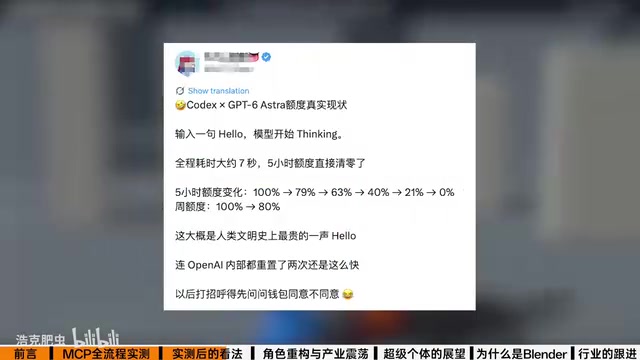
The key insight here is important: AI-generated 3D assets don't need to be production-ready. They can function as "spatial scaffolding" for downstream video generation. This kind of cross-tool collaboration may offer more practical value than simply chasing high-fidelity models.
Kling (可灵) is a video generation model released by Kuaishou, belonging to the "C-Dance class" (i.e., video diffusion models based on reference images or conditional control). The core pain point of such models is their lack of three-dimensional spatial awareness: when a camera needs to orbit an object or multiple characters move simultaneously in a scene, the model tends to produce perspective collapse, object bleed-through, and incoherent motion paths — fundamentally because pure image diffusion models have no explicit constraint on 3D geometric relationships. Feeding a lightweight geometric scene built in Blender as "spatial scaffolding" into a video model is essentially providing structural priors — depth maps, normal maps, or camera trajectories — that hard-constrain the diffusion process to physical space. This approach follows the same logic as ControlNet's structural control over image generation, and is one of the mainstream engineering directions for bridging the gap between "2D generation" and "3D consistency."
The Three Real Limits of AI
Across multiple rounds of testing, Fei Chong offered three sober judgments that deserve to be repeated.
The micro level is still rough. That kind of fine-grained adjustment — where one touch too many makes it stiff, one touch too few leaves it flat — is very difficult to describe precisely in text for an AI. High-level detail control remains unsolvable in the short term.
Token costs are still high. Models will improve and costs will fall, but ultimately the best closed-source models won't become cheap enough for anyone to use freely — Kling's pricing model is a visible example of this right now.
Where AI truly dominates is repetitive labor. The soul-crushing repetitive tasks, logical wiring, and node-based procedural modules that fill the industry are what AI will absorb first. For creators, AI has always been a solid capability supplement — not a replacement.
Should You Still Learn the Software? Absolutely.
Faced with the anxiety, Fei Chong's answer is clear: of course you should learn — but the purpose of learning has fundamentally changed.
In the past, you learned so you could do the work yourself. Going forward, you learn so you can judge whether the AI did it correctly, and tell it precisely how to do it right. The 3D designer's role evolves from a heads-down "mechanical technician" to an overview-commanding "3D director."
This also means that entry-level requirements in the industry are becoming far more demanding. Roles that rely purely on grinding hours, mechanical polygon-pushing, and basic modeling will be ruthlessly compressed. The industry will value only two things: irreplaceable aesthetic judgment and narrative composition, and deep evaluative knowledge of top-tier material physics and rendering pipelines.

The deeper shift is happening at the business structure level. In the past, large-scale realistic assets required big studios throwing armies of people at the problem. Today, Blender plus AI has become a "super art engine" for independent creators. We may soon see tight-knit teams of three to five people — leveraging extremely low time costs — producing the output volume that previously required dozens of outsourced workers.
Four Core Competencies for the Future 3D Designer
Fei Chong believes that in the AI + 3D content ecosystem, the people who truly stand out will excel across four capability boundaries:
- Aesthetic judgment: AI can instantly give you a hundred options, but deciding which one fits still requires you. That takes long-term accumulated experience — something AI can't provide.
- Full-pipeline vision: What stages exist from concept to delivery, and where are the bottlenecks? You don't need to do every step yourself, but you must understand every step.
- AI direction ability: Writing effective prompts, designing workflows, reviewing outputs, and fixing the mistakes AI makes.
- Commercial communication ability: Finding clients, setting prices, building a portfolio, running a social media presence. The first three determine what you can produce. The last one determines whether anyone will pay for it.
Why Did Blender Explode — and Not the Legacy Commercial Software?
There's an intriguing phenomenon here: the GPT-6 Astra wave didn't lift the big commercial software boats — it ignited Blender. Fei Chong says he envisioned this three years ago. The core comes down to three points.
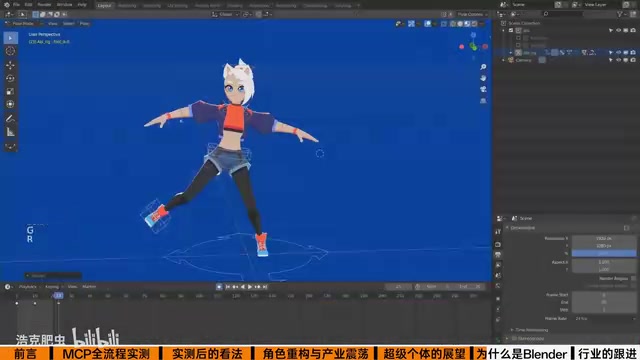
Open source with maximally open APIs. Commercial closed-source software carries steep annual licensing fees and cumbersome seat restrictions. Blender is permanently free with no barrier to entry, fully open-source, carries no licensing risk, and offers nearly zero friction for external tool integration.
A naturally full-pipeline monolithic architecture. Modeling, rigging, animation, simulation, and rendering all operate within a unified data environment. When AI automates and chains pipeline stages together, it doesn't have to deal with industrial friction like axis confusion when exporting FBX across software, or lost materials.
A highly mature global open-source ecosystem. Massive libraries of open-source plugins, Python scripts, and standardized tools make Blender the easiest 3D environment for AI to learn, call, and adapt to. The best upcoming 3D AI tools and scripts will almost certainly target Blender first.
This also means that the spatial awareness and pipeline experience you've built up in Blender won't become obsolete — it may actually become the most effective "operating system" for directing AI.
Blender's Python API and bpy module give external programs complete scene read/write capabilities, and virtually every interface operation can be reproduced via script. This is a key differentiator that other mainstream 3D software (Maya, 3ds Max, Cinema 4D) — while also supporting scripting — cannot match in terms of openness and community depth. Even more importantly, Blender's node-based material system (Shader Nodes) and Geometry Nodes organize logic naturally as data-flow graphs, which aligns closely with how AI generates code — the AI can precisely control procedural generation workflows by adding, removing, or modifying nodes and parameters, without needing to parse complex binary formats or proprietary protocols. By contrast, the closed-source formats and seat licensing of commercial software not only increase integration costs but also make them unlikely candidates for AI training and adaptation. Blender's plugin ecosystem — with tens of thousands of stars on GitHub — provides large language models with a vast corpus of high-quality Python example code as training data, further deepening AI's "familiarity" with its API.
Transformation Is a Starting Point, Not an Endpoint
Standing at the wave of AI, open source is seen as the beginning of innovation and an indispensable foundation for the AI era. Every transformation brought on by new creative tools is not the end of human careers — it's the starting point of an entirely new content ecosystem.
For industries like games, VR, and XR, the Blender + AI 3D pipeline is worth actively exploring. Rather than treating AI as a threat or using it as an excuse not to learn, embrace it — the latter approach only raises the bar for entering the industry yourself.
Related articles

Gemini 4 Argon Hands-On: AI Builds Board Games, Constructs Temples, and Trains Robots Autonomously
Gemini 4 Argon hands-on roundup: AI autonomously builds a desk racetrack and temple in Blender, writes a ray tracing engine, trains a humanoid robot to sink 7 shots, plus API pricing and developer access.

The Magic Octagonal Coin: Why Only 9% of People Can Predict Its Flip?
Only 9% of people can correctly predict the Magic Octagon coin flip. This article explains its spatial rotation mechanism, common cognitive pitfalls, and a new hypothesis based on Relevance Theory, exploring the limits of human spatial reasoning.

Sam Altman: AI Is Entering the Era of Scientific Discovery — Math Breakthroughs Will Replicate in Biology and Energy
Sam Altman says AI is entering the era of scientific discovery — math breakthroughs will replicate in biology, materials science, and energy to help develop new drugs and energy sources.