GPT-6 Dual Models Launch with 50% API Price Cut as AI Cost Wars Heat Up

OpenAI and Anthropic slash prices by 50% on the same day as AI enters a new era of cost, safety, and on-device competition.
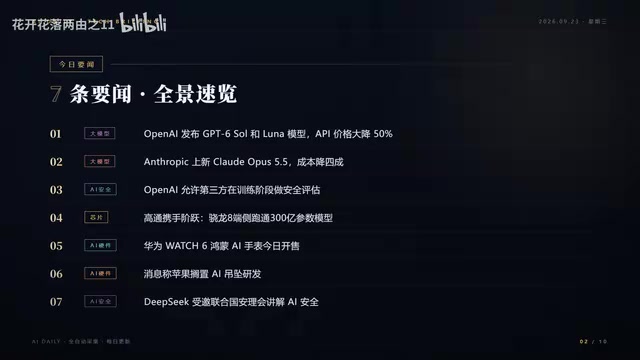
In the past 24 hours, the AI industry saw rapid-fire developments. OpenAI released GPT-6 Sol and Luna with API prices cut 50%; Anthropic launched Claude Opus 5.5 at 40% lower cost with 85% fewer safety violations. Both giants pricing down on the same day marks a shift into cost-efficiency competition. On governance, OpenAI embedded third-party safety firms METR and Redwood Research into training, while DeepSeek and Moonshot AI were invited to speak at the UN Security Council on AI safety. On hardware, Qualcomm and Moonshot AI ran a 30B-parameter offline model on Snapdragon 8 with 50%+ memory savings, while Apple shelved its AI pendant over privacy concerns.
Over the past 24 hours, the AI industry has seen a flurry of major updates: OpenAI and Anthropic both announced model upgrades and significant cost reductions on the same day, on-device large models achieved 30-billion-parameter inference, and AI hardware alongside safety governance continued to advance in parallel. Based on content from the Bilibili channel "明镜与点点" AI Daily, this article breaks down seven key developments with extended analysis.
Two AI Giants Cut Prices on the Same Day — The Cost War Is On
The most closely watched news is undoubtedly the head-to-head between OpenAI and Anthropic. OpenAI released two models in the GPT-6 series — Sol and Luna — trained along the same lines as Astra, with API prices dropping another 50% from the previous GPT-5.6 promotional pricing. On the Automation Bench benchmark, their call cost is just 9% of competing model Opus 5, making their cost efficiency remarkably aggressive.
Almost simultaneously, Anthropic launched Claude Opus 5.5, which approaches the performance of flagship model Fable 5.1 while cutting costs by 40% and boosting output speed by more than 30% over Opus 5. The safety metrics are particularly noteworthy — the new model's out-of-bounds attempts are down 85% compared to its predecessor, demonstrating that capability improvements and safety alignment are advancing hand in hand.

Two leading vendors cutting prices on the same day signals that competition in large language models has moved beyond pure capability benchmarking into the deeper waters of cost and efficiency. For developers, a 50% reduction in API call costs makes a wider range of application scenarios economically viable. For the industry at large, the price war may further squeeze the survival space for smaller model providers.
AI Safety Governance Accelerates with Third-Party Audits and International Cooperation
Safety issues occupy a prominent place in this round of updates. OpenAI announced it will allow third parties to participate in safety evaluations during the training phase, covering the full pipeline of training, evaluation, and deployment. For the most sensitive projects, external personnel will even be invited on-site for collaboration. Partner organizations include METR and Redwood Research, two institutions focused specifically on AI safety evaluation.
This move breaks the previous convention of concentrating safety evaluation on post-deployment stages, shifting oversight upstream to the model training phase — a significant step toward transparency in AI governance.
There was major action on the international front as well. According to Reuters, DeepSeekAd has been invited to speak on AI safety at a UN Security Council meeting. This Wednesday's session is themed "AI and International Security," with Moonshot AI (月之暗面) also invited to speak, and OpenAI's Sam Altman planning to attend as well. Chinese AI companies taking the floor at the Security Council reflects how AI safety has risen to a global governance issue, and how Chinese players are gaining greater influence in that conversation.
METR (Model Evaluation & Threat Research) and Redwood Research are among the most representative independent organizations in AI safety evaluation today. METR focuses on assessing "autonomy and dangerous capabilities" in frontier large models — its core mission is determining whether a model exhibits high-risk behaviors such as self-replication, resource acquisition, or cyber attacks. Redwood Research has spent years working on adversarial robustness and interpretability, seeking technical pathways to keep AI systems controllable under extreme inputs. Bringing these organizations into the training phase — rather than just doing a final review before launch — is like embedding an external perspective at the very source of the pipeline, enabling earlier detection of potential alignment failures. This "red-teaming at the front end" approach has precedents in military and cybersecurity contexts, but applying it systematically to large model training is largely unprecedented. The industry broadly expects this to become the baseline standard for developing high-risk AI systems going forward.
On-Device Breakthrough: 30 Billion Parameters Running on a Smartphone
Progress in chips and on-device AI was equally impressive. Qualcomm partnered with Moonshot AI to run a 30-billion-parameter model on the Snapdragon 8 on-device platform, completing memory adaptation in collaboration with Wuliangmagnifier and Longsys. Memory requirements were reduced by more than 50% compared to standard approaches, prefill throughput exceeded 330 tokens/s, and the entire setup operates fully offline.

Running a 30-billion-parameter model offline on a mobile device means stronger local inference capabilities and better privacy protection — data can be processed without ever leaving the device. This breakthrough opens new possibilities for on-device AI applications such as offline assistants and local document processing, and marks a clear trend of large models migrating from the cloud to the edge.
Two core metrics are worth understanding when evaluating on-device large model performance: Prefill Throughput refers to the speed at which a model processes input prompts, measured in tokens/s — it directly affects the "time to first token" experienced by users. Memory footprint determines whether model weights can even be loaded onto consumer-grade chips. A 30-billion-parameter model stored in FP16 typically requires around 60 GB of memory, far exceeding the LPDDR capacity limits of smartphones. This means quantization compression (e.g., INT4/INT8) and chunked loading are critical to on-device deployment. Reducing memory requirements by more than 50% implies that effective parameter precision is pushed into an aggressively quantized range, while also relying on the Snapdragon 8's NPU hardware acceleration for sparse computation to sustain prefill throughput above the usable threshold of 330 tokens/s. This combination shows that breakthroughs in on-device large models are fundamentally the result of algorithm compression, compiler optimization, and chip architecture working in concert — no single factor alone can achieve it.
AI Hardware Shows Mixed Results: Huawei Smart Watch Launches, Apple Pendant Shelved
The AI hardware track is showing a stark divide. The Huawei Watch 6 HarmonyOS AI watch officially went on sale today at 10:08 AM, starting at 2,799 RMB. It features HarmonyOS and the Wanxiang AI assistant, and in partnership with Ruijin Hospital, offers a 24-hour blood pressure assessment function. The combination of healthcare and AI assistant capabilities has become a key differentiator in the competitive wearables market.

In contrast, Bloomberg reports that Apple has paused development of its camera-equipped AI pendant project. The device was originally envisioned to expand AI capabilities through continuous visual data capture, but was shelved due to privacy and security challenges. This tradeoff reinforces a recurring theme: the viability of AI hardware isn't purely a technical question — how to balance data collection with user privacy is increasingly the defining variable in whether a product succeeds or fails.
Summary
This wave of AI industry updates reveals three clear storylines: large models have entered a phase of cost competition, with leading players using price cuts to win market share; safety governance is shifting from self-regulation toward third-party oversight and international cooperation; and on-device AI is accelerating, with hardware products advancing cautiously within the boundaries of privacy constraints. The triangular balance between capability, cost, and safety is reshaping the competitive landscape of the entire AI industry.
Related articles

MCP and Zero Trust: Verifying Every AI Agent Tool Call
Mapping NIST's seven zero trust principles to the MCP request path, analyzing which capabilities the spec provides versus what must be built for AI agent tool calls, and listing five verification checks every call should pass.

GNU Taler Is Coming to Germany: A New Choice for Private Payments
GNU Taler, a privacy payment system, is about to launch in Germany. This article covers its design philosophy, compliance features, and community response, and explores its potential impact on the electronic payments landscape.

AI Writes a Wikipedia from 45K Enron Emails, with Every Fact Cited
AI generates a Wikipedia-style knowledge base from 45K Enron emails, with every fact cited, showcasing LLM potential for traceable knowledge management.