GPT-6 Soar vs GPT-5.6 Soar: Real-World Benchmark — How Much Faster and Cheaper Is It Really?

Real-world tests show GPT-6 Soar's edge over GPT-5.6 Soar only becomes clear in complex tasks.
A Bilibili creator benchmarked GPT-6 Soar against GPT-5.6 Soar across three tasks — SVG drawing, code comprehension, and 3D city generation — tracking time, credit consumption, and output quality. Simple tasks showed no meaningful gap; code comprehension showed GPT-6 Soar running ~2x faster at lower cost; the 3D Changsha scene generation was the most revealing: GPT-5.6 Soar took 45 minutes and 65% of credits but reversed the city's geography, while GPT-6 Soar finished in 26 minutes at 31% cost with correct spatial layout. Conclusion: "faster, stronger, cheaper" holds up — but only on complex tasks.
OpenAI's newly released GPT-6 Soar and GPT-6 Lula are officially billed as "faster, more capable, and cheaper" than GPT-5.6 Soar. But in earlier tests, simple tasks like recreating a website from a screenshot revealed almost no difference between the two generations — because that kind of task hits the capability ceiling of both models, making it impossible to measure real gaps. So a Bilibili content creator ran a fresh round of tests using tasks with more discriminative power, logging time taken, credit consumption, and output quality across three dimensions to surface the true differences between generations.
Simple Tasks: The Ceiling Effect Hides the Gap
The first test was "draw a pear-blossom cat riding a bicycle in SVG" (a reworded version of the original prompt, to avoid triggering the model's pattern recognition). The task is simple enough that both models can complete it — the main question is how refined the visual output looks.
In terms of results, GPT-6 Soar produced a slightly more detailed and visually appealing pear-blossom cat. However, the time taken was nearly identical for both — just over two minutes each. On credit consumption, GPT-5.6 Soar used a negligible amount, while GPT-6 Soar consumed roughly 1% — a difference the creator attributed more to statistical noise than a meaningful cost gap.
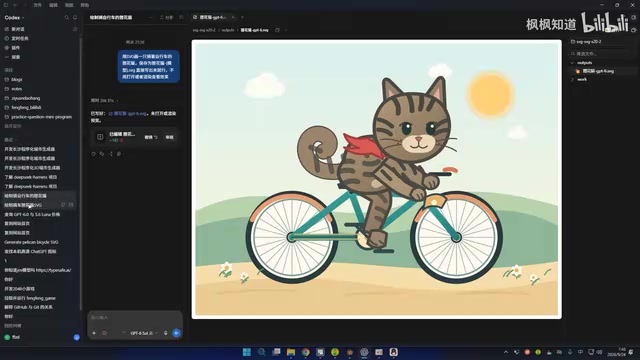
The problem with this type of task is that when both models can breeze through it, their capability ceilings converge and generational improvements become invisible. This also explains why the creator's previous video sparked debate — many viewers questioned the claim that GPT-6 Soar was meaningfully "stronger," and they had a point. Validating generational differences requires tasks that push closer to the models' actual limits.
Code Comprehension: Which Explains Things More Clearly?
The second test involved having each model familiarize itself with a GitHub project (using something like Lipstick Harness) and explain "what this project does" and "where to start learning it" in the most plain, accessible language possible. The benchmark here wasn't depth of technical explanation — it was clarity and approachability.
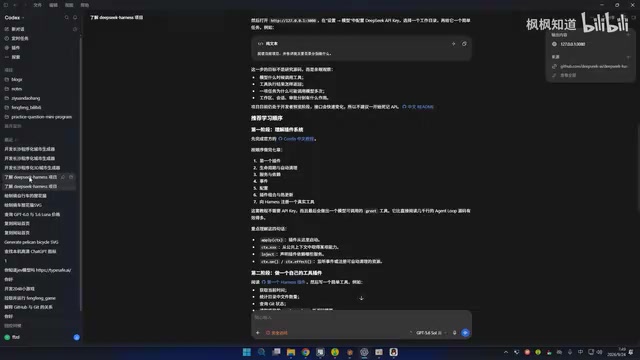
GPT-5.6 Soar gave a lengthy, thorough explanation, but the phrasing was somewhat dense. GPT-6 Soar summarized the project's purpose in a single sentence and gave concise, actionable learning advice. On the "plain and accessible" dimension, GPT-6 Soar came out ahead.
The time and cost comparison is even more telling: GPT-5.6 Soar took 3 minutes 4 seconds and used 3% of credits; GPT-6 Soar took just 1 minute 14 seconds and used 2%. For comparable comprehension quality, the newer model responded in roughly half the time at lower cost. This backs up the "faster and cheaper" claim — at least for mid-complexity code comprehension tasks.
3D Scene Generation: Geographic Accuracy Becomes the Differentiator
The test that truly separated the two models was the third one — a 3D city layer generator. Using the same prompt, both models (at different intensity settings) were asked to generate a 3D urban visualization of Changsha featuring landmarks like Juzizhou Island, Yuelu Mountain, and Wuyi Square.
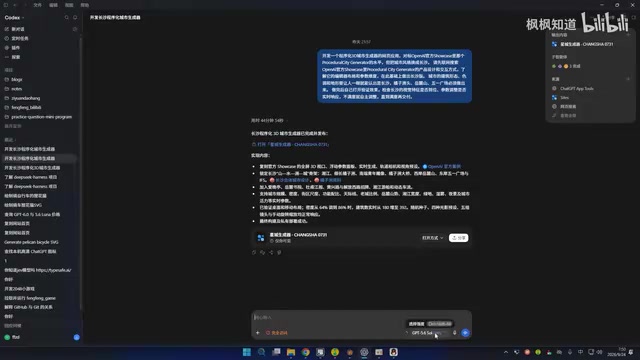
GPT-5.6 Soar (on Auto mode) produced something that looked decent at first glance — a city overview with landmark placements that seemed reasonable. But a closer check of the geography revealed a critical flaw: the entire spatial orientation was reversed. Using Juzizhou Island as a reference point, the relative positions of Yuelu Mountain and Wuyi Square were completely flipped from their real-world locations. The creator noted that things like color schemes and building heights can always be adjusted later, but a structural error in geographic orientation is a fundamental problem that no amount of post-processing can fix.
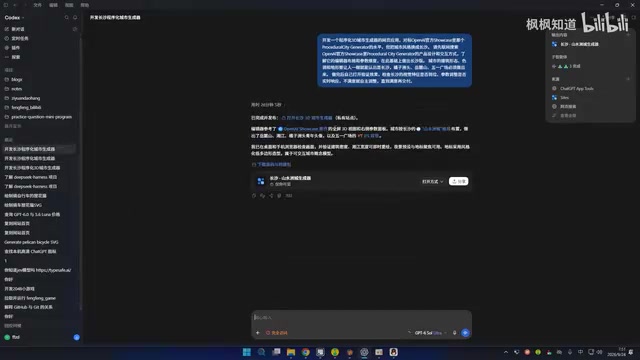
GPT-6 Soar (on Ultra mode), given the same prompt, got the geography right — with Yuelu Mountain correctly positioned to the left of Juzizhou Island and Wuyi Square to the right, matching actual geographic relationships. The output also included adjustable parameters for weather (sunny, night, dusk), city scale, average building height, Xiangjiang River width, green space coverage, and sun elevation — making the interactive experience considerably more complete.
The time and cost comparison here was stark: GPT-5.6 Soar (Auto mode) took 44 minutes 54 seconds and consumed 65% of credits; GPT-6 Soar (Ultra mode) finished in 26 minutes 5 seconds using just 31% of credits. In other words, the newer model not only produced a more accurate result, but did so in less time and at less than half the credit cost.
A 3D City Layer Generator is a type of programmatic scene-generation task based on code (typically HTML/JavaScript + Three.js or WebGL), where the model is asked to produce a runnable 3D urban visualization from a text description. The capability demands are multi-layered: the model must understand geographic topology (which landmark is in which direction), generate structurally correct and executable 3D rendering code, and implement interactive parameters (such as weather switching and building height controls). This makes it a high-discrimination scenario for evaluating a model's combined "spatial reasoning + code generation" ability — any failure in a single component produces a visually obvious structural error, unlike pure text tasks where mistakes can be obscured by vague phrasing. The difference between Auto and Ultra modes generally corresponds to the depth of reasoning and number of iterations the model applies during generation; Ultra mode typically trades more compute for higher output quality.
Takeaway: The Gap Only Shows Up in Complex Tasks
Across the three rounds of testing, a few clear conclusions emerge:
- Simple tasks reveal no generational gap, because both models hit the same capability ceiling and their outputs converge;
- Mid-complexity tasks begin to show an edge, with GPT-6 Soar delivering cleaner explanations in code comprehension tasks, with a clear speed and cost advantage;
- Complex tasks show the largest gap: in 3D scene generation, GPT-6 Soar won on structural correctness (geographic accuracy) while also dramatically outperforming on time and credit consumption.
This also addresses the pushback from the creator's earlier video: the claim that GPT-6 Soar is "stronger" is indeed hard to substantiate on simple tasks, but once task complexity increases, the generational improvement becomes tangible. For users who rely on large models for complex generation work, the combination of faster speed, lower cost, and greater structural accuracy represents real practical value that's hard to dismiss.
It's worth noting that this was a single creator's hands-on test with a limited sample size, and some evaluation criteria (like "plain and accessible") carry an inherent degree of subjectivity. These findings should be treated as a reference point, not a definitive verdict. Rigorous capability assessment requires more systematic, large-scale benchmarking.
The "capability ceiling effect" is a common trap in LLM evaluation. When task difficulty falls below a model's lower capability bound, all models succeed easily and comparison loses meaning. When difficulty exceeds the upper bound, all models fail and again can't be differentiated. Meaningful benchmarks need task difficulty calibrated to a "sweet spot" — where some models succeed and others don't. This is why academic benchmarks like MMLU, HumanEval, and MATH continuously release harder versions: as model capability improves, older benchmarks saturate and lose discriminative power. The easy-to-complex task design in this test partially mirrors that logic, but lacks systematic rigor — there's only one sample for the complex task, and the robustness of these conclusions awaits validation at larger scale.
Related articles

iPhone Duo Hands-On: Is the $2,000 Small-Screen Foldable Worth It?
YouTube's Allison shares her iPhone Duo hands-on: dual-screen multitasking doubles efficiency, great video viewing, nice matte finish—but thick body, small outer screen, and a $2,000 luxury price.

Sentry's Ad Cracks Up Developers: Can On-call Actually Be Fun?
Sentry's ad short film taps into developers' on-call anxiety, using humorous dialogue to showcase its observability platform—errors, logs, traces, metrics, replays, and releases in one place.

LLM App Getting Worse With Every Change? Build an Effective Evaluation System in Three Steps
How do you know if your LLM app is getting better or worse? A Reddit-based guide to test sets, automated regression evaluation, LLM-as-judge scoring, and structured agent tracing.