GPT-6 Sol and Luna Launch: Stronger Performance, Prices Cut by Another 50%

GPT-6 Sol and Luna launch with 50% price cuts; Luna's output price fell over 90% in two months.
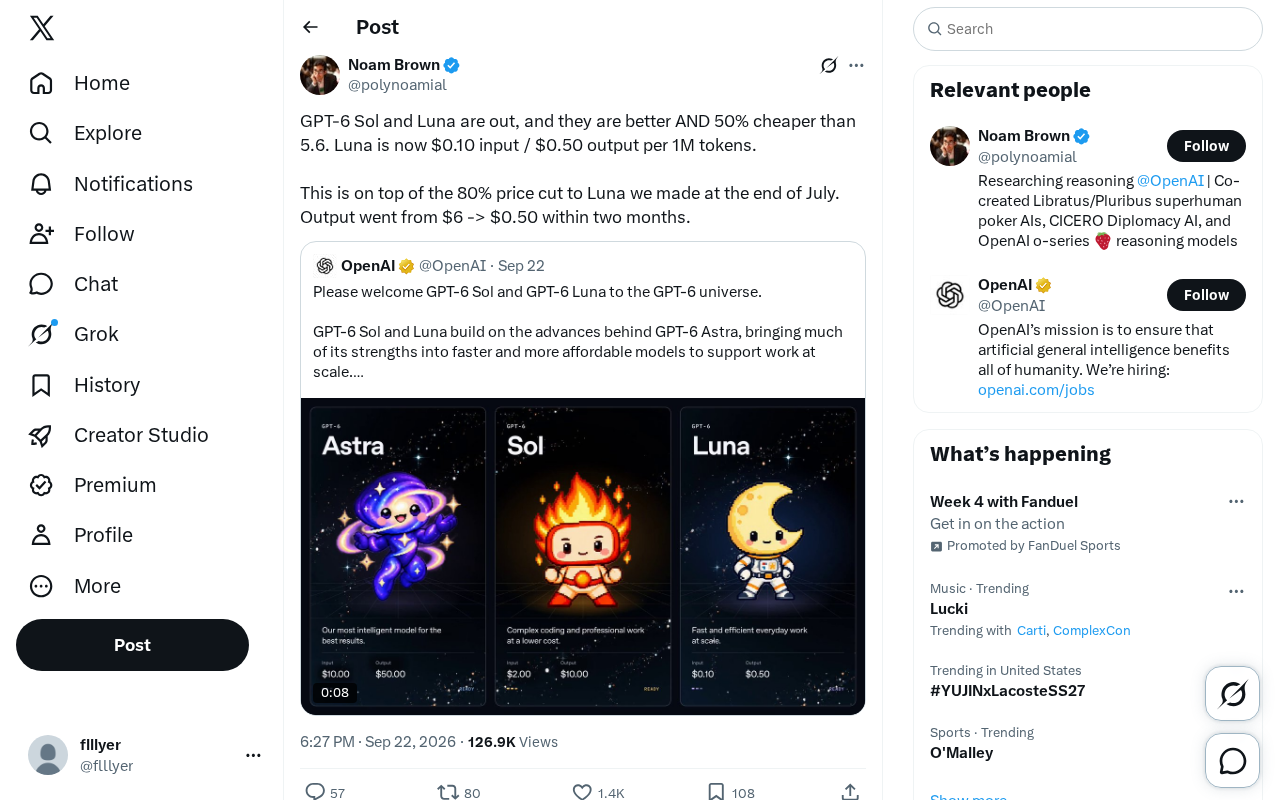
According to a Twitter leak, OpenAI's GPT-6 series introduces two models — Sol and Luna — with improved performance over GPT-5.6 and roughly 50% lower prices. Lightweight model Luna is priced at $0.10 input and $0.50 output per million tokens, with its output price having fallen over 90% across two rounds of cuts in just two months. The trend reflects inference architecture improvements and intensifying market competition, offering direct commercial value for cost-sensitive, high-frequency AI applications like chatbots and bulk content processing. Key details such as Sol's full pricing and performance benchmarks still await official confirmation.
GPT-6 Series Arrives: Better Performance at Lower Prices
A post on Twitter indicates that two models in the GPT-6 series — Sol and Luna — have officially launched. According to the post, both models deliver improved performance over the previous 5.6 generation while also coming in at roughly 50% lower prices.
The lightweight model Luna is drawing the most attention, with pricing set at $0.10 per million input tokens and $0.50 per million output tokens. For high-frequency, cost-sensitive use cases, this pricing level is highly compelling.
Luna's Dramatic Price Drop
The leak specifically highlights that this latest price cut comes on top of a previous major reduction. According to the source, Luna underwent an 80% price slash in late July, and the GPT-6 launch has now brought an additional 50% reduction on top of that.
By the numbers, Luna's output price has fallen from $6.00 to $0.50 per million tokens within two months — a drop of over 90%. In practical terms, developers are now paying roughly one-twelfth of what they were for the same output.
This kind of steep, rapid price decline reflects the ongoing optimization potential in inference costs for lightweight models, as well as the aggressive posture vendors are taking to capture developer mindshare.
The Logic Behind the Price War
Rapid drops in model pricing are typically driven by a combination of factors: improvements to inference architecture, more efficient hardware utilization, and intensifying market competition. As leading vendors continue to push down the cost per token, the barrier to entry for the entire industry falls — enabling more applications to ship at a manageable cost.
For product categories that win on volume — such as bulk content processing, chatbots, data labeling and cleaning — a difference of a few cents per million tokens, when multiplied across large-scale usage, directly determines gross margins.
It's also worth noting that falling inference costs are closely tied to advances in model architecture. In recent years, Mixture of Experts (MoE) has been widely adopted in lightweight model design. Rather than activating all parameters for every inference, MoE only engages a subset, maintaining a high capability ceiling while significantly reducing per-inference compute. Meanwhile, the maturation of quantization techniques has enabled models to run at lower bit-widths with manageable precision loss, further reducing memory footprint and computational overhead. These technical advances form the underlying foundation that allows vendors to keep cutting API prices without sacrificing model quality.
What This Means for Developers
If the reported performance gains and price reductions hold up, the GPT-6 Sol and Luna pairing gives developers more flexible options: Sol can handle more complex reasoning tasks, while Luna is well-suited as the default choice for high-frequency, low-latency scenarios.
In practice, many teams already use a "tiered routing" strategy — simple requests go to the cheaper model, while complex ones are escalated to the higher-performance model. Luna's dramatic price reduction makes the cost advantage of this approach even more pronounced.
That said, this information comes from a single Twitter source, and key details — including specific performance benchmarks, context window sizes, and Sol's full pricing — have not yet been disclosed. Developers should wait for official documentation and third-party evaluations before making technical decisions.
The "tiered routing" (also known as Model Cascading) strategy has well-established implementations in engineering practice. A common approach is to place a lightweight classifier or rules engine at the request entry point, dynamically routing traffic to different model tiers based on request complexity, required context length, or confidence thresholds. Some teams also implement a "fallback mechanism": the low-cost model generates a candidate response first, and if the confidence score falls below a threshold, the same request is escalated to the higher-performance model for a second pass. As affordable models like Luna continue to improve, a growing share of requests can be resolved satisfactorily at the first tier, driving non-linear reductions in overall inference cost.
Summary
If this leak is accurate, the large model market is experiencing a dual trend of rising performance and falling prices at remarkable speed. Luna's 90%+ output price reduction in two months is the clearest illustration of this shift. For cost-sensitive AI applications, these kinds of adjustments will continue to reshape the underlying economics of products built on top of LLMs.
Related articles

Gemini 4 Argon Hands-On: AI Builds Board Games, Constructs Temples, and Trains Robots Autonomously
Gemini 4 Argon hands-on roundup: AI autonomously builds a desk racetrack and temple in Blender, writes a ray tracing engine, trains a humanoid robot to sink 7 shots, plus API pricing and developer access.

The Magic Octagonal Coin: Why Only 9% of People Can Predict Its Flip?
Only 9% of people can correctly predict the Magic Octagon coin flip. This article explains its spatial rotation mechanism, common cognitive pitfalls, and a new hypothesis based on Relevance Theory, exploring the limits of human spatial reasoning.

Sam Altman: AI Is Entering the Era of Scientific Discovery — Math Breakthroughs Will Replicate in Biology and Energy
Sam Altman says AI is entering the era of scientific discovery — math breakthroughs will replicate in biology, materials science, and energy to help develop new drugs and energy sources.