GPT-6 Sol/Luna Launch with Permanent API Price Cuts, Claude Opus 5.5 Follows Suit

OpenAI and Anthropic race to cut costs with new models as AI safety reaches the UN Security Council.
OpenAI launched GPT-6 Sol and Luna with permanent API price cuts, bringing flagship-level intelligence to large-scale deployments at half the cost. Anthropic responded almost simultaneously with Claude Opus 5.5 — 40% cheaper than Opus 5 — while introducing a frontier capability fallback classifier to balance openness and risk. Moonshot AI open-sourced terminal coding tool StepCode (MIT license), Cloudflare launched Worker Previews for isolated per-change environments, and a Linux ARM64 VM escape vulnerability was patched. Most significantly, OpenAI, Anthropic, DeepSeek, and Moonshot AI are set to brief the UN Security Council on AI risks this week.
OpenAI officially announced two new members of the GPT-6 family on the same day, with Anthropic quickly following up with the first model in the Claude 5.5 series. The two heavyweights are going head-to-head on both capability and cost. Add in Moonshot AI open-sourcing a coding tool, Cloudflare launching preview environments, a Linux kernel ARM64 vulnerability disclosure, and AI safety making it onto the UN agenda — the information density in the AI industry on this single day was remarkably high.
GPT-6 Sol and Luna: Matched Performance, Half the Price
OpenAI has announced that GPT-6 Sol and Luna are officially joining the GPT-6 family. Both models are improvements over GPT-6 Astra, designed to run faster and cost less — making them better suited for large-scale deployment scenarios.
The pricing is what's turning heads. Sol's input price drops from $4 to $2 per million tokens, and output from $20 to $10; Luna is even more aggressive, with input at just $0.1 and output at $0.5. OpenAI's Tibo explicitly stated in the announcement that these API price cuts are permanent — not a limited-time promotion. Additionally, all Plus, Pro, and Business subscribers will receive a one-time usage reset.
On the official Frontier Code benchmark chart, GPT-6 Sol and Luna approach the tier occupied by Claude's flagship models at significantly lower per-task costs — worth noting that the horizontal axis uses a logarithmic scale. On Artificial Analysis's composite Intelligence Index, GPT-6 Sol scores a full 48 points, on par with Astra; Luna scores 36 points, placing it in the high-efficiency, low-cost range.
The intent behind this move is clear: match the intelligence level of the previous flagship generation while slashing prices in half, capturing the large-scale deployment market.
The horizontal axis in the Frontier Code benchmark chart uses a logarithmic scale, which is worth highlighting. Logarithmic scaling compresses the visual gap in the high-price range while stretching the low-price range — so a model that appears to be "approaching flagship territory" on the chart may actually be several times or even dozens of times cheaper in practice. Artificial Analysis's Intelligence Index aggregates scores across multiple standardized tests, collapsing dozens of capability dimensions into a single number for easy cross-vendor comparison — but this also obscures each model's strengths and weaknesses on specific tasks.
Claude Opus 5.5: 40% Lower Cost, Introduces Capability Fallback Mechanism
Anthropic released Claude Opus 5.5 almost simultaneously — the first model in the Claude 5.5 series. It's officially positioned to match Claude Sonnet 5.1's performance on most work tasks while running at 40% lower cost than Opus 5.
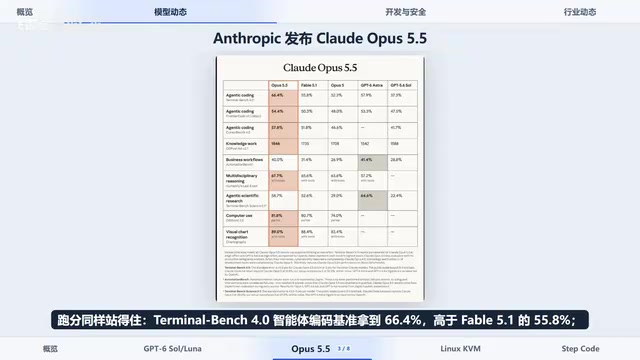
The benchmark numbers hold up well. On Terminal Bench 4.0, an agentic coding benchmark, Opus 5.5 scores 66.4%, surpassing Sonnet 5.1's 55.8%; on the GDPval knowledge work evaluation, it scores 1846 compared to 1735. On Artificial Analysis's intelligence-cost scatter plot covering 661 models, Opus 5.5 (with Fallback) sits at the top-right position on the Pareto frontier — above GPT-6 Astra's various tiers in the chart.
Notably, Opus 5.5 introduces a new constraint: the model has a built-in frontier capability classifier that automatically falls back to Opus 5 when a small set of frontier capabilities are triggered. Anthropic emphasizes that the vast majority of traditional AI development research and general coding tasks are unaffected. This mechanism reflects the safety team's deliberate trade-off between capability openness and risk control.
The Pareto Frontier is a core concept in multi-objective optimization: on an intelligence-cost scatter plot, if another model offers higher intelligence at no greater cost, or lower cost at no lower intelligence, then the original model falls off the Pareto frontier. Being on the frontier means no single other model can simultaneously beat it on both "highest intelligence for the same price" and "lowest cost to achieve the same intelligence." Opus 5.5 (with Fallback) sitting in the top-right corner means that among the 661 models tested, no other model currently surpasses it in both higher intelligence and lower cost simultaneously.
The Fallback Classifier is Anthropic's dynamic downgrade mechanism for high-risk frontier capabilities: an embedded classifier evaluates each incoming request in real time to determine whether it touches a capability category flagged as high-risk; if triggered, the request is automatically routed to the more conservative Opus 5 version with restricted capabilities. This mechanism effectively implements content-based, fine-grained access control at the API layer — without requiring users to manually select different model versions.
Moonshot AI Open-Sources StepCode, Adding Another Contender to the Coding Tool Arena
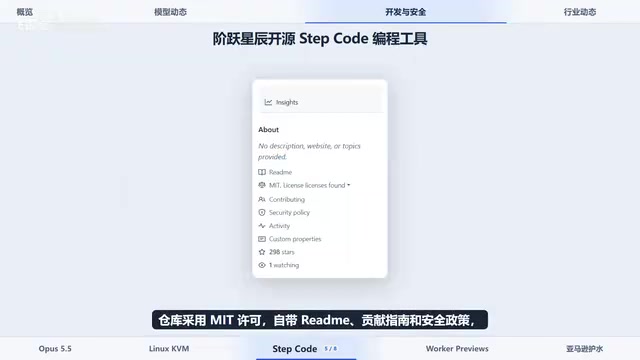
Moonshot AI has open-sourced its coding tool StepCode, hosted on GitHub under the StepFun organization. The repository is public, licensed under MIT, and includes a README, contribution guidelines, and a security policy. It has already accumulated nearly 300 stars and 26 forks shortly after launch.
From the runtime interface, StepCode is a terminal command-line tool with a window title of "StepCode" and the model labeled as "Step5 Preview High." The tips section lists examples such as Chrome scheduled tasks and Go cross-platform targets. Typing "Hi" gets an immediate response, and the bottom input prompt notes support for slash commands, file references via Add, and shell invocation. The overall form factor aligns with today's mainstream terminal AI coding tools, and the MIT license means developers are free to use and build upon it.
Cloudflare Worker Previews: An Isolated Preview Environment for Every Change
Cloudflare has introduced Worker Previews, providing an isolated preview environment — separate from production — for every code change, including changes made by AI agents.
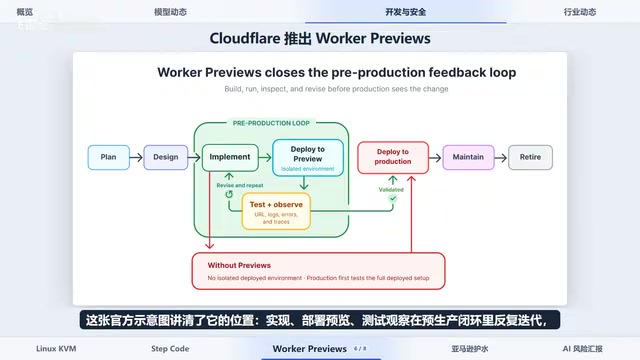
The official diagram clearly illustrates its purpose: deploy, preview, test, observe — iterate within the pre-production loop, and only push to production after validation. This design directly addresses a real pain point: without a preview environment, production is often the first to bear the full brunt of a deployment. As AI agents increasingly submit code changes autonomously, the value of isolated preview environments grows accordingly.
Linux Kernel ARM64 VM Escape Vulnerability
Another security vulnerability has surfaced in the Linux kernel. The flaw, tracked as CVE-2026-89775, exists on the ARM64 platform and allows a TX-5 CVMAd guest to read and write host kernel memory.
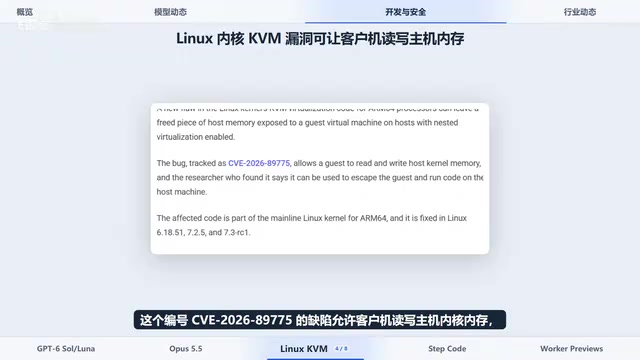
The researcher who discovered the vulnerability confirmed it can be used to escape the virtual machine and execute code on the host. A fix has already landed, distributed via the ARM64 mainline kernel and patched in versions 7.2.5 and 7.3-RC. The good news is that the trigger requirements are steep: ARM64 nested virtualization is disabled by default and requires ARMv8.4 hardware and specific feature support, limiting the actual attack surface considerably.
VM Escape is one of the most severe vulnerability classes in virtualization security: an attacker executes code inside a guest VM, exploits a flaw in the hypervisor or host kernel to break through the isolation boundary, and then reads/writes host memory or executes arbitrary code with host-level privileges. Once achieved, all other VMs on the same physical machine are at risk — particularly severe in multi-tenant cloud environments. This specific vulnerability involves Nested Virtualization on the ARM64 platform, where a hypervisor runs inside a VM (common in CVM confidential computing environments). The fact that nested virtualization is disabled by default and requires ARMv8.4 and specific hardware features significantly narrows the practical attack surface — but in compliance-sensitive or high-security cloud environments, remediation should still be prioritized.
Industry News: Amazon Water Conservation Investment and AI Safety Reaches the UN
Amazon announced a $20 million investment in water conservation efforts in the Colorado River Basin, and is leading the formation of a corporate coalition with a $100 million fundraising target. The new alliance, formally called the Colorado River Basin Partnership, has a two-year fundraising goal of $100 million, with the first two funded projects located in California and Arizona.
In an exclusive report by Reuters, multiple AI companies are set to brief the UN Security Council this week on AI risk topics, with the meeting focused on AI and international security. The lineup is significant: OpenAI's Sam Altman plans to attend in person, diplomats expect a senior Anthropic representative to be present, and DeepSeekAd, Moonshot AI, and other companies have received invitations and will deliver remarks. AI safety has officially entered the highest-level multilateral agenda, marking the field's transition from a technical topic to a global governance issue.
Related articles

A Single Prompt Triggers a Global PHP Security Storm: Is AI a Savior or a Hidden Risk?
A single AI prompt triggered a global PHP security crisis affecting Wikipedia and the Internet Archive. This article reviews the incident, analyzes the OpenAI-Amazon controversy, and explores the security paradox of lowered vulnerability discovery barriers in the AI era and developer response strategies.

When AI Is Taken Away: How Reliance on Shortcuts Undermines Your Problem-Solving Resilience
A study of 1,222 people found that after using AI to answer questions, once AI was removed, people gave up on more problems than a control group that never used AI. The article analyzes the impact of AI reliance on learning resilience and metacognition, and explores design implications for AI learning tools.

Carta and NewView Partner to Let Startup Employees Cash Out Equity Early
Carta and NewView Capital partner to simplify startup tender offers, helping employees sell equity early. Analysis of the mechanism, liquidity pain points, and impact.