GPT-Image-2.5 vs Nano Banana 2: A Practical Guide to Dual-Model Routing in Image Generation Pipelines

Route GPT-Image-2.5 and Nano Banana 2 by task—precision edits vs. extreme aspect ratios—via a unified endpoint.
A developer shares a production approach for integrating GPT-Image-2.5 (Sunburst) and Gemini 3.1 Flash Image (Nano Banana 2) into an automated image pipeline using task-based routing. Sunburst excels at edit locality, preserving reference assets across multi-round iterations without subtle drift. Nano Banana 2 handles extreme aspect ratios (up to 8:1) and offers native search grounding for factually accurate infographics. A unified endpoint eliminates redundant SDK boilerplate. The post closes with an open question: is Sunburst's fidelity reliable enough to replace traditional inpainting and ControlNet safeguards entirely?
When comparing image generation models, the instinct is to throw two new contenders into an "arena" and declare a winner. But one developer's production experience, shared on Reddit, offers a different perspective: rather than debating whether GPT-Image-2.5 (codenamed Sunburst) or Nano Banana 2 (Gemini 3.1 Flash Image) is "better," treat them as complementary tools that address different failure modes — and route tasks to each accordingly within an automated generation pipeline.
After two weeks of integration testing, the core logic of this approach is task-based routing — different generation needs get handed off to whichever model handles them best, rather than betting everything on a single model.
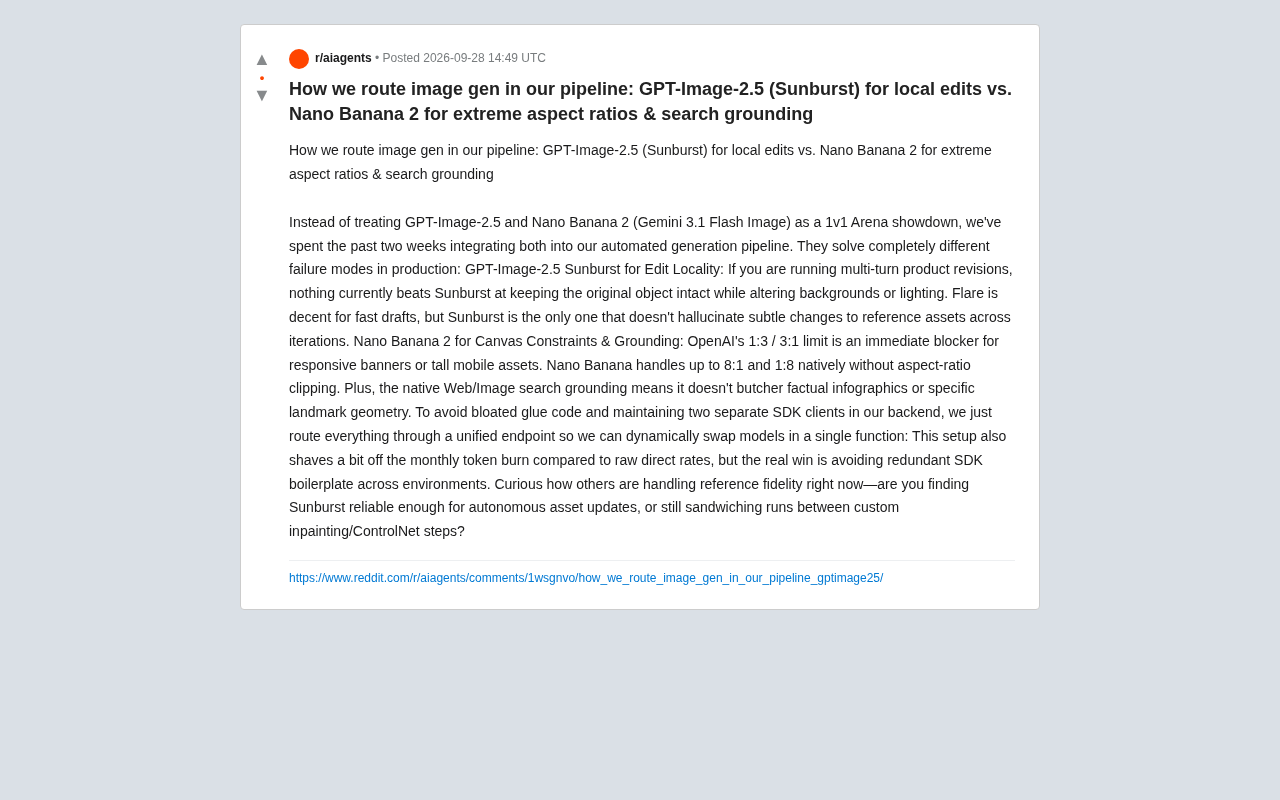
Sunburst's Strengths: Edit Locality and Reference Asset Fidelity
In multi-round product image editing workflows, Sunburst demonstrates the most consistent Edit Locality of any model currently available. Edit locality refers to the model's ability to leave the original subject completely untouched while modifying the background or lighting.
According to this developer's experience, Sunburst is the only model that doesn't introduce "subtle hallucinatory changes" to reference assets across multiple iterations of product retouching. By contrast, another model — Flare — works well for rapid drafting but isn't reliable enough for sequential iterations that require precise preservation of the original subject.
This matters enormously for automated asset updates. If a model makes imperceptible micro-adjustments to the subject on every iteration, the product image gradually drifts away from the original source material over several rounds. Sunburst's stability in this regard makes it better suited for autonomous asset modification tasks.
Edit Locality is a key quality metric for image editing models — it measures how well a model "exercises restraint" when executing a localized edit instruction. Ideally, when a user says "change the background to white," the model should only modify background pixels, leaving the product's shape, texture, color, and shadows entirely intact. However, many diffusion models perform global re-sampling across the entire image during reconstruction, causing the subject to undergo subtle deformation or texture drift — sometimes called Semantic Drift. In a single edit, this deviation may be imperceptible, but in an automated pipeline with multiple iterative rounds, accumulated errors can cause the final image to diverge significantly from the original source. The traditional fix is to layer an inpainting mask on top of the model to physically isolate the modified region. Sunburst's ability to maintain edit locality without requiring explicit masks is the core reason it stands out in automated asset maintenance scenarios.
Nano Banana 2's Strengths: Extreme Aspect Ratios and Search Grounding
Nano Banana 2 solves an entirely different class of problems: aspect ratio constraints and factual grounding.
For responsive banners or vertical mobile assets, OpenAI models' 1:3 / 3:1 aspect ratio ceiling becomes a hard blocker. Nano Banana 2 natively supports extreme ratios up to 8:1 and 1:8, generating directly at those dimensions without requiring post-processing stitching or outpainting.
More notably, it offers native Web / image search grounding. This means that when generating factual infographics or layouts requiring specific landmark geometry, the model can draw on search results to reduce "hallucinated" content. For scenes that need to accurately reproduce real building facades or precise data charts, this grounding mechanism significantly lowers the risk of factual errors.
In short: Sunburst handles precision editing, Nano Banana 2 handles scale and accuracy — and the two cover non-overlapping failure points in production environments.
Search Grounding (also called Retrieval Grounding) refers to a model's ability to perform real-time retrieval from external knowledge sources (such as web pages or image databases) during generation, using those results as contextual constraints on the output — thereby reducing hallucination. For pure language models, grounding is typically used to prevent fabrication of facts. In image generation, grounding means that when a model needs to depict a specific building's correct appearance, a real brand's actual logo, or an accurate statistical chart, it can reference real visual material rather than constructing something from scratch. This is especially important for infographics, city landmark illustrations, and science diagrams where factual accuracy matters. Models without grounding tend to produce images that are "roughly similar in shape but completely wrong in detail," while grounding effectively adds a layer of verifiable visual reference anchors to the generation process.
Unified Endpoint Routing: Cutting Boilerplate and SDK Maintenance Overhead
On the engineering side, the easiest trap when integrating two models simultaneously is maintaining two separate SDK clients on the backend — leading to a proliferation of duplicate boilerplate code and bloated glue logic.
This developer's solution was to route all requests through a single unified endpoint, enabling dynamic model switching within a single function. This eliminates the need to maintain separate SDK integrations across different environments; switching models becomes a matter of changing a single parameter.
The developer also noted that compared to calling each provider's raw rates directly, this unified routing approach shaves a small amount off monthly token costs. But in their view, the real benefit isn't cost savings — it's the elimination of redundant SDK boilerplate across environments, making the pipeline far easier to maintain.
Glue code and boilerplate are common maintenance pain points in software engineering. When a team integrates with multiple AI providers simultaneously, each typically offers a separate SDK, different authentication schemes, and varying request/response data structures — forcing the backend to maintain independent client logic, error handling, and retry mechanisms for each model. The unified endpoint routing approach is essentially an abstraction layer or API gateway that normalizes disparate vendor interfaces into a single internal standard. Business code only needs to specify "use Model A or Model B" as a parameter, without needing to know anything about the underlying SDK differences. This architecture not only reduces the marginal cost of onboarding new models, but also makes A/B testing and model fallback switching more flexible — a common engineering pattern for building scalable AI applications.
An Open Question: Is Reference Fidelity Reliable Enough?
The post closes with an open question worth discussing across the community: Is Sunburst's reference fidelity reliable enough to support fully autonomous asset updates?
Phrased another way: do we still need to wrap a custom inpainting or ControlNet step around the generation pipeline as a safety net?
This gets at a core tension in current image generation deployments: the models themselves have improved, but in an unattended automated pipeline, can we fully trust them not to go off the rails? If Sunburst's edit locality is solid enough, then traditional ControlNet precision control steps could potentially be simplified away. If it's not quite there yet, human review or an additional control layer is still needed as a backstop.
ControlNet is a diffusion model control framework introduced in 2023. By incorporating additional conditional control networks (such as edge detection maps, depth maps, or pose skeletons), it enables generated outputs to structurally conform to reference inputs with much greater precision than text prompts alone. Inpainting (also called local redrawing) marks specific regions of an image as "to be filled," with the model regenerating only those regions while leaving everything else pixel-perfect. Both techniques have long served as the primary safety nets in automated image pipelines for ensuring "what shouldn't change, doesn't change." As end-to-end models like Sunburst improve their edit locality, a natural engineering question arises: are extra ControlNet/Inpainting steps still necessary? Removing them simplifies the pipeline and reduces latency, but if the model experiences occasional semantic drift, there's no last line of defense. This is the quintessential reliability-vs-complexity tradeoff that engineering teams face today as they move from "assisted generation" toward "fully autonomous generation."
Takeaways
The lesson from this practice is clear: when dealing with generation models of varying capabilities, task-based routing is usually a better fit for production needs than picking a single winner. Sunburst handles precision editing tasks requiring high-fidelity asset preservation; Nano Banana 2 takes on extreme aspect ratios and scenarios requiring factual grounding; and a unified endpoint reduces engineering maintenance overhead.
For teams building automated image pipelines, rather than agonizing over which model is comprehensively "better," the more productive starting point is to map out your actual failure modes — and then put the right model in the right place.
Related articles

iPhone Duo Hands-On: Is the $2,000 Small-Screen Foldable Worth It?
YouTube's Allison shares her iPhone Duo hands-on: dual-screen multitasking doubles efficiency, great video viewing, nice matte finish—but thick body, small outer screen, and a $2,000 luxury price.

Sentry's Ad Cracks Up Developers: Can On-call Actually Be Fun?
Sentry's ad short film taps into developers' on-call anxiety, using humorous dialogue to showcase its observability platform—errors, logs, traces, metrics, replays, and releases in one place.

LLM App Getting Worse With Every Change? Build an Effective Evaluation System in Three Steps
How do you know if your LLM app is getting better or worse? A Reddit-based guide to test sets, automated regression evaluation, LLM-as-judge scoring, and structured agent tracing.