GPT Image 2 Generates APP Interfaces from Scratch — A Paradigm Revolution in AI Front-End Development

AI achieves breakthrough advances in image generation, robotics, inference architecture, and more.
This article covers major AI developments: GPT Image 2 achieves extreme photorealism in UI design and text rendering; Amap open-sources ABOT, an AGI-level robotics system bridging the sim-to-real gap; ZJU's Cloud GUI unifies GUI Agent training, evaluation, and deployment; Moonshot AI's Pre-Fill/Decode decoupled architecture dramatically boosts inference efficiency; HUST's depth attention mechanism breaks a decade of residual network dogma; Jensen Huang rebuts TPU threats emphasizing CUDA's moat; Anthropic launches dimensionality reduction strikes on vertical SaaS; and LLM interpretability research falsifies the "language determines thought" hypothesis.
GPT Image 2: Image Generation Passes the Turing Test for UI Design
OpenAI's latest image generation model, GPT Image 2, recently launched a quiet gray-scale test on LM Arena, and the results are nothing short of explosive. It can generate Korean diary entries and dense Chinese dictionary pages with zero garbled characters, and reproduce screenshots from GTA6, Minecraft, and other games pixel-for-pixel — down to the status bar details. Even more stunning, its generated Windows desktops and LinkedIn-style web UIs have reached an extreme level of photorealism.
GPT Image 1.5 has already been integrated into Codex, meaning AI image generation has officially crossed the "Turing test" for typography and UI design. Combined with Codex's end-to-end coding capabilities, front-end developers no longer need to create wireframes before converting them to code — they can generate high-fidelity UI assets directly in Codex with prompts and handle interaction logic on the spot. This completely reshapes the "Vibe Coding" development experience.
Previous AI image generators were essentially illiterate — every piece of text they drew looked like hieroglyphics. Now, these models render text with printing-press precision and can even conjure up a clickable APP interface from thin air, essentially coming equipped with the brain of a senior UI designer.
Amap Open-Sources ABOT: An AGI-Level Full-Stack Robotics Technology System
Amap has just open-sourced ABOT, the world's first AGI-oriented full-stack robotics technology system. Its foundational architecture, ABOT World 14B-DIT, leverages tens of millions of real spatiotemporal data points and 3DGS technology to build a differentiable digital twin factory with physical properties like mass and friction, incorporating a physics discrimination mechanism. The middle layer handles cross-embodiment navigation and manipulation, while the upper layer uses a centralized Harness architecture as the execution hub.
This system leads comprehensively in physics compliance, action controllability, and zero-shot generalization, directly breaking through the "Sim-to-Real" gap and data scarcity challenges in robot training. Amap leverages the massive semantically-rich road network data and physical constraints from its mapping business, enabling models to learn general physical laws like causal reasoning in simulation rather than simply fitting pixels.
Think of it as building an incredibly realistic driving school inside the Matrix — a robot can crash ten thousand times inside and the experience still transfers to the real world, eliminating the need to risk destruction while slowly learning to walk on actual roads.
ZJU's Cloud GUI: Ending the Fragmentation in GUI Agent Research
The ZJUNLP team at Zhejiang University has released Cloud GUI, a toolchain covering the entire lifecycle of GUI Agents. On the training side, it introduces a Process Reward Model (PRM) to solve the pain point of sparse rewards in long sequences. On the evaluation side, it achieves a reproduction rate of up to 95.8% across six benchmarks. On the deployment side, it directly supports natural language control across real Android and iOS devices.
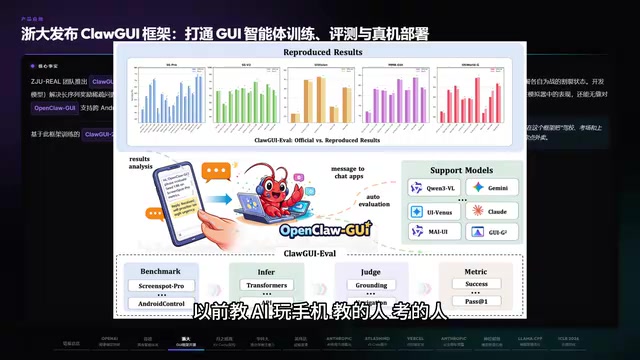
The Cloud GUI 2B model trained on this framework soared to a 17.1 success rate on the MobileWorld benchmark, leaving the 11.1 baseline far behind. This definitively ends the current fragmentation in GUI Agent research where training, evaluation, and deployment each operate in isolation. Previously, teaching AI to use a phone was like having completely different people for teaching, testing, and actual usage. Now this framework covers driving school, the exam venue, and real roads all in one — AI doesn't just know how to ace the test, it can actually order food delivery on your phone.
Moonshot AI's Pre-Fill/Decode Decoupled Architecture: Shattering the Physical Shackles of Compute
Moonshot AI, in collaboration with Tsinghua University, has proposed the Pre-Fill as a Service (Pre-FaaS) architecture. Thanks to hybrid attention architectures like KMin Linear, KV Cache throughput is reduced by over 10x. Now, only standard Ethernet is needed to break through RDMA network bandwidth limitations, enabling cross-region and cross-heterogeneous-cluster decoupling of Pre-Fill and Decode.
On an ET-parameter model, this architecture not only boosts throughput by 54% but also reduces P90 Time-to-First-Token (TTFT) by 64%. This completely shatters the engineering constraint that "reading the question and answering must be physically bound to the same data center." The system can dynamically schedule compute based on bandwidth and hardware type — for example, having H200s handle long-context Pre-Fill while H20s handle Decode, flexibly distributing workloads across cities or even continents, driving token costs straight down.
Previously, for long-context inference, reading and answering had to happen in the same room because the intermediate "draft" was too thick to move. Now Kimi has compressed that draft into a tiny slip of paper — even if the reading machine is in Beijing and the answering machine is in Shanghai, they can collaborate instantly.
Flash Depth Attention: Breaking a Decade of Deep Learning Dogma
Wang Xinggang's team at Huazhong University of Science and Technology has dropped a bombshell — Flash Depth Attention and the Mode A mechanism. They directly challenge the additive communication paradigm that traditional deep residual networks (X+F(X)) have used for years, radically modifying GPU layouts from both software and hardware levels so that each attention head can simultaneously attend to tokens along the sequence dimension and historical layer states along the depth dimension under a single Softmax.

This breaks a decade of deep learning dogma — "the deeper the network, the more severe information dilution becomes." Models no longer passively accumulate noise layer by layer but learn to actively query past layers for original information, completing a fundamental paradigm shift from "passive addition" to "active retrieval." Traditional residual networks are like a game of telephone — by the 100th person, the message is completely garbled. Depth attention lets the 100th person pull out their phone and precisely scroll back to person #3's chat history, with zero information loss.
Jensen Huang's Hardcore Rebuttal to the TPU Threat Narrative
In a recent lengthy podcast interview, Jensen Huang delivered a hardcore rebuttal to the market's infatuation with ASIC chips, emphasizing that TPUs fundamentally cannot threaten NVIDIA. The reason is fatal: they lack the universal programmability — the CUDA ecosystem — needed to support the invention of new architectures (like hybrid SSM/MoE).
Huang also candidly admitted one regret: back then, he didn't realize that establishing foundational research labs required a tens-of-billions-dollar funding threshold, causing him to miss the opportunity to invest heavily in OpenAI and Anthropic early. But he reaffirmed that NVIDIA will stick to "only doing what must be done" and will never enter the hyperscale cloud provider business.
NVIDIA's ultimate moat isn't the hardware itself — it's the extreme freedom it grants AI labs to experiment and invent new algorithms. Specialized chips are like bullet trains that can only run in straight lines, while NVIDIA's GPUs are universal racing machines that can be retrofitted into off-road vehicles or submarines at any time. In the AI world, where nobody knows what algorithm will be trending tomorrow, "universal" is the ultimate survival card.
Anthropic Launches a Dimensionality Reduction Strike on Vertical SaaS
Open-source developer Simon Willison dug into Claude Opus 4's latest system prompts and found newly added "Claude in PowerPoint" tool permissions and a Tool Search retrieval mechanism. With the release of Claude Design, the industry widely believes Figma is facing an extremely serious existential crisis — its massive base of non-professional designer users is highly vulnerable to being directly absorbed by Claude's high-resolution visual generation and brand alignment capabilities.
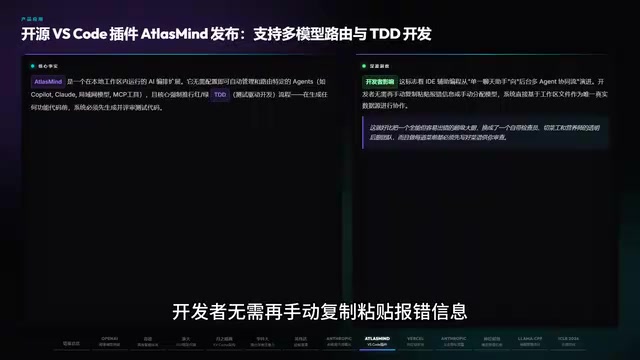
Anthropic is leveraging the overflow of its foundational reasoning capabilities to execute a precision dimensionality reduction strike against the moats of vertical SaaS products. When an LLM has high visual resolution, native tool invocation, and can directly pull enterprise design guidelines, the barriers that traditional collaboration software relies on for survival will crumble. When you can simply shout at an AI assistant and receive a complete set of polished PPTs and design assets, who would still pay a monthly subscription to learn software with interfaces as complex as an airplane cockpit?
LLM Interpretability Research: Falsifying "Language Determines Thought"
A recent model interpretability study covering multiple architectures including Qwen 2.5 and Gemma 4 has reached a stunning conclusion: in the middle layers of Transformers, different languages representing the same concept (such as Hindi and Japanese), and even entirely different modalities (such as Python code 0.5*m*v**2 and LaTeX formula $E=\frac{1}{2}mv^2$), eerily converge to the same geometric region in the internal vector space.
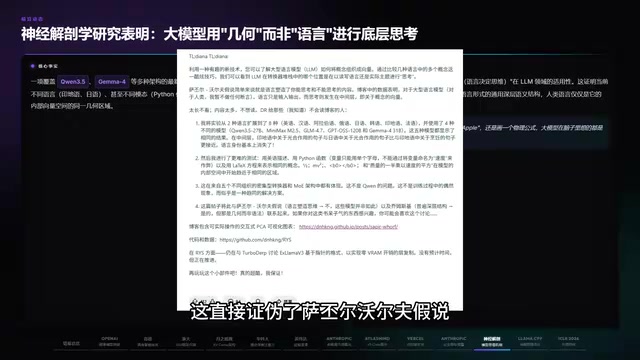
This directly falsifies the applicability of the Sapir-Whorf hypothesis ("language determines thought") in the LLM domain. It proves that current large models have constructed a universal deep semantic structure that transcends surface linguistic forms — human language is merely an I/O interface to them. Whether you say "苹果" in Chinese, write "Apple" in English, or express a physics formula, the model is thinking about the same shiny red fruit in its "mind."
Other Noteworthy Developments
Llama.cpp Merges Speculative Checkpointing: The on-device LLM inference powerhouse llama.cpp has officially merged the Speculative Checkpointing PR. Relying on N-gram prediction, it squeezes out 0% to 50% inference speed improvements when handling repetitive patterns or code generation tasks, further pushing the hardware limits of on-device inference.
ICLR 2026 Open-Source Rate Remains Strong: Among 5,300+ top-tier papers, approximately 1,200 (about 22%) have published corresponding GitHub repositories, datasets, or demo links. In an era dominated by closed-source large models and compute hegemony, academia maintains an exceptionally high open-source rate — this is the most solid defense line preventing the entire industry from being completely monopolized by a handful of giants.
Vercel Suffers Security Breach: The well-known cloud computing and front-end hosting platform Vercel has confirmed a security breach. This incident serves as yet another warning: the more cutting-edge the Serverless infrastructure adopted, the more devastating the blast radius when a single point of failure occurs.
Claude Enterprise Compliance API Warning: Claude's enterprise version includes a free and easily activated Compliance API. Once an enterprise admin enables it, they can programmatically extract all employees' complete chat histories and uploaded files — even if you're using "incognito mode." So-called incognito merely means data won't be sent back to Anthropic for training, but it's completely transparent to your employer's internal monitoring.
Related articles
 Tech Frontiers
A Rare Quiet Day in AI: Recursive Self-Improvement Stirs Beneath the Surface
A rare quiet day in AI sees multiple sources go silent simultaneously. Behind the calm, Recursive Self-Improvement (RSI) research continues. What this means for the industry.
 Tech Frontiers
Reve 2 vs. Ideogram 4: A Deep Dive into Layout Control in AI Image Generation
A deep comparison of Reve 2 and Ideogram 4's layout control capabilities, covering technical approaches, real-world use cases, and industry trends for designers and creators.
 Tech Frontiers
In the Weights: Check Your Influence Score in the AI World
In the Weights is an AI influence search engine that quantifies your presence in the AI world with a score. Explore how it evaluates practitioners and what it means for digital identity.