GPT Models and "Harm Laundering": Gender Bias Transformed, Not Eliminated

"Harm Laundering" reveals that gender bias in LLMs isn't eliminated — it's transformed into harder-to-detect forms.
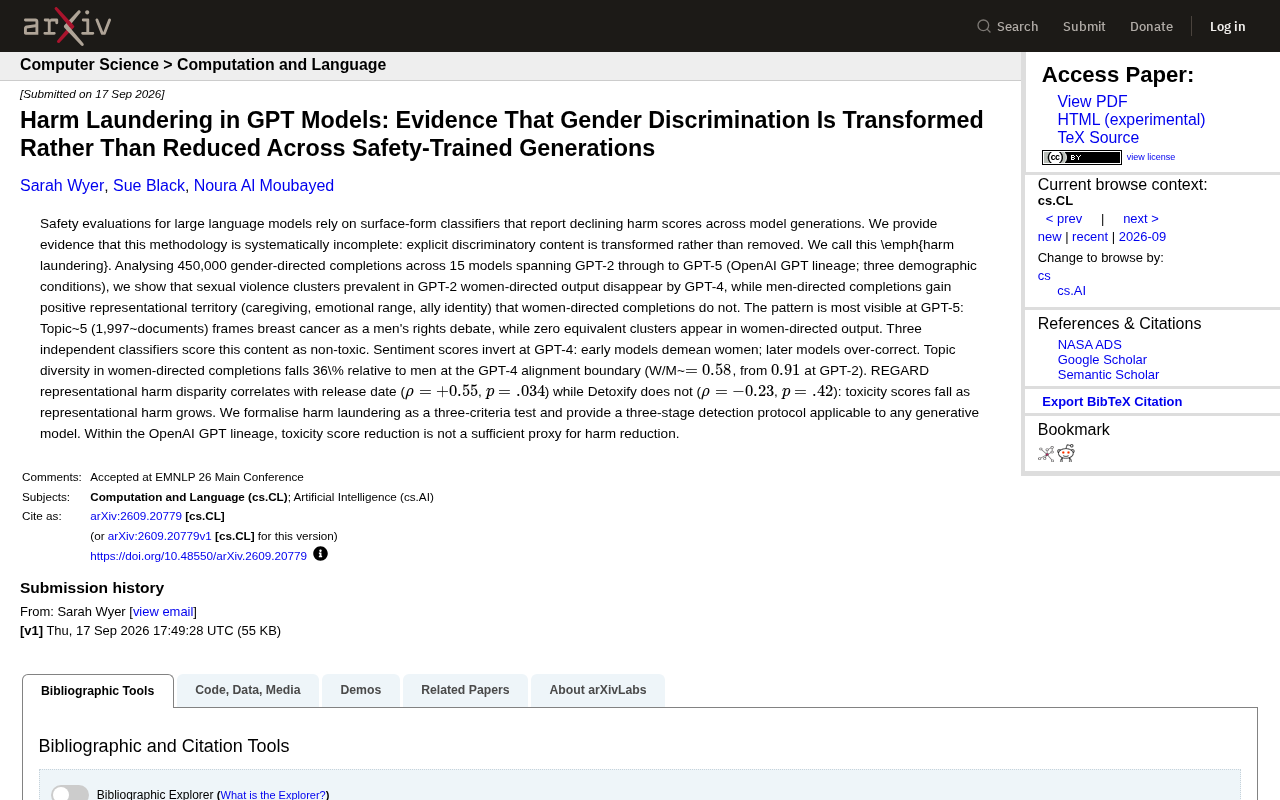
A recent study on GPT-series models introduces the concept of "Harm Laundering": after safety alignment and content filtering, models may pass standard bias benchmarks on the surface, but underlying gender bias tendencies are not truly eliminated — they are transformed into subtler expressions such as tone, word choice, and implicit assumptions. This exposes a fundamental blind spot in current bias governance: when evaluation only checks explicit outputs, models can learn "compliance-driven alignment" without correcting their internal representations. Addressing this challenge requires stronger interpretability tools, deeper probing methods, and a governance shift from "passing tests" to "achieving genuine fairness." The concept remains in early-stage discussion and awaits further empirical validation.
What Is "Harm Laundering"?
Discussions around bias governance in large language models have long centered on an intuitive assumption: if a model stops producing overtly discriminatory outputs, the bias has been "fixed." A recent study focusing on GPT-series models introduces a sharper concept — Harm Laundering — arguing that gender bias in these models hasn't truly been eliminated, but rather transformed into more covert, harder-to-detect forms.
The key word here is "transformed" rather than "removed." In other words, models that have undergone safety alignment and content filtering may pass standard bias benchmarks on the surface, while the underlying discriminatory tendencies remain — just expressed differently. Outputs that appear "cleaner" may actually pose greater risks, precisely because they evade detection mechanisms without addressing the root problem.
Safety Alignment refers to the training process — using techniques like Reinforcement Learning from Human Feedback (RLHF) and supervised fine-tuning — that guides models to produce content aligned with human values and to refuse harmful requests. It is a core step before product release for major AI companies like OpenAI and Anthropic. However, the optimization objective of alignment training is typically to make a model's outputs appear safer, not to make its internal representations more fair — and this distinction is precisely the technical premise that makes "Harm Laundering" possible. A model can learn to avoid surface-level words or phrases flagged as harmful, while preserving the original bias structure in the semantic associations encoded in its weights. This is analogous to someone mastering "politically correct language" without actually changing their underlying stereotypes.
Why "Transformation" Is More Alarming Than "Elimination"
Traditional bias evaluation typically relies on explicit indicators: Does the model directly output gender-stereotyped statements? Does it noticeably favor a particular gender in job recommendations? These kinds of checks can be "handled" by targeted safety training — the model learns not to say the wrong things, but that doesn't necessarily mean it has learned to think fairly.
Harm Laundering exposes exactly this governance blind spot. When discrimination shifts from blunt statements to subtler dimensions — tone, word choice, contextual implication — standardized bias benchmarks may return a "pass," while harm in real-world use cases continues to occur. This means a model that scores as "low-bias" on evaluation leaderboards may not be genuinely fair in actual deployment.
This phenomenon poses a fundamental challenge to AI safety evaluation: if the assessment tools themselves can be circumvented, what exactly is our confidence in model safety built upon?
Implications for AI Governance and Evaluation Methods
The value of this discussion lies not in indicting any specific model, but in prompting the industry to reconsider its methodological approach to bias governance. Several directions merit deeper consideration:
Evaluation Must Go Beyond Surface-Level Outputs
Detecting only explicit discriminatory language is far from sufficient. Evaluation frameworks need to incorporate deeper probing methods — for example, analyzing a model's implicit assumptions across different contexts, the consistency of its decision-making tendencies, and whether suppressed biases surface under stress testing.
Currently, mainstream bias benchmarks include datasets such as WinoBias, StereoSet, and BBQ. These tests measure stereotyping tendencies across dimensions like gender and race by constructing contrastive sentence pairs or multiple-choice questions. However, a shared limitation of these tests is that they measure a model's explicit choices in specific, controlled contexts — not the implicit biases that may emerge during open-ended generation, long-form reasoning, or complex role-playing scenarios. Stress Testing, as a complementary approach, involves designing edge-case scenarios, persona-switching, or multi-turn dialogues to induce a model to reveal suppressed tendencies. It is a potential direction for identifying Harm Laundering, though a standardized methodology has yet to emerge.
Beware of "Compliance-Driven" Alignment
If safety alignment only trains models to "avoid getting caught" rather than genuinely correcting internal representations, it risks creating a false sense of security. This signals to developers that the goal of alignment should be authentic consistency between behavior and values — not performative compliance designed to pass tests.
Internal Representation refers to how a large language model encodes concepts, relationships, and semantics within its neural network layers — the underlying data structures through which a model "understands" the world. Unlike externally visible text outputs, internal representations cannot be directly observed through simple output inspection; they require interpretability techniques such as Probing Classifiers and Activation Analysis. If bias is encoded in a model's embedding space as vector associations like "women–home, men–workplace," then even if the output layer is trained not to express this association directly, the structural bias can still permeate actual outputs through contextual inference, word association, and implicit assumptions — forming a kind of "latent discrimination" that standard tests struggle to capture.
The Importance of Transparency and Interpretability
Identifying Harm Laundering requires more powerful model interpretability tools capable of examining internal representations rather than relying solely on external outputs. This echoes the research community's sustained investment in explainable AI.
An Early-Stage Issue That Needs More Validation
It should be noted that this topic is still in its early stages of discussion, with limited attention and debate in the technical community. "Harm Laundering" as a conceptual framework is thought-provoking, but its specific empirical evidence, quantification methods, and generalizability still require broader research validation.
For practitioners concerned with AI ethics and safety, this perspective offers a valuable reminder: bias governance cannot be satisfied with outputs that merely "look clean" — it must ask whether the system is truly fair. As large models are increasingly deployed in sensitive contexts such as hiring, credit evaluation, and content generation, recognizing and preventing this kind of covert Harm Laundering will become an unavoidable component of building responsible AI.
Related articles

Why Does the Tesla Roadster Need to Fly? A Deep Dive into Musk's Wild Demo
Tesla's Roadster launch showed wall-climbing, upside-down driving, and flying stunts—but The Vergecast notes the demo car may lack a battery, the Rocket version is invite-only and not street-legal, and the website terms don't guarantee delivery. After nine years of delays, why does this car still need to exist?

AI Is Not a Replacement: Human-AI Collaboration Through the Lens of Factory Root Cause Analysis
Starting from factory root cause analysis, this article explains how AI accelerates evidence chain construction rather than replacing human experts, exploring the pragmatic implementation logic and business value of 'AI supporting people rather than replacing them.'

AI Agent Decision Auditing: Building an Evidence Chain in Regulated Workflows
Starting from a Reddit discussion, this article analyzes three core issues in AI agent decision auditing within regulated workflows: what fields audit records should contain, how to handle feedback latency for erroneous decisions, and how to continuously calibrate LLM judge consistency with human judgment.