GPT-OSS-20B Private Deployment Guide: Hardware Selection + Deployment Process + Performance Testing

Complete private deployment guide for OpenAI's open-source GPT-OSS-20B model
OpenAI open-sourced GPT-OSS-20B and 120B models. This guide details the 20B model's private deployment, requiring only 16GB VRAM and fully compatible with the OpenAI API spec for minimal migration effort. It covers GPU selection, model download, API configuration, and real-world performance, while analyzing the core value of private deployment for data security and cost control in high-frequency usage scenarios.
OpenAI recently open-sourced two large language models—GPT-OSS-20B and GPT-OSS-120B—sending ripples through the developer community. For teams looking to run large models locally or within private networks, this is a rare opportunity. This article walks you through the entire process of privately deploying GPT-OSS-20B, from hardware selection and deployment steps to real-world performance results.
OpenAI's Shift in Open-Source Strategy
OpenAI's release of the GPT-OSS series marks a significant strategic pivot. Long known for its closed-source commercial approach—in stark contrast to open-source players like Meta's LLaMA series and Mistral—OpenAI's move is widely interpreted as a response to increasingly fierce competition in the open-source ecosystem. As open-source models like DeepSeek and Qwen continue to close the performance gap with closed-source alternatives, OpenAI needs open-source releases to solidify its developer ecosystem and technical influence. Open-source models allow developers to freely download weight files and run them locally without relying on cloud APIs—a game-changer for enterprises and research institutions with data sovereignty requirements.
GPT-OSS-20B Model Overview & Hardware Requirements
Why Choose GPT-OSS-20B?
OpenAI open-sourced two model sizes: 20B (20 billion parameters) and 120B (120 billion parameters). For individual developers and small-to-medium teams, the 20B version already covers most business scenarios while remaining remarkably hardware-friendly.
According to the official documentation, the minimum hardware requirements for running GPT-OSS-20B are:
- VRAM: At least 16GB
- RAM: At least 4GB available
- Model file size: Approximately 41.3GB (download takes some time)
Relationship between parameter count and VRAM: A large model's VRAM usage is directly related to its parameter count and data precision. In FP16 (half-precision floating point) format, each parameter occupies 2 bytes, so a 20B parameter model theoretically requires about 40GB of storage. However, during actual inference, quantization techniques (such as INT8 or INT4) can dramatically compress the model size—INT4 quantization can reduce VRAM requirements to one-quarter of the original. The fact that GPT-OSS-20B can run on 16GB of VRAM indicates that the official release includes a quantization-optimized version. While quantization introduces minimal precision loss, it has virtually no impact on output quality in most application scenarios.
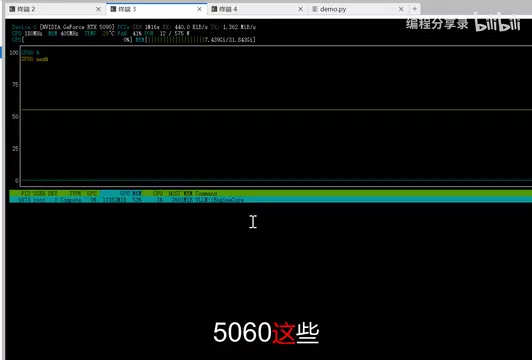
In our testing, running the model on an RTX 5090 (32GB VRAM), GPU memory usage stayed around 50% (approximately 53%), with system RAM usage at about 2.5GB. In other words, a GPU with 16GB of VRAM can absolutely handle it.
GPU Selection Comparison
Choosing the right GPU is the first step in private deployment. Here are recommendations by use case.
Consumer GPUs (Individual/Small Teams):
- RTX 5070/5080: 16GB VRAM, ample performance, mainstream choice
- RTX 4070 Ti Super: 16GB VRAM, excellent price-to-performance ratio
- RTX 2080 Ti Modified Version: 22GB VRAM, approximately $350/card, a high-value option for tight budgets
- RTX 5060: 12GB or 16GB version (confirm specific specs)
Regarding the RTX 2080 Ti modified version, a special note is warranted: the "modified version" refers to aftermarket products where the original 11GB VRAM has been expanded to 22GB by replacing memory chips. The principle involves utilizing pre-reserved memory soldering positions on the PCB, replacing the original 1GB chips with 2GB chips (such as Samsung K4ZAF325BM), thereby doubling capacity without changing the memory bus width. These products mainly come from electronics markets like Shenzhen's Huaqiangbei, priced far below new cards with equivalent VRAM capacity. However, be aware that modified cards carry some stability risks and don't come with official warranty—they're suitable for users on extremely tight budgets who have some hardware troubleshooting capability.
Data Center GPUs (Enterprise Deployment):
- Tesla T4: Relatively affordable, suitable for budget-constrained scenarios
- Tesla V100: Available in 16GB and 32GB versions, used prices around $280-$420
- A100: 40GB or 80GB versions, maximum performance but premium pricing
While consumer GPUs (like the RTX series) and data center GPUs (like Tesla/A100 series) are both based on NVIDIA GPU architecture, they differ fundamentally in design goals. Data center GPUs typically feature larger VRAM capacity, ECC error-correcting memory, higher double-precision compute capability, and NVLink high-speed interconnect support. The Tesla V100, based on the Volta architecture, has dedicated Tensor Cores for matrix computation acceleration, and its HBM2 memory bandwidth can reach 900GB/s—far exceeding the GDDR6X of consumer GPUs. However, consumer GPUs often offer better single-precision performance and price-to-performance ratios, with a more mature driver ecosystem, making them suitable for small-to-medium scale deployments.
Hardware Requirements for GPT-OSS-120B
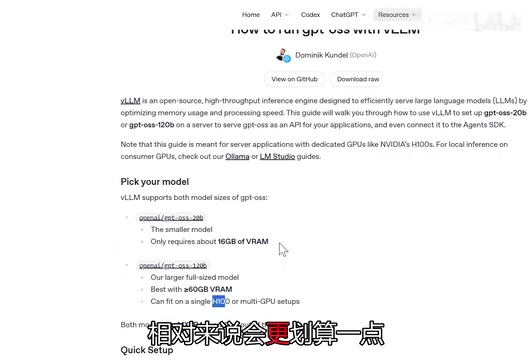
If your business demands stronger inference capabilities, the 120B model is the better choice, though hardware requirements scale up significantly. The official documentation explicitly requires at least 60GB of VRAM. Here are your options:
| Option | GPU Configuration | Estimated Cost |
|---|---|---|
| Single GPU | A100 80GB × 1 | High |
| Dual GPU | RTX 5090 32GB × 2 | ~64GB VRAM |
| Dual GPU | V100 32GB × 2 | ~$840, best value |
| Triple GPU | RTX 4090 24GB × 3 | ~72GB VRAM, but high total cost |
Considering cost and availability, the dual V100 32GB setup is the most cost-effective route for deploying the 120B model—two cards totaling around $840 provide 64GB of VRAM. In multi-GPU deployment, the model distributes different network layers across GPUs using Tensor Parallelism technology, which requires high-speed inter-GPU communication. NVLink interconnect offers higher bandwidth than PCIe, but even with PCIe connections, the performance impact for inference scenarios remains within acceptable range.
GPT-OSS-20B Deployment Walkthrough
Step 1: Download the Model Files
The total model file size is approximately 41.3GB. Choosing the right download source can save considerable time:
- Users in China: ModelScope is recommended for faster domestic network access speeds
- International users: Download directly from HuggingFace
HuggingFace is the world's largest AI model hosting platform, with over 500,000 open-source models and datasets—often called the "GitHub of AI." However, due to network restrictions, users in China often face slow speeds or connection failures when accessing HuggingFace. ModelScope is a domestic alternative launched by Alibaba's DAMO Academy, offering model hosting, download acceleration, and online demos, with servers deployed within China where download speeds typically reach tens of MB/s. Model formats on both platforms are largely compatible, allowing developers to choose their download source based on network conditions.
Step 2: Configure the API Service
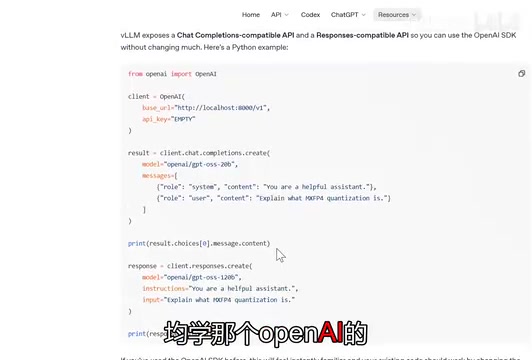
GPT-OSS-20B is compatible with OpenAI's API interface specification, listening on port 8000 by default after deployment. This means your existing applications built on the OpenAI API can connect with virtually zero code changes.
Technical significance of API compatibility: GPT-OSS-20B's compatibility with the OpenAI Chat Completions API specification means it follows the same request/response JSON structure, including the messages array (with system, user, and assistant roles), temperature, max_tokens, and other parameters. This compatibility is enabled by open-source inference frameworks like vLLM and llama.cpp, which provide HTTP service endpoints matching the OpenAI API format. For developers, this means existing integration code from frameworks like LangChain and LlamaIndex, as well as various AI Agent applications, can seamlessly switch by simply modifying the base_url to point to the local service address—dramatically reducing migration costs.
There's one critical detail to note:
# For intranet deployment, the model path must use an absolute path
# rather than a model ID, to prevent the system from attempting to download online
model_path = "/your/local/path/to/gpt-oss-20b"
Common pitfall: When deploying in an intranet environment, the model field must contain the local absolute path, not the model ID. Otherwise, the system will attempt to fetch the model file online and throw an error in isolated networks.
The API supports authentication via API Key, with a request structure containing system prompts and user messages—fully compatible with the OpenAI Chat Completions API.
Real-World Performance: How Does GPT-OSS-20B Actually Run?
We conducted multiple rounds of testing with GPT-OSS-20B on an RTX 5090. Here are the results:
- Response speed: Output generated within 1-2 seconds, smooth experience
- Resource usage: GPU VRAM usage at ~53%, RAM usage at ~2.5GB, leaving ample headroom
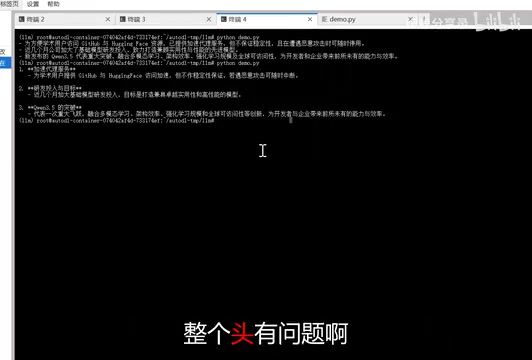
- Task performance: Good quality on text summarization, information extraction, and structured content organization
A 20-billion-parameter model is more than sufficient for common enterprise scenarios, including document summarization, intelligent Q&A, and content generation.
Core Value of Private LLM Deployment
Data Security: Intranet Operation Eliminates Leakage Risks
The core value of private deployment is data security. For government agencies, banks, and other financial institutions, keeping data within the internal network is a hard requirement. Deploying a large model locally means all Q&A interactions happen within the intranet without passing through public networks, eliminating data leakage risks at the source.
Enterprise intranet LLM deployment typically adopts physical isolation or logical isolation network architectures. Physical isolation (air-gapped) means the deployment server has absolutely no internet connection, with all data transfer occurring through internal networks. This architecture is a mandatory compliance requirement in finance, defense, and government sectors—China's Classified Protection 2.0 Level 3 standard explicitly requires core business systems to be physically isolated from the internet. In such environments, model files must be imported via offline media (such as encrypted hard drives), inference services are exposed to business systems through intranet IPs and ports, and all logs and data are stored within intranet storage, ensuring end-to-end data stays within the domain.
Cost Advantages: Significant Savings in High-Frequency Usage Scenarios
Compared to calling cloud APIs, private deployment offers significant cost advantages in high-frequency usage scenarios:
- Cloud APIs: Billed per token—the more calls you make, the higher the cost. Especially in today's booming AI Agent scenarios, daily token consumption can easily reach millions
- Local deployment: After the one-time hardware investment, ongoing operational costs are mainly electricity—ideal for high-volume workloads
Token Consumption Analysis in AI Agent Scenarios: AI Agents are a hot paradigm in current LLM applications, completing complex tasks through multi-step reasoning, tool calling, and self-reflection. Unlike simple single-turn Q&A, a single Agent task may involve 5-20 or more LLM calls: including task planning, information retrieval, result verification, and error correction. Each call consumes hundreds to thousands of tokens, and with accumulated conversation history in the context window, a single Agent task's total token consumption can reach tens of thousands. At GPT-4o's API pricing (~$2.5/million input tokens), an enterprise processing 1,000 Agent tasks daily could face monthly API bills of tens of thousands of dollars—making the economic advantage of local deployment increasingly apparent.
Taking AI Agent applications as an example, each task typically requires multiple rounds of LLM calls, with token consumption multiplying accordingly. Replacing the underlying model with a locally deployed GPT-OSS-20B can yield considerable long-term savings.
Conclusion: Who Should Deploy GPT-OSS-20B?
For developers looking to explore local LLM deployment, GPT-OSS-20B is a highly practical starting point: it runs on 16GB of VRAM, has a low deployment barrier, and is fully compatible with the OpenAI API specification for minimal migration costs.
- Budget-conscious: A single RTX 4070 Ti Super or modified RTX 2080 Ti (~$350) can run a 20-billion-parameter model locally
- Need more power: Two V100 32GB cards (totaling ~$840) can deploy the 120B version for enterprise-grade intelligence
As AI capabilities continue to proliferate, private deployment is becoming an increasingly pragmatic choice for enterprises and developers alike. If you have data security requirements or high API call volumes, consider starting with GPT-OSS-20B as your first step into local deployment.
Related articles
 Tutorials
ChatGPT Plus Subscription Guide: Are GPT-5.5, image-2, and Codex Worth the Upgrade?
A detailed look at ChatGPT Plus features — GPT-5.5, image-2, and Codex — with a Plus vs Pro comparison and a complete step-by-step subscription guide for users outside the US.
 Tutorials
Harness AI Engineering in Practice: Using Claude Code to Master Enterprise-Level E-Commerce Development
Deep dive into Harness AI Engineering: master enterprise e-commerce development with Claude Code using the Rules, Skills, Wiki, and Changes framework.
 Tutorials
Cursor + Codex Dual-IDE Collaboration: A Practical Methodology for Open-Source Project Customization
A complete methodology for open-source project customization based on real-world experience, detailing the Cursor+Codex dual-IDE workflow, seven-stage process, MVP validation, and AI source code reading techniques.