gpyou: A CLI Tool to Rent the World's Cheapest GPU with One Click

gpyou aggregates global GPU clouds via one CLI, auto-comparing prices to rent the cheapest instance and switch when sold out.
gpyou is a Product Hunt developer tool that aggregates global GPU cloud resources through a single CLI, scans provider inventory and prices in real time, automatically rents the cheapest available instance, and switches to the next best option when it is taken. Dubbed the "OpenRouter of compute," it uses prepaid credits with per-second billing for short-term fine-tuning, elastic inference, and containerized tasks. Developed by Robert Keus, it earned 83 votes and ranked 12th on Product Hunt. It addresses price volatility and unstable inventory, but cross-cloud migration overhead, performance transparency, and prepaid fund safety remain key variables.
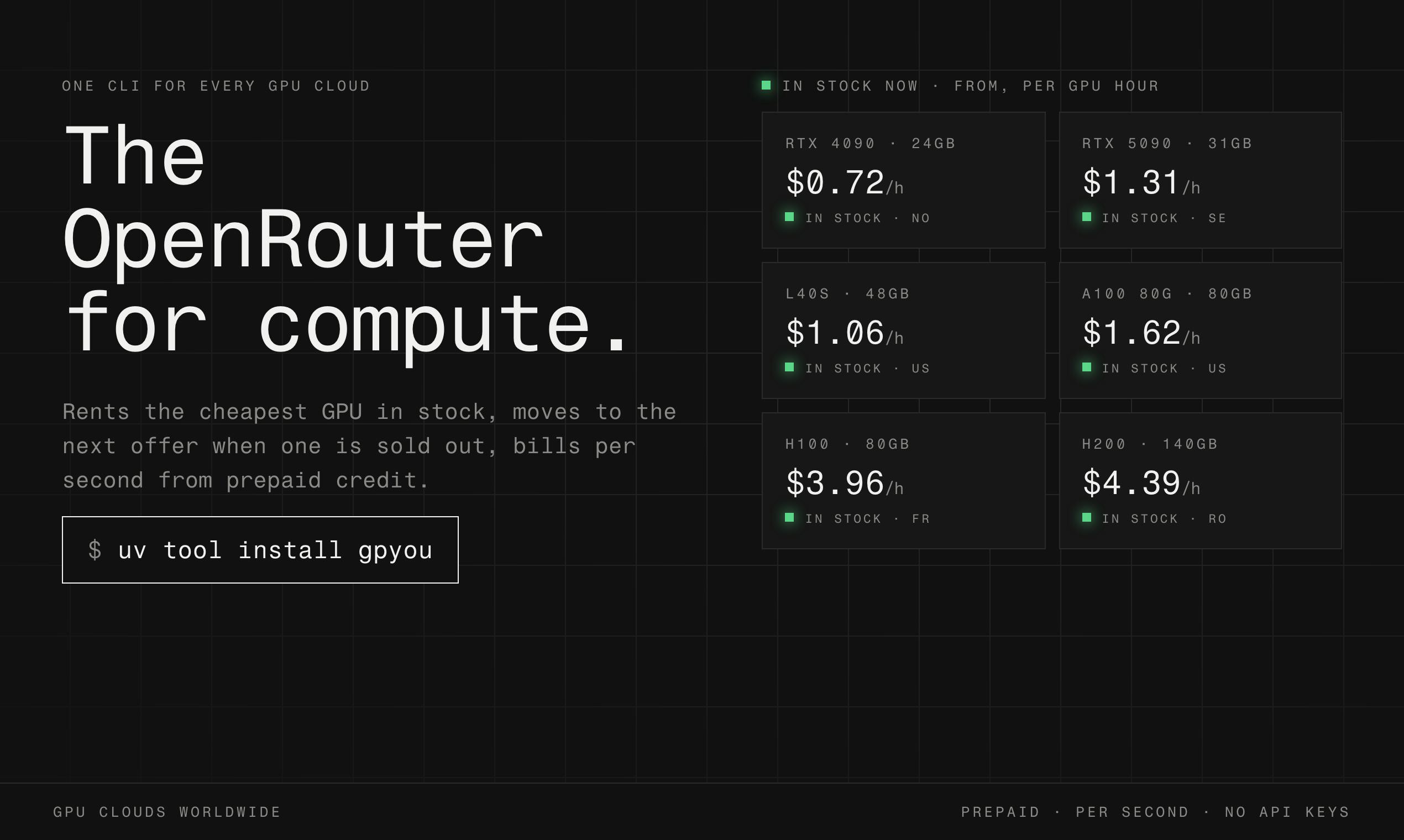
With the cost of AI model training and inference remaining high, how to obtain GPU compute at the lowest cost has become a focus for developers. A new product on Product Hunt called gpyou proposes an interesting solution: with a single command-line instruction, automatically rent the cheapest GPU in stock worldwide, and automatically switch to the next one when an offer sells out. It is aptly called the "OpenRouter of compute."
Core Features: Cross-Cloud Price Comparison and Automatic Switching
gpyou's core logic is very clear: users can access global GPU cloud resources through a single CLI (command-line interface). The system scans the inventory and prices of various cloud providers in real time, selects the cheapest available GPU instance, and automatically migrates to the next best option after that instance is rented by someone else. The entire process is transparent to the user and requires no manual intervention.
This model is similar to OpenRouter's role in the LLM API space—OpenRouter aggregates APIs from multiple model providers and automatically routes to the lowest-priced or most available service, while gpyou transplants the same idea to the underlying compute layer. For developers who need to frequently launch short-term tasks (such as model fine-tuning, containerized inference, or self-hosted coding model services), this automated price comparison and switching can significantly reduce operational overhead.
OpenRouter is a third-party routing platform that aggregates APIs from multiple large language model providers. Developers can call models from different vendors through a unified interface, and the platform automatically selects the backend based on price, availability, and latency. gpyou borrows this model and moves the logic of "aggregation–price comparison–routing" down from the model API layer to the GPU infrastructure layer: OpenRouter routes inference requests, while gpyou routes rental requests for compute instances. The common premise of both is that upstream supply is highly fragmented and prices fluctuate in real time, so an intermediary layer is needed for real-time optimal matching. The difference is that the switching cost for API routing is close to zero, while GPU instance switching involves data and environment migration, making the engineering complexity much higher.
Billing and Use Cases
According to the Product Hunt page, gpyou uses a prepaid credit model and bills by the second. This means users only pay for the actual seconds used, avoiding the waste caused by traditional cloud services' hourly billing. It is especially suitable for the following scenarios:
- Short-term experiments: quickly run a fine-tuning task lasting from a few minutes to a few hours, where per-second billing is more precise.
- Model inference services: deploy self-hosted models or coding models and use them elastically based on traffic.
- Containerized tasks: run Docker containers without occupying instances for long periods.
In addition, gpyou supports running containers, fine-tuning models, deploying model services, and even running "your own coding model." This suggests that its target users are not only AI researchers but also engineers who need low-cost compute for development.
Per-second billing is a more granular billing method compared with traditional cloud services' hourly or monthly billing. Mainstream GPU clouds usually use whole hours as the minimum billing unit, so a task that runs for only ten-plus minutes still incurs a one-hour charge, and the waste is especially obvious for short-term, high-frequency tasks. Per-second billing requires the platform to have fine-grained usage collection and settlement capabilities, and it also means that the actual cost of a single task is closer to real resource consumption. For workloads with short durations and high volatility, such as fine-tuning, batch inference, and containerized tasks in CI, per-second billing can significantly reduce the per-task cost; but for services that run stably for long periods, the difference between per-second and hourly billing is diluted, and the price advantage then comes more from cross-cloud price comparison than from billing granularity.
Market Positioning and Potential Challenges
gpyou's positioning targets two pain points in the GPU compute market: price volatility and unstable inventory. The current GPU cloud market is fragmented, prices vary greatly among providers, and popular models are often sold out. Through aggregation and automatic switching, gpyou can in theory help users always obtain available compute at the lowest price.
But this model also faces challenges. First, cross-cloud migration involves overhead such as image transfer and environment configuration, and the degree to which automatic switching is "seamless" depends on implementation details. Second, GPU models, network performance, and storage performance differ among cloud providers, and unified abstraction may sacrifice some performance transparency. Finally, the prepaid credit model requires users to trust the platform's stability and the safety of their funds.
The degree to which cross-cloud migration is "seamless" depends on several key engineering steps: whether instance images can be quickly rebuilt on the new cloud, whether model weights and datasets need to be retransferred, whether CUDA drivers and container runtime versions are compatible, and how traffic is switched after the external service IP changes. If migration relies on re-pulling tens of GB of model weights from object storage, the switching latency may reach the minute level, which is not friendly to online inference services. In addition, GPUs with the same model name from different cloud vendors may differ in memory bandwidth, interconnect topology, and CPU allocation. If the unified abstraction layer exposes only price and model, users will find it difficult to judge performance differences, and there may be a hidden cost of "cheaper but slower."
Developer Perspective
gpyou was developed by Robert Keus and received 83 votes and 6 comments on Product Hunt, ranking 12th. From the product categories, it is classified under API, developer tools, and artificial intelligence, indicating that it is positioned as a productivity tool for developers. For users accustomed to the command line, a CLI that aggregates global GPU clouds can indeed reduce the hassle of switching between different consoles.
However, public information is currently limited, and it is not yet clear which specific cloud providers it supports, the range of GPU models, or network latency performance. These details will determine whether it can truly become the "OpenRouter of compute."
Conclusion
gpyou uses a simple CLI to abstract the price comparison and rental process across global GPU clouds, with per-second billing and automatic switching as its highlights. If executed well, it has the potential to become a practical tool for developers to obtain compute at low cost. But cross-cloud consistency and performance transparency remain key points to watch.
One-line Summary
gpyou uses a single CLI to aggregate global GPU clouds, automatically compare prices and rent the cheapest instance, and support switching when sold out.
Paragraph Summary
gpyou is a developer tool on Product Hunt that aggregates global GPU cloud resources through a single command-line interface, scans the inventory and prices of various providers in real time, automatically rents the cheapest available instance, and switches to the next best option when that instance is occupied. It is aptly called the "OpenRouter of compute." It uses prepaid credits and bills by the second, making it suitable for short-term fine-tuning experiments, elastic model inference, and containerized tasks. The product was developed by Robert Keus and received 83 votes on Product Hunt, ranking 12th. Its value lies in addressing the two major pain points of price volatility and unstable inventory in the GPU cloud market, but the overhead of image transfer and environment configuration in cross-cloud migration, the transparency issues caused by GPU performance differences among vendors, and the fund safety of the prepaid model remain key variables in whether it can deliver on its "seamless" promise.
Related articles

Nothing CMF Buds 2A Drops to $17.89 on Black Friday: A New Low for ANC Earbuds
Nothing CMF Buds 2A wireless earbuds Black Friday deal: just $17.89 on Amazon, about $11 off retail and a record low. ANC earbuds at an entry-level price.

When AI Creation Gets Accused of "Spitting": Hacker News Heats Up Over the Glaude Controversy
A Hacker News post, "Spitting in the Face of Glaude," sparks debate on AI creation transparency and attribution ethics. This analysis examines the blurred creator identity behind the controversy and offers practical advice for AI content production.

Akai Embraces Custom Firmware: MPC Sample 1.4 Lets Users AI-Program Their Sampler
Akai embraces the modding community with MPC Sample 1.4 firmware, supporting vibe-coded custom firmware and effects. We analyze the impact of this open strategy on music hardware and AI-assisted programming.