GrapheneOS Plans to Support High-End Motorola Devices by 2027

GrapheneOS plans to support high-end Motorola devices by 2027, diversifying beyond Pixel hardware.
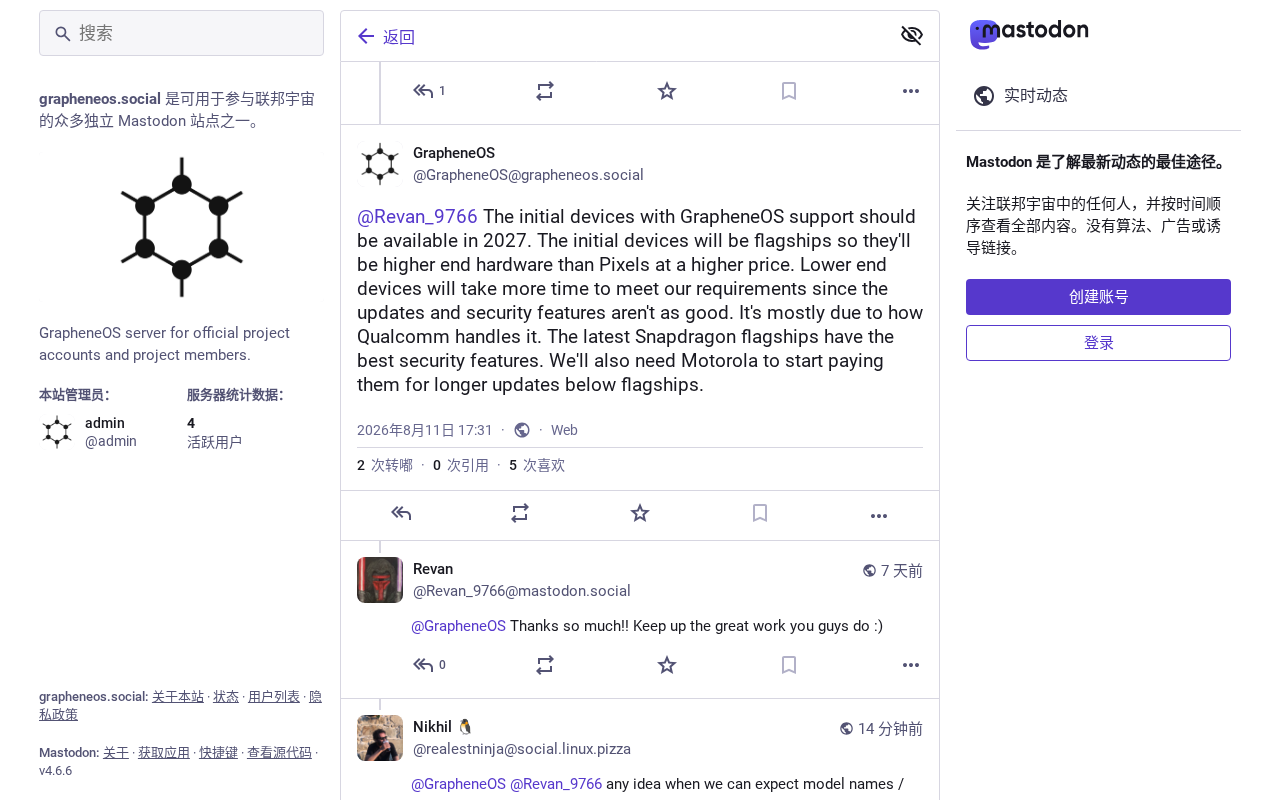
GrapheneOS, the security-hardened mobile OS long exclusive to Google Pixel, has announced plans to support high-end Motorola devices by 2027. This move aims to reduce single-vendor dependency and expand hardware options for privacy-conscious users. Key challenges include ensuring Motorola devices meet strict security requirements like Verified Boot with Bootloader re-locking. The extended timeline reflects the complexity of hardware adaptation and manufacturer collaboration needed.
A Privacy-Focused OS Gets New Hardware Options
For years, GrapheneOS — the privacy and security-focused custom Android system — has been almost exclusively tied to Google's Pixel lineup. GrapheneOS is a privacy and security-enhanced mobile operating system built on the Android Open Source Project (AOSP), founded by security researcher Daniel Micay in 2014 (originally named CopperheadOS, later renamed following a team split in 2018). The system implements extensive security hardening measures on top of standard Android, including a hardened memory allocator (hardened_malloc), enhanced sandbox isolation, fine-grained network permission controls, and sensor access restrictions. Unlike custom ROMs such as LineageOS that prioritize feature expansion, GrapheneOS's design philosophy centers on providing privacy protection without sacrificing security — which places near-exacting demands on underlying hardware security capabilities.
This status quo is about to change. According to recent discussions on Hacker News, GrapheneOS plans to support select high-end Motorola devices by 2027. This means privacy-conscious users will no longer be limited to a single brand when choosing hardware.
For those who follow mobile security, this is a noteworthy signal. It's not just about a privacy OS expanding its device compatibility — it reflects the long-standing challenges and potential breakthroughs in the broader privacy ecosystem's hardware dependency problem.
Why GrapheneOS Has Long Depended on Google Pixel
The Stringent Bar for Hardware Security
The core reason GrapheneOS has only supported Google Pixel devices for years comes down to its high hardware security requirements. GrapheneOS needs devices to meet a series of conditions to deliver its promised security guarantees, including:
-
Verified Boot: Ensures system integrity from boot through runtime, and allows users to re-lock the Bootloader after flashing a custom system. The technical implementation of Verified Boot is based on the Android Verified Boot (AVB) framework, which uses a cryptographic signature chain starting from a hardware root of trust to sequentially verify the integrity of each boot stage — Bootloader, kernel, system partition, and so on. If any component has been tampered with, the device will refuse to boot or warn the user. The critical distinction for GrapheneOS is whether "user-controllable root of trust" is supported — meaning users can inject their custom OS signing keys and re-lock the Bootloader, restoring the device to a fully verified boot state. Most Android devices only recognize manufacturer-preloaded keys, leaving the device permanently in an "unverified" state after Bootloader unlocking, which exposes it to Evil Maid attacks (physical access attacks).
-
Hardware Security Module: Such as the Titan M security chip on Pixel devices, providing hardware-level guarantees for key storage and brute-force attack prevention. Titan M is a dedicated security chip introduced by Google starting with the Pixel 3, representing a mobile implementation of a Hardware Security Module (HSM). It runs independently from the main processor with its own flash memory, RAM, and processor, managing device encryption keys, verifying Bootloader integrity, and limiting password brute-force attempts. Compared to software-only TEE implementations (Trusted Execution Environment, such as ARM TrustZone), a dedicated security chip's advantage is that even if the main processor's operating system is fully compromised, attackers cannot extract key material stored in the security chip.
-
Timely Firmware and Security Patches: Manufacturers must provide long-term, stable low-level driver and security update support. Google Pixel, for example, offers at least 7 years of security update support and complete kernel source code — still a rarity in the Android ecosystem.
The Google Pixel lineup excels in all these areas, particularly in allowing users to re-lock the Bootloader after flashing — a feature that has long been scarce in the Android world. The Bootloader is the first software component executed when a device powers on, and its locked or unlocked state directly determines the integrity of the device's security trust chain. In a locked state, the Bootloader only allows signature-verified system images to boot, forming a complete trust chain from hardware to software. While unlocking the Bootloader grants users the freedom to flash custom systems, it also means anyone with physical access could potentially flash a malicious system. The vast majority of Android manufacturers (Samsung, Xiaomi, OPPO, etc.), even if they allow Bootloader unlocking, do not support re-locking after flashing a third-party ROM — this isn't a technical limitation but rather a deliberate restriction driven by warranty and legal liability considerations.
The Risk of a Single Hardware Source
However, over-reliance on a single manufacturer carries obvious risks. If Google adjusts Pixel's hardware strategy, Bootloader policies, or security chip design, the GrapheneOS project could be left in a vulnerable position. The GrapheneOS team has publicly expressed concerns about Pixel's future direction multiple times and has clearly stated their desire to find alternative hardware platforms that meet their security standards.
The Significance of Supporting High-End Motorola Devices
A Critical Step in Breaking the Pixel-Only Dependency
Expanding support to high-end Motorola devices can be seen as an important step in GrapheneOS's hardware diversification efforts. Since being acquired by Lenovo in 2014, Motorola has maintained relatively independent operations in its product strategy. Historically, its Bootloader policy has been comparatively open, offering official unlock tools (though without re-locking support). In recent years, Motorola's high-end product line (such as the Edge series) has adopted Qualcomm Snapdragon 8-series flagship chips, which include Qualcomm's Secure Processing Unit (SPU) and TrustZone implementation. GrapheneOS choosing Motorola as an expansion target is likely related to certain adjustments in Motorola's hardware security strategy — for example, potentially supporting custom AVB key injection and Bootloader re-locking in future high-end models. This kind of manufacturer-level willingness to cooperate is a prerequisite for technical implementation.
However, it must be emphasized that whether Motorola's high-end devices can meet GrapheneOS's security standards hinges on whether they possess hardware security capabilities comparable to Pixel — particularly Verified Boot and Bootloader re-locking capability. If these conditions cannot be met, even if the system can run, its security guarantees will be significantly diminished.
Interpreting the 2027 Timeline
Setting the target at 2027 also reflects the complexity of this kind of adaptation work. Porting a security-hardened operating system to a new hardware platform goes far beyond simple system compilation. The engineering complexity manifests across multiple layers: first, BSP (Board Support Package) adaptation, including integration of closed-source components like GPU drivers, camera HAL (Hardware Abstraction Layer), and baseband firmware; second, verification of each security feature, such as SELinux policy configuration, key management interface integration, and hardware random number generator validation; finally, long-term maintenance commitment, requiring hardware manufacturers to continuously provide kernel security patches and firmware updates throughout the device's lifecycle.
The extended timeline means the team needs to establish sufficient collaboration with hardware manufacturers on firmware support, update cycles, and other aspects to ensure sustainable system maintenance.
Potential Impact on the Privacy OS Ecosystem
Expanded Hardware Choice for Users
For everyday users, the most direct benefit is an expanded range of hardware options. Previously, using GrapheneOS meant purchasing a Google Pixel. In the future, if Motorola models become available, users can make more flexible decisions based on price, design, availability, and other factors. This is particularly important in regions where Pixel availability is unstable.
Enhanced Ecosystem Resilience and Risk Resistance
From a project health perspective, hardware source diversification can significantly improve the resilience of the entire privacy OS ecosystem. When a system is no longer tied to a single vendor, its ability to withstand policy changes and supply chain risks is strengthened. This carries strategic significance for projects aimed at long-term privacy protection.
In the current mobile privacy OS landscape, besides GrapheneOS, there are CalyxOS (also Pixel-based but with a more relaxed security policy, allowing microG as a Google services alternative), DivestOS (supporting a wider range of devices but with weaker security guarantees), and Linux kernel-based options like PureOS (for the Librem 5 phone) and postmarketOS. GrapheneOS is known for the strictest security standards and has been recommended by multiple information security organizations as the top mobile system for high-risk users (journalists, activists, security researchers). Its expanded hardware support could trigger a chain reaction across the entire privacy OS ecosystem — if more manufacturers begin providing hardware support for privacy systems, it will push the entire industry toward more open security architectures.
Key Questions That Remain Unanswered
As a plan still in its early stages, publicly available information is limited, so several points warrant cautious observation:
- Specific supported models remain unclear: "High-end Motorola phones" is a broad description, and exactly which models will be supported awaits official clarification.
- Can the security level match Pixel?: This is the core question determining the plan's success or failure. If Motorola devices cannot provide equivalent hardware security capabilities, GrapheneOS's core value proposition will be compromised. While Qualcomm's platform also offers a similar Secure Processing Unit (SPU), implementation quality and openness vary significantly across manufacturers — an important factor the GrapheneOS team needs to evaluate on a case-by-case basis.
- Plans may change: There is considerable time between now and 2027, during which the hardware market and manufacturer policy landscape could shift significantly.
Conclusion
GrapheneOS's plan to support high-end Motorola devices by 2027 represents a positive step toward freeing privacy operating systems from single-hardware dependency. While details remain incomplete, the direction is commendable — a more diverse, more resilient privacy ecosystem will ultimately benefit all users who value data sovereignty and mobile security. Going forward, we should continue monitoring GrapheneOS's official announcements regarding specific device models and security capabilities.
Related articles

Amphibious Transforming Drone: Beyond 100x Power Savings, What Are the Real Needs?
Is the amphibious transforming drone just a gimmick? Starting from the 100x power difference of the M4 Morphobot, explore real application scenarios and thesis topic ideas, analyzing boundary conditions where pure drones and pure ground robots both fail.

Warhound Raises $200 Million: Genetically Engineered "War Dogs" Paired with Anduril Gear
Warhound raises $200M, backed by Ben Lamm and Palmer Luckey, to genetically engineer dogs for military and law enforcement use and equip them with Anduril gear. This article analyzes its technology direction, funding logic, and ethical controversy.

Claude API Comes to Google Cloud: IAM Integration and SDK Access Guide
Anthropic hosts the full Claude API on Google Cloud with IAM-controlled permissions and unified billing. This guide covers the Vertex AI and Anthropic-hosted entry points, IAM role configuration, and SDK access.