Grok 4.5 Coding Benchmark: A Deep Dive into Performance, Speed, and Cost

Grok 4.5: xAI's coding-focused model delivers strong value with high speed and low cost.
xAI's Grok 4.5 is a coding-focused model co-trained with Cursor, offering 80 TPS speed and just $2/M input tokens. It scores 64.7 on SWE Bench Pro with 4.2x better token efficiency than Opus 4.8. This hands-on review covers front-end generation, a Minecraft clone, 3D rendering, and more.
Grok 4.5: xAI's First Model Purpose-Built for Coding Agents
xAI has officially released Grok 4.5, their first model specifically built for Coding Agents and real-world software engineering scenarios. Founded by Elon Musk in March 2023, xAI's core team brings together research talent from DeepMind, OpenAI, and Google Brain. Since the Grok series first debuted in November 2023, it has been undergoing a strategic shift from a general-purpose conversational assistant to a vertically specialized model—and Grok 4.5 marks a major milestone in this transition. Unlike previous models that chased impressive benchmark scores, Grok 4.5's positioning is crystal clear: cutting-edge coding capabilities, combined with high speed and low cost.
About Coding Agents: A Coding Agent is the product of deeply integrating large language models with software engineering toolchains. Unlike traditional code completion tools (such as the early GitHub Copilot), a Coding Agent can autonomously complete multi-step tasks: understanding requirements, breaking them into subtasks, invoking terminal commands, reading and writing to the file system, running tests, and iteratively fixing issues based on the results. Such agents typically operate within a "ReAct" loop (Reasoning-Acting-Observing) or a more complex tree search framework.
The Underlying Logic of the ReAct Framework: ReAct (Reasoning + Acting) is an agent paradigm formally proposed by a Google research team in 2022. Its core idea is to interweave the language model's "reasoning chain" with "external tool calls," forming a closed loop of "think → act → observe → think again." In coding scenarios, this means the model can not only generate code but also actively execute it, read error messages, consult documentation and APIs, and revise its strategy based on the observed results. More advanced Coding Agents also employ Tree Search or Monte Carlo sampling methods to explore multiple solution paths simultaneously, prioritizing branches that pass test cases—this is precisely the underlying reason SWE Bench-style benchmark scores have seen substantial improvements over the past two years. It is also because of this architecture that models can continuously execute dozens or even hundreds of steps. As a result, Token efficiency, latency, and cost are far more critical for Coding Agents than for ordinary conversational scenarios—a complex engineering task may consume millions of Tokens, and cost differences are amplified linearly.
What you may not have noticed is that this model is the product of joint training between xAI and Cursor. Cursor is currently one of the most respected AI code editors among professional developers on the market. Built on VS Code, it deeply integrates several top-tier models. Developed by Anysphere, Cursor rapidly gained popularity among developers in 2023 thanks to its "multi-file understanding" and "Composer" features, and now boasts over a million monthly active users. The joint training with xAI represents a noteworthy new trend in the AI industry: model providers obtaining "human preference signals" directly from high-quality vertical-scenario tools, rather than relying on traditional crowdsourced annotation.
RLHF Data Quality and Vertical-Scenario Feedback Signals: RLHF (Reinforcement Learning from Human Feedback) was formally proposed by OpenAI in 2017 and applied at scale in InstructGPT. Its core is to train a "reward model" that predicts human ratings of output quality, then use that reward model to guide the language model in optimizing its output policy via reinforcement learning algorithms like PPO. Traditional RLHF relies on crowdsourced annotation platforms (such as Scale AI and Surge AI), where annotators' professional backgrounds vary widely and often struggle to provide high-quality judgments in specialized domains like coding. In contrast, feedback signals from real Cursor users hold a fundamental advantage: the annotators are professional developers making accept/reject decisions in real projects, and their judgments directly relate to whether the code runs properly in production environments, rather than abstract notions of "does it look right." The noise level of this "Implicit Feedback" is far lower than that of explicit crowdsourced ratings, and it is considered one of the key data strategies for breaking through the ceiling of coding capabilities. The quality of this RLHF data far exceeds that of general crowdsourcing—because behind every accept/reject signal lies a professional judgment made by a real developer in a real project, resulting in lower noise and higher signal density. Similar collaboration models have previously appeared between OpenAI and GitHub Copilot, and between Anthropic and Replit.
This means that Grok 4.5's training data and reinforcement learning feedback signals incorporate programming interaction data from real Cursor users—including developers' accept/reject behaviors, code modification patterns, and debugging paths. This training approach based on "feedback from real workflows" is fundamentally different from training that relies solely on synthetic data or academic benchmarks, enabling the model to better understand developers' true intentions in real-world scenarios. Its training data spans programming, science, engineering, mathematics, and more, with the goal not being to maximize benchmark scores, but to efficiently solve real engineering problems.
From an overall positioning standpoint, Grok 4.5 does not attempt to be the most powerful model—it hasn't fully reached the level of Claude 5 or GPT 5.5. But it fills a highly practical niche: it strikes an excellent balance among capability, latency, and price, making it well suited as a daily-driver development tool.
Benchmarks: A Strong Upper-Mid-Tier Performer with Outstanding Value
Across various benchmarks, Grok 4.5 delivers well-rounded performance:
- Terminal Bench: 83.3%, essentially tied with GPT 5.5, only slightly below Claude 5
- SWE Bench Pro: 64.7 points, surpassing GPT 5.5, but still notably behind Claude 5's 80.4 points
- Deep SWE 1.0: 62%, ranking third among all frontier models
- World of AI Benchmark: ranked fourth, far ahead of Opus 4.7
About the SWE Bench Series: SWE Bench (Software Engineering Benchmark) is currently one of the most authoritative benchmarks in the field of AI coding capability evaluation, released by a Princeton University team in 2023. Its core design philosophy is to extract already-resolved Issues from real GitHub open-source projects and have the model pass the corresponding test cases by modifying the codebase, without knowing the solution beforehand. The reason SWE Bench is so highly valued in the industry is that it measures a model's "real-world applicability" within actual codebases, rather than its performance on simple algorithm problems—it requires the model to understand cross-file dependencies, adhere to the project's existing coding style conventions, and precisely locate and fix issues without breaking other functionality, which closely mirrors real engineering scenarios. SWE Bench Pro is its more rigorous advanced version, filtering out samples that could easily be "guessed" through, making it closer to real engineering complexity. Notably, SWE Bench evaluation results are highly sensitive to the choice of agent framework—the same underlying model, paired with different scaffolding and tool-calling strategies, can score more than 20 percentage points apart. This is why the industry needs to consider both "bare model" and "with framework" conditions when interpreting such leaderboards, in order to accurately assess a model's true capability boundaries.
The most notable aspect is its Token efficiency. On SWE Bench Pro tasks, Grok 4.5 produces 4.2x fewer output Tokens than Opus 4.8.
The Economics of Token Efficiency: The importance of Token Efficiency in Coding Agent scenarios is often underestimated. Large language model APIs bill by the Token, and the working mode of Coding Agents dictates that their Token consumption far exceeds that of ordinary conversations: each tool call requires re-feeding the full context (including conversation history, file contents, and error logs) into the model, and as task steps accumulate, context length grows linearly. Inference optimization techniques represented by KV Cache can partially mitigate the computational overhead of repeated prefixes, but the cost of output Tokens still cannot be compressed. Therefore, given comparable output quality, a more concise output style (avoiding redundant explanations and getting straight to the code) offers a significant cost advantage in large-scale deployment. The economic significance of this figure is profound: for a typical SWE Bench task, a good Coding Agent needs to execute 30–80 rounds of tool calls, with each round accumulating thousands of Tokens of context. For enterprises building AI-native development platforms or automated CI/CD pipelines—CI/CD (Continuous Integration/Continuous Delivery) being the core infrastructure of modern software engineering, with AI evolving from assisting code generation to autonomously participating in the entire build, test, and deployment process—if 1,000 engineering tasks are processed per month, a 4.2x difference in Token efficiency could mean the difference between thousands and hundreds of dollars in monthly API costs. In large-scale scenarios, this advantage often carries more decision-making weight than the marginal quality difference of a single task. This means that when running long-duration coding tasks, its cost advantage is greatly amplified—you get high-quality intelligent output at lower cost and faster speed.
Price and Speed: The Real Killer Feature
Grok 4.5's pricing is highly competitive: just $2 per 1 million input Tokens and $6 per 1 million output Tokens. Compared to other mainstream frontier models, this price is significantly lower.
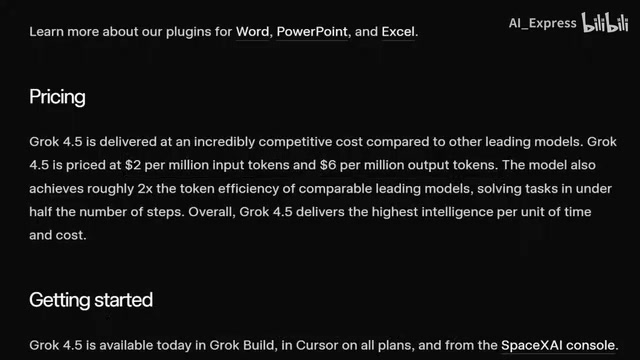
Speed is equally impressive. Grok 4.5 sits in the "fast model" tier, reaching around 80 TPS (Tokens per second). For everyday conversational scenarios, 30–40 TPS is already smooth enough; but in Coding Agent workflows, the model often needs to continuously output large amounts of code, explanations, and tool call results, so 80 TPS means waiting time is halved, significantly improving the developer's interactive experience. Behind this speed advantage lies xAI's massive investment in inference infrastructure—its Colossus supercomputing cluster in Memphis boasts over 100,000 H100 GPUs, providing ample compute support for high-throughput inference. The model currently supports a 500K Token context window—roughly equivalent to 400,000 lines of code or hundreds of files, enough to accommodate the complete codebase of a medium-sized project—and is reportedly set to be upgraded to 1 million Tokens soon, at which point it will be able to handle large monolithic repositories, which is especially important for refactoring tasks that require a global understanding of code dependencies.
Real-World Performance: Excellent Front-End and Design Capabilities
macOS Clone: Astonishing Component Completeness
In actual generation tests, Grok 4.5's front-end code generation capabilities are impressive. In one test, it was used to generate a macOS clone, and the completeness of the various components was quite high: the top menu bar can change wallpapers, drag apps, and open the calendar; the bottom Dock animation is smooth; and it even includes a built-in FPS shooter game—all completed in a single generation pass.
The only shortcoming is that the functional depth of the apps still falls short of Opus or Fable 5, but the overall performance is already quite remarkable.
SaaS Landing Pages and Design Aesthetics
In a test generating a high-end SaaS landing page, Grok 4.5 used a React 18 architecture, incorporated GSAP and Scroll Trigger animations, and implemented each requirement from the prompt one by one. GSAP (GreenSock Animation Platform) is one of the most mature JavaScript libraries in the front-end animation field. Born in 2008, it initially became known for solving cross-browser animation compatibility issues, and later evolved into the industry standard for high-performance tweening animations. Its core advantage lies in directly manipulating DOM properties rather than relying on CSS transitions, enabling complex timeline control that far exceeds CSS Animation—for example, precisely choreographing the entrance, fade-out, and morphing of multiple elements into a millisecond-level timeline sequence. Scroll Trigger is a plugin it launched in 2020 that can precisely bind animation playback progress to page scroll position, supporting advanced features such as pinned elements (Pin), parallax effects (Parallax), and segmented triggering (Scrub), and is currently the mainstream animation solution for high-end SaaS products and brand websites. The model's ability to proactively choose and correctly invoke a professional library like GSAP without additional prompting—rather than falling back on basic CSS animations—reflects its deep understanding of front-end ecosystem technology selection. This kind of "technical taste" is precisely an important dimension distinguishing high-quality code generation models from ordinary ones. This reveals a distinct characteristic of the model: its design aesthetics are quite on point. Combined with its advantages in price, efficiency, and speed, it's ideal for prototyping or project scaffolding. It also adapts well to different prompts, flexibly applying different packages, components, fonts, and typography styles.
Minecraft Clone: Ranked Third Overall

The Minecraft clone generated by Grok 4.5 ranked third among all top models (the top two being Fable 5 and GPT 5.5). It features a crafting system, allows placing different blocks and using tools, generates tool textures in a rather unique way, and produces creatures that behave close to those in the real game. This kind of "game clone" task is an excellent litmus test for evaluating a model's systematic engineering capabilities: it not only requires the model to understand the Game Loop architecture, collision detection algorithms, and Chunk management logic, but also to coordinate multiple modules—rendering pipeline, input handling, and state management—within a single generation pass, ultimately delivering complete, runnable code. Capability shortcomings often have nowhere to hide in such comprehensive tasks. The only flaw was that the torches failed to work as expected.
Weaknesses: 3D Scenes Still Have Room for Improvement
Not all tests were perfect. On tasks related to 3D graphics (Three.js), Grok 4.5's performance was somewhat uneven.
Solar System Rendering Falls Somewhat Flat
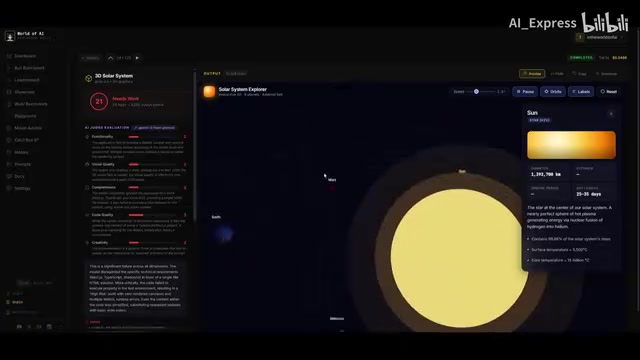
In the 3D solar system prompt test, the model did generate the code and an asteroid belt, but the overall effect was flat, with textures and contrast lacking finesse. Each planet was essentially just a simple texture plus a basic color, missing the visual details that would make it stand out. Similarly, the drift physics of an F1 car were not accurate enough, and the windows of background buildings were not fully generated.
This shows that Grok 4.5 still needs more training in the 3D subdomain. It's worth noting that generation results can be noticeably improved by adjusting reasoning depth and prompt quality.
SVG and Creative Rendering, on the Other Hand, Are Excellent
Interestingly, once you switch to the SVG domain, Grok 4.5's performance improves markedly. Whether drawing a butterfly (with well-executed symmetry and color variation), creative painting (adding its own stylistic elements), or an animated lava lamp (nicely handling the glowing tones, flowing blobs, and sense of physics), it all comes out quite beautifully.
It even implemented a ray tracing renderer using WebGL with Shaders, showcasing atmospheric effects, a procedural sky, and animation. WebGL Shaders are low-level graphics programs that run directly on the GPU, written in the GLSL (OpenGL Shading Language) language, controlling the rendering process of each pixel through two stages: the Vertex Shader and the Fragment Shader. Ray Tracing is the rendering algorithm in computer graphics that comes closest to the physical realism of optics: it simulates the complete path of light rays departing from the camera, intersecting objects in the scene, reflecting/refracting, and ultimately calculating pixel colors, naturally achieving effects like global illumination, soft shadows, and caustics. Due to its enormous computational load, traditional ray tracing was long confined to offline rendering (such as film CG), until NVIDIA introduced hardware-accelerated ray tracing units in its RTX architecture in 2018, gradually bringing real-time ray tracing into the gaming realm. Implementing ray tracing in software within a GPU Shader (i.e., "software ray tracing") requires a deep understanding of the mathematical intersection formulas between rays and spheres/planes, BVH acceleration structures, and shading equations—traditionally something only professional graphics developers could achieve. The model's ability to correctly write Shader code and implement effects such as atmospheric scattering (Rayleigh Scattering) and a procedural sky in a single generation pass demonstrates that Grok 4.5 has a solid understanding of the underlying principles of graphics, rather than merely relying on template stitching. In terms of pure visual creativity, this is one of Grok 4.5's most outstanding generation results to date.
Low-Poly Open World
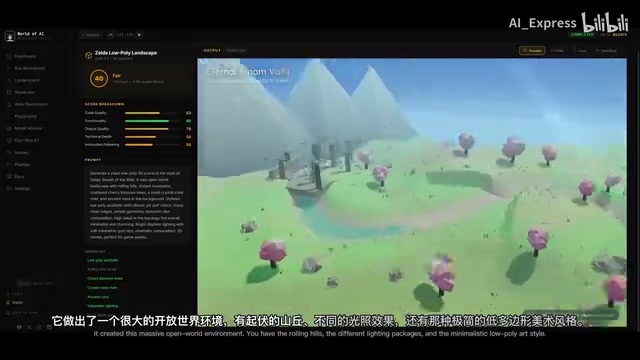
When generating a low-poly scene inspired by The Legend of Zelda: Breath of the Wild, Grok 4.5 delivered a satisfying result: a large open world, rolling hills, varied lighting effects, and atmospheric details like cherry blossom trees, with natural composition and a unified overall style. The low-poly (Low Poly) style originated as an objective product of early 3D games constrained by hardware, but after works like Monument Valley and The Legend of Zelda: Breath of the Wild elevated it into an aesthetic language, it has become a mainstream stylistic choice in indie games and rapid prototyping. In code generation scenarios, a low-poly scene is a good test for evaluating a model's "3D scene organization capabilities": it requires the model to correctly understand Three.js geometry generation (BufferGeometry), the material system (cartoon shading materials like MeshToonMaterial), the balance of directional and ambient light, and Scene Graph hierarchy management, while also transforming abstract style descriptions into concrete parameter settings—for example, mapping "Breath of the Wild style" to specific values for polygon density, color levels, and shadow edge sharpness. Grok 4.5's success on this task reflects its deep understanding and flexible application of the APIs of mainstream 3D libraries like Three.js, as well as its cross-domain ability to translate humanistic aesthetic descriptions into engineering parameters.
Conclusion: Not the Most Powerful, but a Great Daily Driver
Grok 4.5 fills a valuable niche in the current AI ecosystem—it may not be the most powerful, but it's fully capable of serving as a daily driver. For developers who need to handle everyday coding, debugging, and agent workflows, its efficient, fast, and inexpensive characteristics are highly appealing.
The Industry Context of Multi-Model Collaboration Workflows: Multi-Model Orchestration is a significant paradigm shift in AI application development after 2024. As different models exhibit differentiated distributions across capability dimensions, developers and enterprises have begun adopting a "routing layer" strategy: using lightweight, fast models to handle high-frequency, low-difficulty tasks, and concentrating the compute budget on the critical nodes that truly require deep reasoning. The underlying logic of this strategy is essentially an engineering economics problem—on the Pareto frontier of model capabilities, different cost-quality trade-off points correspond to different business scenario needs, rather than there being a single optimal solution. Frameworks like LangChain and LlamaIndex already have built-in model Router components that support dynamic model selection based on task complexity, expected latency, and cost budget; IDEs like Cursor and Windsurf have also begun supporting automatic switching of underlying models by task type, for example using a fast model for code completion and a strong-reasoning model for architecture design consultation. The recommended usage strategy is: use Grok 4.5 for everyday development tasks, and switch back to more powerful models like Claude 5 or Fable 5 when encountering particularly complex engineering problems. This kind of "multi-model collaboration" workflow strikes the best balance between cost and capability.
Grok 4.5 is currently accessible via Grok Build, the API, or Cursor plans, with availability in the EU region expected in mid-July. For developers seeking value for money, this is an AI programming assistant worth serious consideration.
Related articles

Disaster and Glory of the Apollo Program: The History We Must Revisit Before Returning to the Moon
From the fatal Apollo 1 fire to Apollo 8's daring lunar orbit to Apollo 11's successful landing—revisiting the disasters, fears, and compromises of the Apollo program and their lessons for today's return to the Moon.

Netflix Trust Exercise Turns Into Firing Trap: Where Are the Boundaries of Corporate Trust?
A Netflix employee was fired after sharing private info in a trust exercise. We analyze the risks of corporate trust exercises and how employees can protect themselves.

AMD CDNA5 Architecture Deep Dive: Technical Evolution and the AI Computing Competition Landscape
Deep analysis of AMD's CDNA5 architecture covering Chiplet packaging upgrades, HBM memory evolution, and low-precision compute optimization, examining how AMD challenges NVIDIA's AI chip dominance.