Grok 4.5 Free in Cursor: Performance, Cost, and Usage Guide

Grok 4.5 is now free in Cursor on all plans—here's how to enable it and use it wisely.
xAI's Grok 4.5 is now free in Cursor across all plans. It performs solidly on benchmarks, offers standout token efficiency with per-task costs as low as ~$0.31, and works best in a mix-and-match strategy alongside premium models. Learn how to enable it and make the most of this limited-time free window.
Grok 4.5 Quietly Lands in Cursor — For Free
Many developers may not have noticed a recent change: xAI's Grok 4.5 is now available in Cursor for free. No API key, no credit card required, and no extra configuration needed—it simply appears in the model list. In hands-on testing, there were almost no noticeable limits during use, which means you can call a Frontier-tier model with essentially zero barrier to entry.
The backstory is worth mentioning: Grok 4.5 is the first model released following the collaboration between xAI and Cursor, and its training data includes a large amount of Cursor programming corpus. In a sense, Cursor has actually become the most convenient free gateway to experience this model.
How to Enable It for Free
The process is very simple:
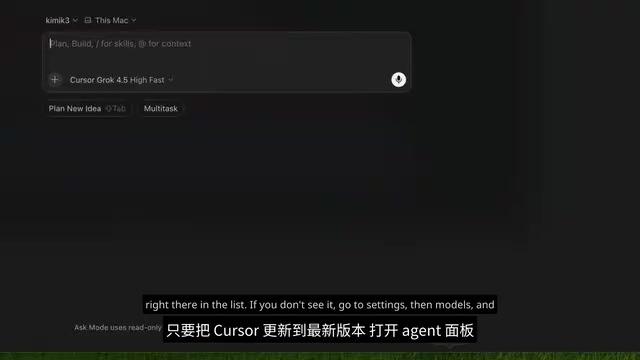
- Update Cursor to the latest version;
- Open the Agent panel, click the model selector, and Grok 4.5 should be right there in the list;
- If you don't see it, go to Settings → Models and manually toggle on the corresponding switch.
It's worth emphasizing that all Cursor plans can use it, including the free plan that never requires payment. During the launch phase, Cursor even doubled the usage quota, though that promotional window has now ended.
Two Big Reasons Grok 4.5 Deserves Your Attention
Cursor already integrates multiple frontier models, so why single out Grok 4.5? There are two core reasons.
Reason One: Solid Benchmark Performance
Based on publicly available evaluation data, Grok 4.5's capabilities are no joke:
- Terminal Bench: Scored 83.3%, roughly on par with GPT-5.5, slightly below the Gemini series;
- SWE-Bench Pro: Can solve 64.7% of tasks;
- Context window: Up to 500K tokens.
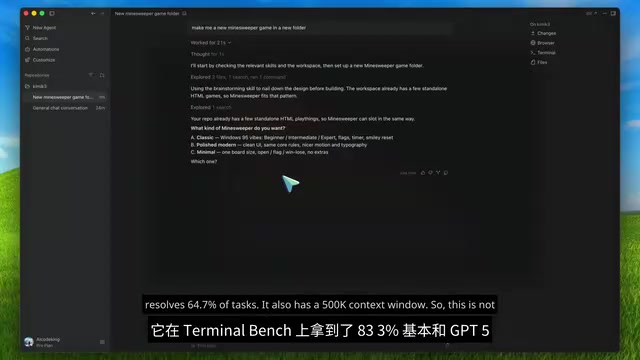
This is not a token "freebie" model thrown in to pad the list—it's a genuine competitor in the frontier tier. In several coding test problems, its ranking even surpassed Sonnet 5 and Opus 4.7.
Reason Two: A Significant Token Efficiency Advantage
What truly stands out is its cost efficiency. Measured data shows that when completing equivalent tasks, Grok 4.5 outputs roughly one-quarter the number of tokens compared to Opus 4.8. Combining lower token consumption with a lower per-unit price, the gap is quite substantial:
| Model | Cost per Task (Measured) |
|---|---|
| Grok 4.5 | ~$0.31 |
| Opus series | ~$2.75 |
Even after the free window closes and API billing kicks in, its pricing is only $2 per million input tokens and $6 per million output tokens—a relatively affordable tier among mainstream frontier models. For scenarios requiring long-running Agentic tasks, this efficiency advantage is especially pronounced.
How Long Will the Free Window Last? What to Know Before You Start
Regarding the limitations everyone cares about most: this is indeed a limited-time free offer, and there's currently no clear end date. However, a few points deserve attention:
- Some users on the Cursor forum have reported confusing Usage page displays—the same usage record is sometimes marked as free and sometimes counted against your quota;
- Cursor has historically adjusted billing rules without prior notice.

We recommend checking the Usage page regularly during use to avoid unexpected charges. Based on historical patterns from similar model launches, such free windows typically last anywhere from a few days to several weeks, so if you want to try it out, sooner is safer.
More Than Just Cursor as an Entry Point
If you don't use Cursor, Grok 4.5 is currently also available for free in Grok Build, and it supports Grok CLI as well. No matter your workflow, there are multiple channels to access this model.

A Practical Strategy: Mix and Match, Not Replace
It should be noted that Grok 4.5 is not an all-around replacement for your main model. On the most difficult tasks, it still falls slightly behind Gemini 5 and Opus 4.8.
A more sensible approach is a mix-and-match strategy:
- Assign Grok 4.5 to long, tedious Agentic workflows;
- Focus your paid quota on complex problems that truly require top-tier capabilities;
- Continuously observe its actual performance in your own real codebase to build an intuitive sense of judgment.
A frontier-tier model built right into the editor you use daily, and for free—running it alongside paid models is clearly the most cost-effective combination available right now.
Summary
Grok 4.5's free availability in Cursor is an opportunity window worth seizing. It holds a solid place in the frontier tier on benchmarks, with particularly outstanding token efficiency, bringing per-task cost down to roughly one-ninth of comparable models. While it isn't yet top-tier on the most difficult tasks, it's already plenty practical as a high-value assistant for handling everyday programming and long-flow tasks.
For developers, the action item is clear: while the free window is still open, flip the switch in your settings and just start running it.
Related articles

Disaster and Glory of the Apollo Program: The History We Must Revisit Before Returning to the Moon
From the fatal Apollo 1 fire to Apollo 8's daring lunar orbit to Apollo 11's successful landing—revisiting the disasters, fears, and compromises of the Apollo program and their lessons for today's return to the Moon.
Netflix Trust Exercise Turns Into Firing Trap: Where Are the Boundaries of Corporate Trust?
A Netflix employee was fired after sharing private info in a trust exercise. We analyze the risks of corporate trust exercises and how employees can protect themselves.

AMD CDNA5 Architecture Deep Dive: Technical Evolution and the AI Computing Competition Landscape
Deep analysis of AMD's CDNA5 architecture covering Chiplet packaging upgrades, HBM memory evolution, and low-precision compute optimization, examining how AMD challenges NVIDIA's AI chip dominance.