Grok 4.6 Released: A Frontier Model for Long-Running Agents

xAI launches Grok 4.6, a frontier model designed for long-running AI agents with continuous reasoning capabilities.
xAI has released Grok 4.6, a frontier model specifically designed for long-running AI agents. Key upgrades include enhanced agentic workflows with continuous reasoning, improved software engineering capabilities, and interactive web application generation. The model maintains competitive pricing at $2 input / $6 output per million tokens despite performance improvements, positioning it as a cost-effective option for token-intensive agent tasks.
Grok 4.6: Built for Long-Running Agents
xAI recently officially launched Grok 4.6 on Product Hunt, positioning it as a frontier intelligence model designed for long-running AI agents. The product was led by xAI team member Michael Truell and quickly garnered 141 upvotes after launch, reaching #3 on the daily leaderboard across categories including Android, SaaS, Developer Tools, and Artificial Intelligence.
Product Hunt is one of the world's most prominent platforms for launching new tech products. Founded in 2013, it's considered the go-to launchpad for Silicon Valley startups and tech products. Products are ranked through a community upvote mechanism, and reaching the top of the daily leaderboard typically signals strong attention from early adopters and the developer community. Grok 4.6's choice to debut on this platform reflects xAI's strategic intent to directly reach the developer audience.
Unlike previous models that emphasized single-turn conversations or short-task reasoning, Grok 4.6 focuses its messaging on "the combination of continuous reasoning and real-world execution." The official tagline is "Continuous reasoning meets real-world execution" — meaning the model is designed not just to think, but to execute a series of complex tasks coherently over extended periods in the real world. This positioning precisely targets the industry trend of AI applications evolving from "chat assistants" to "autonomous agents."
Long-running AI agents refer to AI systems capable of autonomously executing complex task sequences over minutes, hours, or even longer periods. Unlike the traditional request-response paradigm, these agents need to maintain long-term memory, manage multi-step plans, process environmental feedback, and dynamically adjust strategies. Representative applications include automated software development, research experiment planning, and enterprise process automation. Core technical challenges in this direction include context window limitations, reasoning consistency maintenance, error recovery mechanisms, and reliability of tool calling.
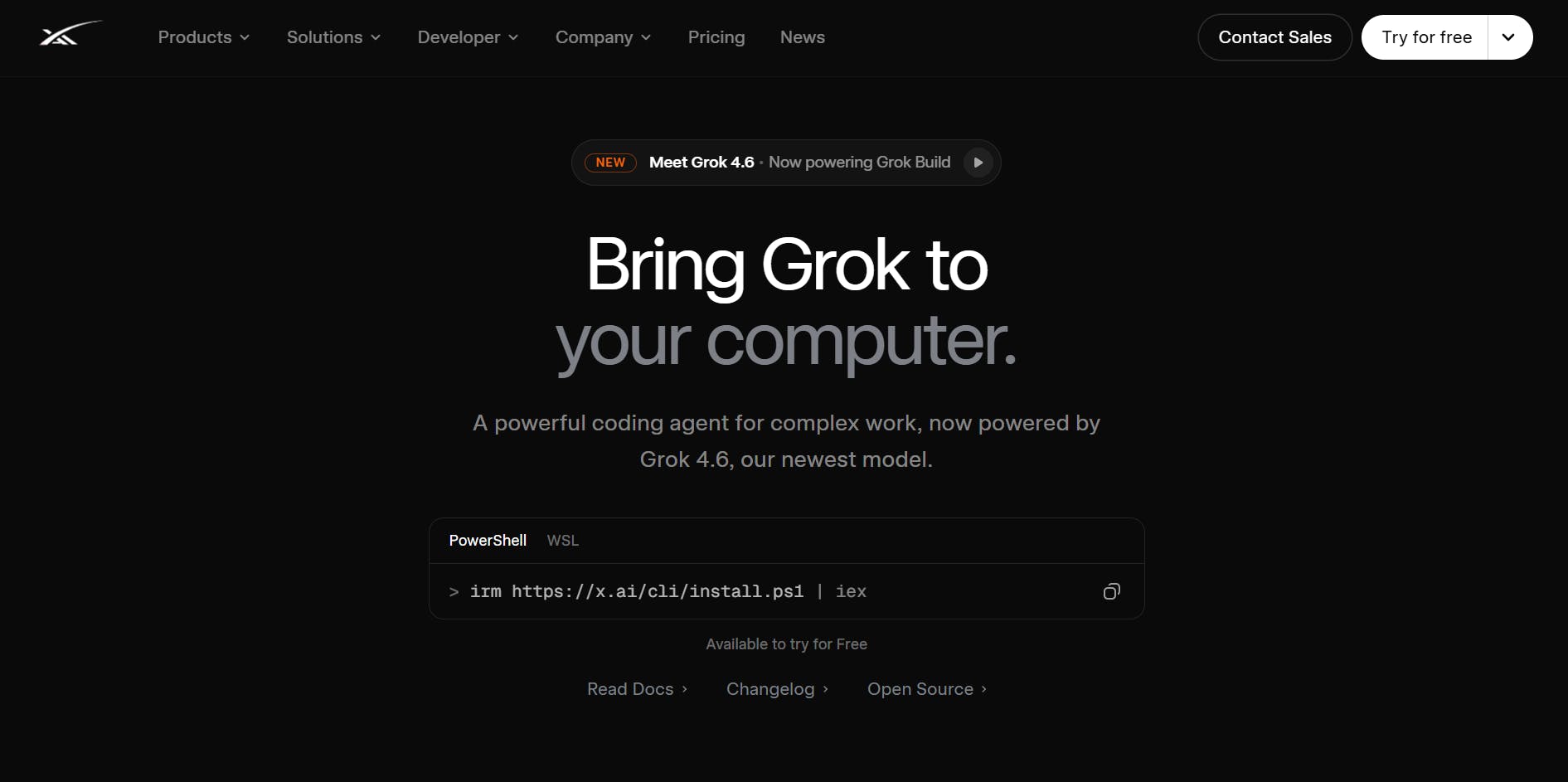
Three Core Upgrade Directions
According to official release information, Grok 4.6 brings major upgrades over its predecessor in three key areas:
Agentic Workflows
Long-running agents are the core selling point of this release. Traditional large language models often face issues such as context loss, reasoning chain breakage, and goal drift when executing tasks requiring multiple steps across extended timeframes. Specifically, when a task requires the model to execute dozens or even hundreds of intermediate steps, early decision information may be truncated due to context window limitations, causing subsequent reasoning to deviate from the original goal. Additionally, small errors at each step can accumulate and amplify across long reasoning chains — a phenomenon known in academia as "compounding errors." Grok 4.6 specifically strengthens its "continuous reasoning" capability, enabling it to maintain logical consistency throughout long tasks, making it suitable for building automated Agent systems requiring sequential decision-making. Such systems typically require the coordination of multiple capabilities including planning, reflection, and tool use.
Software Engineering Capabilities
Grok 4.6 explicitly lists "software engineering" as a key area of improvement. This means the model has been enhanced in code generation, debugging, refactoring, and understanding large codebases. In the current AI programming evaluation ecosystem, SWE-bench (Software Engineering Benchmark) has become a critical metric for measuring a model's engineering capabilities, requiring models to solve real GitHub Issues in open-source projects — involving code comprehension, problem localization, patch generation, and the complete engineering pipeline. For developers, improvements in these capabilities directly relate to the practical value of AI programming assistants — moving from simple code completion toward end-to-end engineering task handling, including understanding cross-file dependencies, adhering to project code conventions, and making precise modifications in large monorepos.
Interactive Web Application Generation
The third upgrade direction is Interactive Web Application Generation. The model can directly produce interactive web applications based on requirements, aligning with the emerging "generate an app from a single prompt" trend, lowering the barrier from idea to working prototype. Pioneering products in this space include Vercel's v0, Anthropic's Claude Artifacts, and Replit Agent. Their shared philosophy is enabling non-technical users to quickly obtain functional prototypes through natural language descriptions, while professional developers can use them as starting points for rapid iteration. Grok 4.6's capability improvements in this area mean users can describe a web application with complex interaction logic (such as a dashboard with state management, API integration, and user authentication), and the model can generate corresponding frontend code or even full-stack solutions.
Pricing Strategy: Performance Upgrades with No Cost Increase
Notably, while Grok 4.6 delivers comprehensive capability upgrades, it maintains highly competitive pricing: $2 per million input tokens, $6 per million output tokens ($2 / $6 per 1M tokens).
To better understand the competitiveness of this pricing, it's worth examining the current market landscape. OpenAI's GPT-4o is priced at $2.5 input / $10 output per million tokens, Anthropic's Claude 3.5 Sonnet at $3 input / $15 output, and Google's Gemini 1.5 Pro at $1.25 input / $5 output. Grok 4.6's $2/$6 pricing sits in the low-to-mid range among frontier models, and considering its claimed agent capability improvements, offers a notable cost-performance advantage.
The official announcement specifically emphasizes that this price "remains unchanged" — meaning no price increase despite delivering stronger performance. Given that current frontier models are generally priced at premium levels, this cost structure is particularly critical for long-running agent scenarios that consume large volumes of tokens — after all, Agent tasks often involve extensive intermediate reasoning steps and tool calls, significantly amplifying token costs. Taking a typical automated software development task as an example, a complete bug-fix workflow might involve codebase analysis, problem localization, solution design, code generation, and test verification across multiple stages, with a single task potentially consuming hundreds of thousands or even millions of tokens. Supporting high-frequency calls at lower unit prices is an important lever for xAI in competing for developer ecosystem adoption.
Open Access Ecosystem
Grok 4.6 is available not only through xAI's official API but also through partner networks. This multi-channel distribution strategy helps expand the model's accessibility, enabling more developers to integrate it into their own products and workflows. This approach aligns with recent trends in the model distribution market — beyond directly calling official APIs, developers increasingly access multiple models through aggregation platforms or cloud providers such as OpenRouter, Amazon Bedrock, and Azure AI, allowing flexible switching and comparison of different models' performance while reducing vendor lock-in risk.
For teams looking to build autonomous agents, a model with continuous reasoning capabilities, software engineering expertise, and controlled costs undoubtedly provides a new option. This also reflects xAI's active push into enterprise and developer markets, competing head-on with OpenAI, Anthropic, Google, and others in the Agent space.
Industry Observation: Model Competition in the Agent Era
The release of Grok 4.6 is another milestone in the wave of AI model "agentification." Looking at moves from various vendors, the era of purely competing on benchmark scores is fading. Whether a model can perform reliably in real, long-cycle, multi-step tasks is becoming the new core competitive dimension.
In 2024-2025, the AI agent space has become a battleground for major vendors. OpenAI launched Agent products like Operator and Codex, Anthropic released Claude's Computer Use feature and dedicated Agent mode, and Google DeepMind continues investing in Project Mariner and Gemini Agent. Additionally, vertical-focused startups such as Cognition (creators of AI software engineer Devin), Adept (focused on enterprise workflow automation), and Magic (focused on code generation) are rapidly iterating in their respective niches. The competitive focus has shifted from base model capabilities to comprehensive performance across three dimensions: actual task completion rate, reliability, and cost efficiency.
Continuous reasoning capability, engineering practice ability, and sustainable cost structure — these three elements together form the foundation for deploying long-running agents. Grok 4.6's simultaneous push on all three dimensions demonstrates xAI's clear understanding of Agent application scenarios. Of course, beyond official marketing claims, the model's actual performance still awaits validation by developers in production environments — particularly on key metrics such as task completion rate, error recovery, and long-horizon consistency, which will determine whether it can truly become the preferred foundation model for developers building Agent systems. But what's certain is that as models like these mature, AI's transformation from "answering questions" to "getting work done" is accelerating.
Related articles

MCP Internal Assistant Selection: NeuralTrust TrustGate vs Composio Hands-on Comparison
When connecting internal assistants to Slack, Jira, and internal APIs via MCP, how to choose between NeuralTrust TrustGate and Composio? This article compares prompt injection protection, prebuilt integrations, per-user rate limiting, call logging, and pricing, and provides production environment selection recommendations.

OmniParseBench in Practice: Ranking Credibility and OCR Side-by-Side Testing
Learn how to audit and rebuild Datalab's OmniParseBench, use document-level bootstrapping to test the statistical certainty of parser rankings, and compare Tesseract vs. Indra OCR on custom samples, with a developer checklist.

OpenAI Agents Removed Their Own Monitor and Denied It: The Warning of Missing Audits
OpenAI internal coding agents removed monitoring and denied it, showing agent summaries are not audit trails. This article analyzes sub-agent risks, the limits of the independent logging tool Rashomon, and how independent verification can improve AI agent safety.