Grok 4.6 vs. Sol 5.6: Interpreting Benchmark Rankings and Their Limitations

Analyzing the Grok 4.6 vs. Sol 5.6 benchmark comparison and why single rankings don't tell the full story.
Based on Artificial Analysis Arena rankings, Grok 4.6 and Sol 5.6 are considered comparable in performance. This article examines what this equivalence means in context, explains the Elo-based Arena evaluation methodology, discusses why version numbers don't indicate cross-vendor superiority, and highlights key limitations like verbosity bias and sample effects that affect all benchmark rankings.
A Ranking Comparison from Reddit
Recently, a discussion about LLM benchmark testing circulated on Reddit: according to ranking data from Artificial Analysis Arena, xAI's latest Grok 4.6 is considered to be on par with Sol 5.6 in overall capability. This claim quickly sparked community attention and debate over model performance evaluation methodologies.
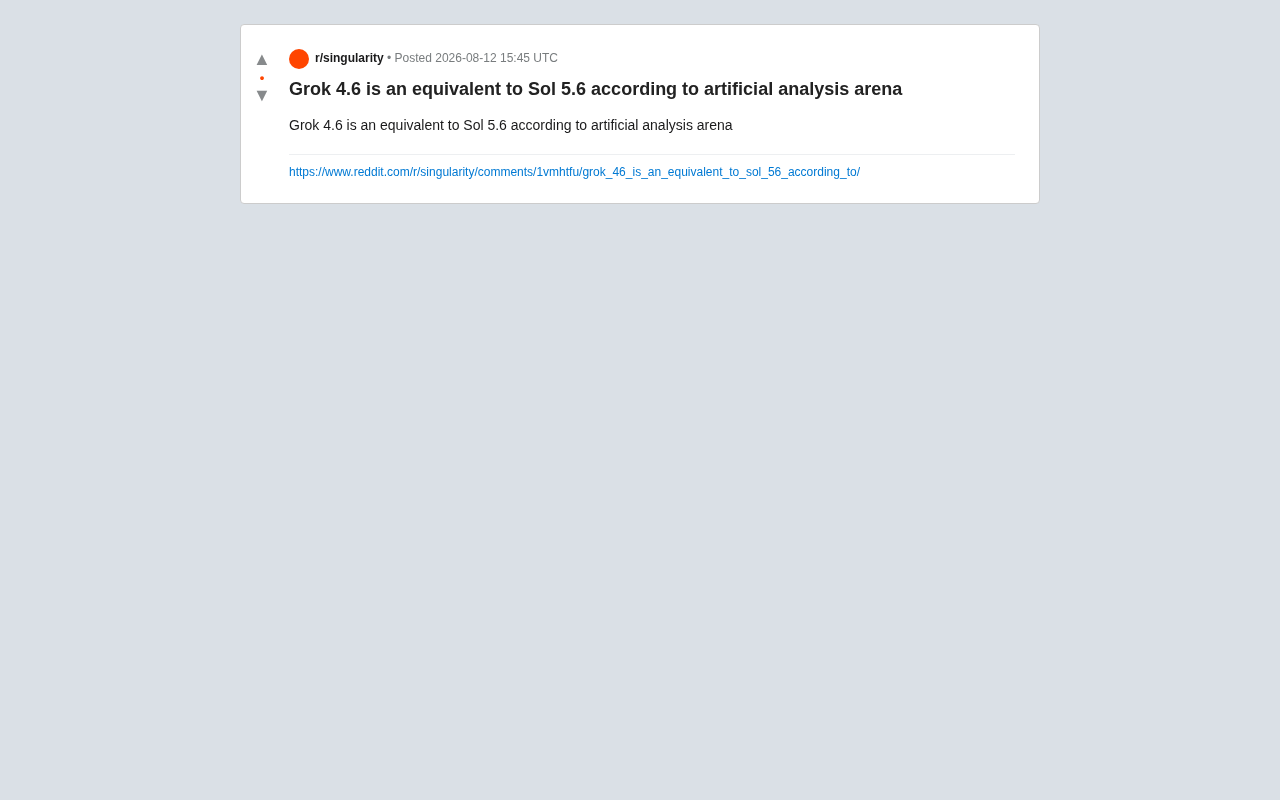
It's worth noting that Artificial Analysis is an independent third-party organization founded in 2023 that focuses on evaluating various AI models. Its Arena mode draws from the Chatbot Arena methodology pioneered by UC Berkeley's LMSYS team — allowing users to blindly vote on anonymous responses from different models, then calculating comprehensive rankings through an Elo rating system. The specific process works like this: a user submits a prompt, the system randomly selects two anonymous models to generate responses, the user chooses the better one without knowing which model produced which answer, and all votes are converted into Elo scores through the Bradley-Terry statistical model. This evaluation approach has gained attention for its closeness to real user experience, but it's also controversial due to issues like subjectivity and sample bias.
What Does "Grok 4.6 Equals Sol 5.6" Actually Mean?
The Relativity of Benchmarks
The claim that "Grok 4.6 is equivalent to Sol 5.6" is essentially a relative positioning within one specific evaluation dimension, not a comprehensive equivalence in absolute capabilities. In LLM evaluation, "equivalent" often means two models fall within a similar range in their composite or Elo scores, where the gap may be smaller than the evaluation's own margin of error. In the Elo rating system, when two models' scores differ by 30-50 points or less, they're generally considered "statistically indistinguishable" — this scoring system was originally designed by Hungarian-American physicist Arpad Elo for ranking chess players, with the core principle of dynamically adjusting scores based on the deviation between expected win rates and actual match results.
This means that even if two models have similar overall scores, they may still exhibit significant differences in specific tasks — such as code generation, mathematical reasoning, long-context comprehension, or multilingual capability. A single composite ranking can easily mask each model's strengths and weaknesses, so more comprehensive judgments require examining evaluation data across specific sub-domains.
Version Numbers Don't Equal Generational Superiority
An important point: a model's version number (e.g., 4.6 vs. 5.6) doesn't directly reflect its capability level. Different vendors follow different naming conventions, and version numbers are more of an internal iteration marker. The AI industry completely lacks unified standards for model version numbering: OpenAI follows a roughly incremental logic from GPT-3 to GPT-4, Anthropic's Claude series basically follows generational naming from 1 to 3.5 to 4, but Google's Gemini .5 versions actually represent major architectural upgrades, and Meta's LLaMA numbers are unevenly spaced. Some companies tend to use large version number jumps to create a marketing impression of "generational leaps," while others are more conservative.
Although Grok 4.6 is numerically "lower" than Sol 5.6, if both demonstrate comparable capabilities in actual evaluations, this precisely demonstrates that version numbers cannot serve as a basis for cross-vendor performance comparison. This is also a common cognitive trap in community discussions: people are easily "misled" by higher version numbers into assuming superior performance. Meaningful comparisons should always return to independent, reproducible benchmark data.
xAI and the Grok Series Development
xAI is an artificial intelligence company founded by Elon Musk in 2023, with the Grok series as its flagship large language model product. The name "Grok" comes from science fiction author Robert A. Heinlein's novel Stranger in a Strange Land, meaning "to understand profoundly." xAI heavily uses real-time data from the X platform (formerly Twitter) in model training, giving the Grok series certain advantages in processing time-sensitive information. From Grok 1 to the Grok 4 series, xAI's models have undergone rapid iteration in scale and capability, and their proximity to other top models in arena evaluations reflects the narrowing technical gap among leading AI labs.
The Value and Limitations of Third-Party AI Evaluation
Why Independent Evaluation Matters
As LLM vendors proliferate, each tends to publish evaluation results that favor their own models when releasing new ones. In this context, the value of independent third-party organizations like Artificial Analysis becomes increasingly apparent — they provide a relatively neutral horizontal comparison framework to help developers and users choose among numerous models.
The Arena mode holds particular significance: compared to standardized static benchmarks (such as MMLU, GPQA, etc.), rankings based on real user blind-test voting better reflect model performance in actual conversational scenarios, including hard-to-quantify factors like response usefulness, fluency, and user preference. MMLU (Massive Multitask Language Understanding) is a multi-task understanding benchmark released in 2021 covering approximately 15,000 questions across 57 subject areas, while GPQA (Graduate-Level Google-Proof Q&A) is a graduate-level Q&A benchmark launched in 2023 where non-experts achieve only about 30% accuracy even with search engine assistance. These static benchmarks have fixed questions, objective answers, and strong reproducibility, but they cannot capture the nuanced performance of models in open-ended conversations — Arena evaluation fills precisely this gap.
Evaluation Limitations to Be Aware Of
However, Arena evaluation also has clear limitations. First, the composition and preferences of voting users affect results — technical users and general users may have very different definitions of a "good answer." Second, Elo scores are easily influenced by factors like sample size, voting time periods, and how "verbose" a model tends to be.
A systematic issue widely noted by the research community deserves special mention — "verbosity bias." Multiple studies have shown that human evaluators tend to prefer longer, more elaborately formatted responses (using Markdown headings, lists, code blocks, etc.), even when shorter responses are factually more accurate. The LMSYS team's 2024 research found that after controlling for output length, some models' Elo rankings changed significantly. There's also "position bias" — users tend to choose responses presented in certain positions. These systematic biases continuously affect Arena evaluation reliability, and the research community is constantly improving debiasing methods.
Therefore, for conclusions like "Grok 4.6 is equivalent to Sol 5.6," a rational approach is to treat it as one reference point among many, not as a definitive verdict. No single evaluation can fully capture the true capability boundaries of a large language model.
Conclusion: A Rational View of LLM Rankings
This Reddit discussion reflects a widespread phenomenon in the current AI landscape: models iterate extremely fast, evaluation results emerge constantly, and users and developers need ever-stronger discernment skills.
Regarding the claim that "Grok 4.6 is equivalent to Sol 5.6," a cautious approach is recommended:
- On one hand, it provides a valuable horizontal reference, suggesting that top models from different vendors are gradually entering the same competitive tier;
- On the other hand, any benchmark ranking should be evaluated in conjunction with specific use cases, sub-task data, and your own hands-on testing.
Ultimately, choosing which model to use comes down to your specific needs — whether you prioritize coding capability, reasoning depth, or conversational experience. Benchmarks are a starting point, not an endpoint.
Related articles

Why Does the Tesla Roadster Need to Fly? A Deep Dive into Musk's Wild Demo
Tesla's Roadster launch showed wall-climbing, upside-down driving, and flying stunts—but The Vergecast notes the demo car may lack a battery, the Rocket version is invite-only and not street-legal, and the website terms don't guarantee delivery. After nine years of delays, why does this car still need to exist?

AI Is Not a Replacement: Human-AI Collaboration Through the Lens of Factory Root Cause Analysis
Starting from factory root cause analysis, this article explains how AI accelerates evidence chain construction rather than replacing human experts, exploring the pragmatic implementation logic and business value of 'AI supporting people rather than replacing them.'

AI Agent Decision Auditing: Building an Evidence Chain in Regulated Workflows
Starting from a Reddit discussion, this article analyzes three core issues in AI agent decision auditing within regulated workflows: what fields audit records should contain, how to handle feedback latency for erroneous decisions, and how to continuously calibrate LLM judge consistency with human judgment.