Grok 4 Free Access Guide: Zero-Barrier Methods for Users in China

How to access Grok 4 and other mainstream AI models for free via third-party aggregation platforms.
This article explains how to use xAI's newly released Grok 4 along with ChatGPT, Gemini, Claude, and other major AI models for free through third-party AI aggregation platforms. It covers Grok 4's technical features (MoE architecture, strong reasoning), explains how aggregation platforms achieve free service through bulk API quota purchasing and resource sharing, provides hands-on testing of AI image and video generation features, and reminds users about data security risks.
Introduction
With xAI officially releasing the Grok 4 series models, many users are eager to try out this AI tool that has shown impressive results across multiple benchmarks. However, the reality is that users in China face the dual barriers of access restrictions and subscription costs, making direct usage far from straightforward.
This article shares a method to use Grok 4 and many other mainstream AI models for free through third-party aggregation platforms. The entire process requires no complex setup, making it accessible even for beginners.
Note: The stability and data security of third-party platforms vary. Avoid entering sensitive personal information or trade secrets when using them.
What Is Grok 4? Why Should You Care?
Grok 4 is the next-generation large language model from xAI, the company founded by Elon Musk. Established in 2023, xAI's core mission is to develop AI systems that "truly understand the nature of the universe," distinguishing itself from other commercially driven AI companies. The Grok series was initially distributed primarily through integration with the X (formerly Twitter) platform, featuring real-time internet search capabilities that allow it to access the latest social media updates and news.
Grok 4 stands out in multiple authoritative benchmarks (such as MATH, HumanEval, and MMLU), competing directly with top-tier models like GPT-4o and Claude 3.5, particularly in mathematical reasoning and code generation. Its underlying architecture employs a Mixture of Experts (MoE) mechanism, which optimizes inference efficiency while maintaining high performance. In simple terms, the MoE architecture allows the model to dynamically activate different "expert sub-networks" when handling different types of tasks, rather than invoking all parameters every time. This achieves a better balance between computational cost and output quality.
What Are AI Aggregation Platforms? How Can They Offer Grok 4 for Free?
A number of third-party AI aggregation websites have emerged, integrating mainstream models like Grok, ChatGPT, Gemini, Claude, and Midjourney into a single interface, offering users a free or extremely low-cost experience.

The technical logic behind these platforms is worth understanding: Major AI companies (OpenAI, Anthropic, Google, xAI, etc.) all provide standardized REST API interfaces that allow third-party developers to access their model capabilities through paid API calls. Aggregation platforms reduce costs by bulk-purchasing API call quotas, leveraging time-based resource sharing across users (similar to the overselling model in cloud computing), and incorporating advertising or premium services. This allows them to provide free or low-cost access for regular users. While this model is technically sound, its commercial sustainability heavily depends on the platform's operational strategy and financial health — which is the fundamental reason why service stability varies greatly among such platforms.
Key advantages include:
- Zero cost: No need to subscribe to each AI service separately, saving hundreds of yuan per month in subscription fees
- One-stop access: Over a dozen AI models consolidated in one interface, making it easy to compare results side by side
- Low barrier to entry: Directly accessible from within China's network environment without additional tools
AI Image and Video Generation: Hands-On Testing
AI Image Generation Steps
The platform includes a built-in Imagine image generation feature that supports creating images from text descriptions and uploading reference images for style transfer. Here's the workflow:
- After opening the website, click the "Imagine" entry in the function menu
- Enter a prompt in the input box (supports both Chinese and English), or directly upload a reference image
- Click the generate button — results typically appear within 20-40 seconds
For users looking to try AI art generation for free, this feature can handle most everyday creative needs.
AI Video Generation Experience
Beyond image generation, the platform also offers AI video creation, supporting short videos up to 720p resolution and 10 seconds in length.
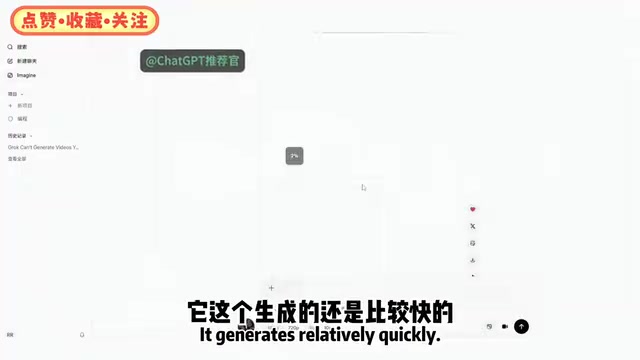
In actual testing, video generation speed was quite decent — roughly one minute to produce a clip. While duration and resolution are limited, it's already quite practical as a free tool for creating social media short video assets, product showcase animations, and similar use cases.
Complete List of Supported AI Models
The aggregation platform's model coverage is impressively broad, encompassing virtually all of today's most popular large models:

Conversational AI Models
| Model | Developer | Key Strengths |
|---|---|---|
| Grok 4 | xAI | Strong reasoning, excels at coding and math |
| ChatGPT 5.5 | OpenAI | Well-rounded capabilities, broad knowledge |
| Gemini | Multimodal understanding, excellent search integration | |
| Claude | Anthropic | Outstanding long-text processing, detailed responses |
These four models represent the current top tier of global AI large models, each with distinct strengths: ChatGPT has built the broadest user base through its first-mover advantage, performing consistently across natural language understanding and multi-task processing; Gemini is deeply integrated with Google Search and the Google Workspace ecosystem, offering unique advantages in multimodal (text, image, audio, video) understanding; Claude, founded by former core OpenAI researchers, is known for its "Constitutional AI" safety training methodology, supports up to 200K tokens of ultra-long context, and excels particularly in generating structured long-form text; Grok differentiates itself through real-time data access and strong reasoning capabilities. Different models excel in different vertical scenarios — creative writing, code debugging, data analysis — which is precisely the core value of an aggregation platform's "side-by-side comparison" capability.
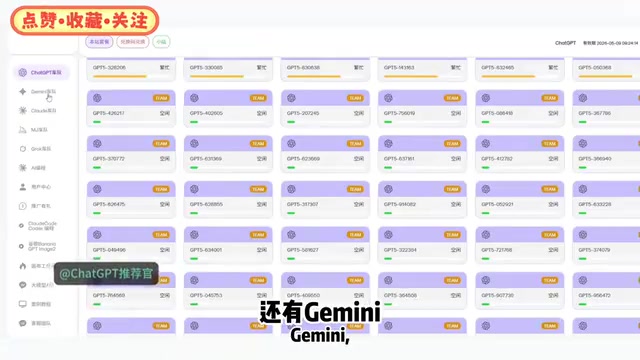
Image Generation AI Models
- Imagine / Imagine 2: The platform's proprietary image generation tool — fast with generous free quotas
- Midjourney (MJ): An industry-renowned AI art tool known for exceptional visual quality
- Nanobunana: A niche model with relatively generous free quotas, suitable for batch image generation
Background on image generation technology: Midjourney is one of the most commercially successful AI image generation tools, built on Diffusion Model technology. Diffusion models work by gradually adding noise to training images, then training a neural network to learn the reverse "denoising" process, thereby generating images from random noise that match text descriptions. Midjourney is renowned for its distinctive artistic style and high aesthetic quality, commanding a loyal following among designers and creative professionals. The Imagine and similar proprietary tools offered by aggregation platforms are typically fine-tuned from open-source models. While they may be slightly inferior to Midjourney in image quality, they offer more generous free quotas, making them suitable for everyday use where image quality requirements are less demanding.
Usage Recommendations: Who Should Use Aggregation Platforms?
Recommended Use Cases
These AI aggregation platforms are particularly suitable for the following types of users:
Related articles
 Tutorials
ChatGPT Plus Subscription Guide: Are GPT-5.5, image-2, and Codex Worth the Upgrade?
A detailed look at ChatGPT Plus features — GPT-5.5, image-2, and Codex — with a Plus vs Pro comparison and a complete step-by-step subscription guide for users outside the US.
 Tutorials
Harness AI Engineering in Practice: Using Claude Code to Master Enterprise-Level E-Commerce Development
Deep dive into Harness AI Engineering: master enterprise e-commerce development with Claude Code using the Rules, Skills, Wiki, and Changes framework.
 Tutorials
Cursor + Codex Dual-IDE Collaboration: A Practical Methodology for Open-Source Project Customization
A complete methodology for open-source project customization based on real-world experience, detailing the Cursor+Codex dual-IDE workflow, seven-stage process, MVP validation, and AI source code reading techniques.