Grok Bot vs ChatGPT Agent: Which AI Agent Is More Powerful?

Grok Bot and ChatGPT Agent work in different locations, suited respectively to workflow automation and web tasks.
The article compares xAI's Grok Bot with OpenAI's ChatGPT Agent, noting nearly opposite design philosophies. Grok Bot is a standalone app where each agent has a cloud computer, can log into authorized tools, and run multi-step tasks across applications even when your laptop is off—ideal for startups automating entire workflows. ChatGPT Agent works in the browser, completing multi-step web tasks and is more mature at general web tasks, suitable for research and first-time users. The core difference is work location. Choose ChatGPT Agent for general web tasks and Grok Bot for cross-tool automation. Maturity judgments come from a single YouTube channel review and may change with product iterations.
AI agents are evolving from "chatbots" into executors that can independently complete multi-step tasks, but different products have vastly different design philosophies. Grok Bot and ChatGPT Agent are often compared, and many people assume they do the same thing—when in reality, the two work in almost opposite ways.
What Is Grok Bot? A Persistent "Cloud Employee"
According to a comparative analysis by a YouTube tech channel, Grok Bot, launched by xAI, is an application separate from the Grok chatbot. Its core selling point: each agent has its own cloud computer, can proactively log into tools you've authorized, and can continuously complete multi-step tasks.
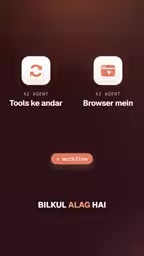
This means that even if your laptop is turned off, the task continues to progress in the cloud. The channel's description is vivid: Grok Bot is more like an "Always On Team," working inside the tools you use daily without requiring you to stare at a browser window.
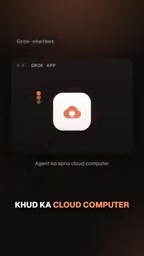
This form factor is suited to delegating repetitive workflows wholesale—such as cross-application data organization, scheduled task triggering, and multi-tool chained automation. The original article also notes that currently, Grok Bot's main user base consists of startups and users who want to "automate an entire segment of work."
AI Agent refers to an intelligent system capable of perceiving its environment, making autonomous decisions, and executing actions to achieve goals—distinct from chatbots that only generate text. Traditional chatbots follow a single-turn or multi-turn "input-output" conversation model, whereas AI agents possess task decomposition, tool invocation, state memory, and error recovery capabilities, enabling them to continuously execute multi-step operations without human intervention. Both Grok Bot and ChatGPT Agent fall into this category, but the former emphasizes persistent operation in a cloud virtual machine and proactive operation of external tools, while the latter focuses on web interaction within a browser environment. Understanding an agent's "work location" (cloud vs. browser) helps determine its capability boundaries: cloud agents can chain together cross-application workflows but require higher permission configuration; browser agents are easy to get started with but are limited by the web interface.
What Is ChatGPT Agent? A Mature "Browser Assistant"
ChatGPT Agent takes a completely different approach. According to the same source, it works in the browser: browsing web pages, clicking buttons, and completing multi-step web tasks.
The channel cites review opinions stating that ChatGPT Agent is currently more mature at general web tasks. In other words, its strength is "you say one sentence, and it operates on the web on your behalf," covering scenarios like research, information gathering, and form filling.
For users trying AI agents for the first time, the original article's assessment is: if you need general web tasks and research-type work, ChatGPT Agent is a safe and pragmatic choice.
General Web Task refers to online operations that do not rely on a specific website's API and can be completed solely by simulating human browsing behavior (such as clicking, scrolling, and filling out forms). Typical scenarios include information retrieval, price comparison, booking, and form submission. Such tasks require agents to have web page parsing, element localization, and dynamic interaction capabilities, typically implemented through browser automation frameworks (such as Playwright and Puppeteer). ChatGPT Agent's maturity in such tasks means it has good robustness and success rates when handling unstructured web interfaces. In contrast, workflow automation tasks that require cross-application, long-running operation (such as scheduled data synchronization and multi-system chaining) fall outside the scope of general web tasks and are better suited to agents with independent cloud environments (such as Grok Bot).
The Core Difference: Work Location Determines Capability Boundaries
The dividing line between the two is not model capability, but "where the agent works."

Grok Bot works inside tools and has its own cloud environment, so it can execute tasks across applications over extended periods—but this also means it requires higher authorization and configuration costs. ChatGPT Agent works in the browser, with more intuitive interaction and a lower barrier to entry, but its task boundaries are limited by web operations themselves.
Using the original article's metaphor: Grok Bot is an always-on team, while ChatGPT Agent is a mature assistant—the former waits for you to build the workflow, the latter waits for you to give instructions.
How to Choose?
Starting from practical scenarios, the decision logic can be straightforward:
- General web tasks, research, first-time agent experience: Prioritize ChatGPT Agent; its maturity and safety are more reliable.
- Cross-tool workflow automation, needing an agent to run independently for extended periods: Grok Bot's design is a better fit, especially for startup teams handing entire business processes to an agent.
Note that "more mature" and "better suited" here both come from the YouTube channel's review opinions and represent a single source's judgment; actual experience will change as products iterate. Before handing critical business to any agent, it's advisable to first validate its stability and permission boundaries with low-risk tasks.
The two agents are not substitutes for each other but cover two paths of automation: one operates outward on web pages, the other takes over the toolchain inward. Understanding this is more valuable than debating "which is stronger."
One-line Summary
Grok Bot and ChatGPT Agent work in different locations, suited respectively to workflow automation and web tasks.
Paragraph Summary
The article compares xAI's Grok Bot with OpenAI's ChatGPT Agent, noting that their design philosophies are almost opposite. Grok Bot is a standalone application where each agent has a cloud computer, can proactively log into authorized tools, and can continuously execute multi-step tasks across applications—even when the local machine is off—making it suitable for startups automating entire business processes. ChatGPT Agent works in the browser, completing multi-step web tasks by browsing pages and clicking buttons, and is more mature at general web tasks, suitable for research, information gathering, and first-time agent users. The core difference lies in work location: Grok Bot resides inside tools, while ChatGPT Agent operates on the web. Selection advice: choose ChatGPT Agent for general web tasks, and Grok Bot for cross-tool workflow automation. Note that maturity judgments come from a single YouTube channel review, and actual experience may change as products iterate.
Related articles

OpenAI Partners with Shield: How the Astra Agent Revolutionizes IT Troubleshooting
OpenAI and Shield launch the Astra agent, which autonomously logs into computers and legacy systems to fix IT issues in real time, 35-40% faster than traditional models, with humans involved only when judgment is needed.

iPhone Duo Battery Life Tested: One Charge a Day Is Unavoidable, and the Large Screen Is the Culprit
iPhone Duo battery test: heavy use needs at least one charge a day, and about 30% remains after 6.5 hours of screen-on time. How often the large screen is unfolded is key; a MagSafe battery pack helps, and long-term degradation is also worth watching.

Kimi K3.1 Pro Open-Sourced: 2.8 Trillion Parameters Close In on Opus
Moonshot releases the open-source MoE model Kimi K3.1 Pro, with 2.8T total parameters and 104B activated, trailing Opus 5.5 by under 1 point on Terminal Bench 4.0.