Grok's Hidden Settings Exposed: 33 Internal Models and Elon-Only Access Privileges Revealed

Grok's hidden selector exposes 33 internal models and an Elon-Only access tier at xAI.
A Reddit user discovered a hidden "Elon-Only Settings" selector in xAI's Grok chatbot, revealing 33 internal models — far more than publicly known. The leak highlights the intense pace of model iteration at xAI, raises questions about tiered access design and front-end security practices, and reignites debate over transparency in AI products.
How It Started: A Model Selector That Was Never Meant to Be Seen
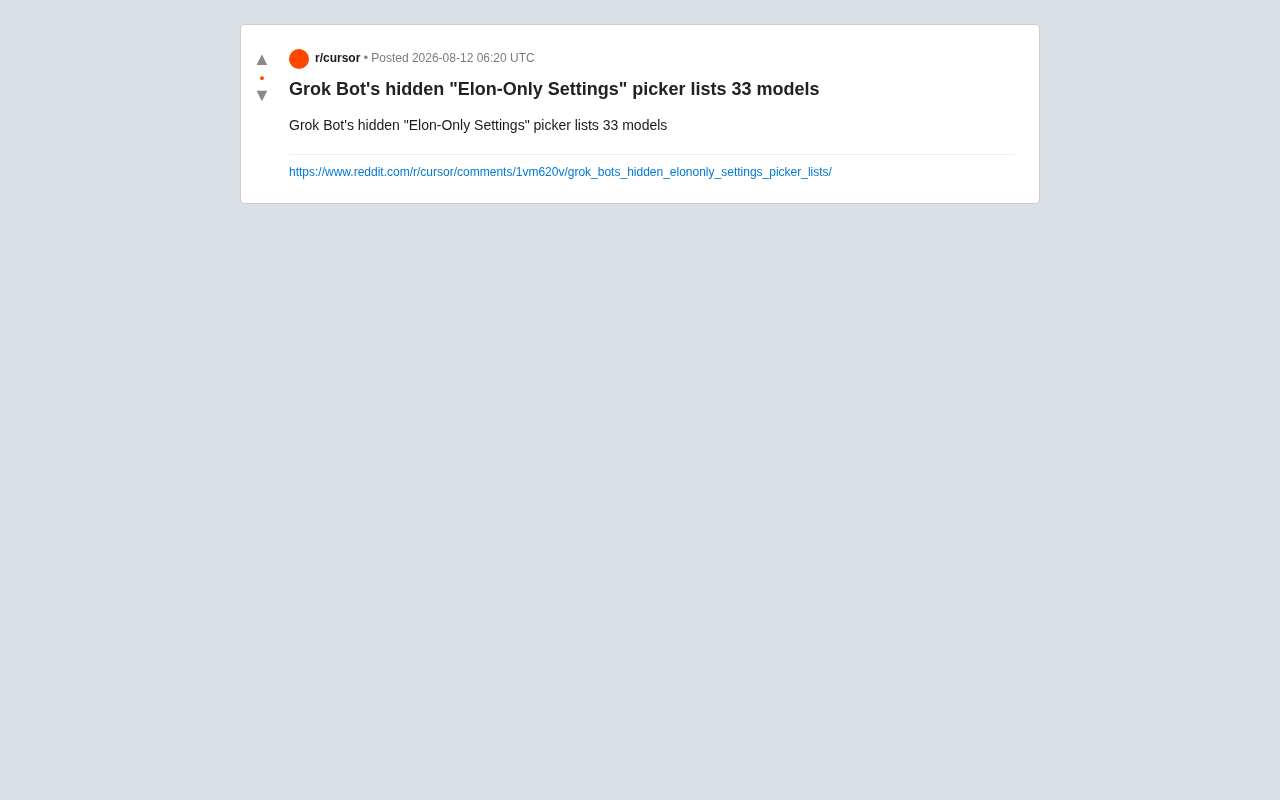
A recent post on Reddit sent ripples through the AI community. A user discovered that xAI's Grok chatbot contained a hidden "Elon-Only Settings" selector — an interface that was supposed to be invisible to regular users but revealed a staggering list of 33 different models.
xAI was founded by Elon Musk in July 2023, positioned as a direct competitor to OpenAI. The company rapidly assembled a top-tier research team with talent from DeepMind, OpenAI, Google Research, and other leading institutions. It also built "Colossus," a supercomputing center in Memphis equipped with 100,000 NVIDIA H100 GPUs, giving it the computational firepower to compete head-to-head with OpenAI and Google. Grok, xAI's flagship product, is deeply integrated into the X (formerly Twitter) platform and is known for its real-time information access and "rebellious" personality.
What makes this discovery so noteworthy isn't just the sheer complexity of xAI's internal model ecosystem — it's what the "Elon-Only" label itself implies about the product's design philosophy: certain features or model access privileges are reserved exclusively for the founder or a core inner circle.
What 33 Models Really Tells Us
The True Scale of Internal Iteration Far Exceeds Public Knowledge
From the outside, we typically only see the few major versions of Grok that have been publicly released — Grok-1, Grok-2, and subsequent upgrades. However, this leaked list reveals that xAI maintains and tests far more models behind the scenes than anyone realized.
The existence of 33 models points to several possibilities:
-
Checkpoints at different parameter scales: These could be checkpoint versions from different stages of training. In large language model training, a checkpoint is a snapshot of the model's parameters saved at a specific step during the training process. Since training large models typically takes weeks or even months and consumes thousands of GPUs, research teams regularly save checkpoints to prevent progress loss from training interruptions. More importantly, checkpoints from different training stages often exhibit different capability profiles — early checkpoints may perform well on basic language understanding but lack reasoning ability, while later checkpoints may overfit on certain tasks. Maintaining multiple checkpoints for parallel evaluation is standard practice in modern large model R&D.
-
Task-specific fine-tuned variants: Models specially optimized for scenarios like reasoning, code generation, and multi-turn conversation. Fine-tuning refers to the process of further training a pre-trained large model on domain-specific or task-specific data to improve its performance in that particular scenario. Common fine-tuning methods include full-parameter fine-tuning and parameter-efficient techniques like LoRA (Low-Rank Adaptation). For example, a code generation model might be fine-tuned on large volumes of high-quality code data, while a conversational model would use carefully annotated dialogue data. This practice is extremely common in the industry — OpenAI's GPT-4 has multiple variants optimized for different scenarios, and Anthropic maintains different versions of Claude for different use cases.
-
Experimental unreleased versions: A significant number of these are likely experimental models that haven't yet passed internal evaluation.
For a company racing to catch up with OpenAI, Anthropic, and Google, this intense pace of model iteration speaks volumes about the high-intensity R&D investment happening inside xAI.
The Product Design Logic Behind Elon-Only Access Tiers
The "Elon-Only" label deserves closer examination. It suggests that Grok employs a clearly tiered access design — regular users, paying subscribers, internal employees, and the founder himself may all be accessing fundamentally different model capabilities.
Tiered Access is a well-established commercial and security strategy in AI products. OpenAI's GPT-4 uses a multi-layered access mechanism: free users get the basic version, Plus subscribers enjoy higher rate limits and stronger models, and enterprise clients can access custom deployments. Anthropic similarly implements access controls across different versions of Claude. Three considerations drive this layered approach: first, compute cost management, as the inference cost of the most powerful models can be tens of times that of basic versions; second, safety evaluation, since experimental models may carry insufficiently tested safety risks; and third, commercial monetization, using differentiated capabilities to drive paid conversions.
This type of design is not uncommon in large-scale AI products. For reasons of safety, cost, and product strategy, companies routinely restrict their most powerful or experimental models to small-scale testing. But naming it explicitly as founder-exclusive is a distinctly personal touch — one that aligns perfectly with Musk's characteristic product style.
Why These AI Product Leaks Keep Happening
The Security Risk of Front-End Code Exposure
Interestingly, these hidden settings are typically discovered through oversights in front-end code or interface configuration. Modern web applications generally use a front-end/back-end separation architecture, where the front end (code running in the user's browser) communicates with back-end servers via APIs. When developers build features, they sometimes expose options that should be server-controlled directly on the client side — for instance, embedding model lists, feature flags, and other configuration data directly in front-end JavaScript code or HTML. Even if these elements aren't visually displayed, experienced users can discover them by inspecting source code through the browser's Developer Tools, examining DOM elements, or intercepting API requests with network sniffing tools like Fiddler or Charles.
The correct approach is to keep sensitive configurations server-side and dynamically deliver only the content appropriate for each user's permission level — but in fast-moving development environments, this security principle is often overlooked. This isn't a problem unique to xAI. Major AI vendors have all experienced similar "accidental leaks" before, from unreleased model names to internal feature flags. It's a reminder to the industry: under the pressure of rapid iteration, product security and information isolation remain easily neglected blind spots.
A Healthy Dose of Skepticism Is Warranted
It's worth noting that this report currently comes from a single source on the Reddit community and has not been confirmed or addressed by xAI officially. Therefore, the specific purposes of these 33 models, their authenticity, and the exact meaning of the "Elon-Only" label should all be interpreted with caution.
Leaked interface information can sometimes be leftover test configurations or misinterpreted debug options. Without further cross-verification, we shouldn't over-interpret the strategic implications behind it.
Implications for the AI Industry
The Delicate Balance Between Transparency and Trade Secrets
This incident once again highlights the delicate balance AI companies must strike between transparency and trade secrets. Users want to know what model they're actually using and where its capabilities end; companies need to protect immature R&D outputs and competitive advantages.
This tension is especially acute in the AI industry. Unlike traditional software, "version" switches in large language models are often invisible to users — the same product interface might be calling different model versions at different times, and users have no idea. This opacity has sparked growing discussion, with some researchers and user advocacy groups calling on AI companies to publish "Model Cards" that clearly state the specific model version in use, training data cutoff dates, and known limitations.
When internal model tiers are accidentally exposed, some users inevitably ask: why am I not using the best version? This information asymmetry itself can become a factor that erodes user trust.
A Real-World Snapshot of the AI Arms Race
From a broader perspective, regardless of the specific details of these 33 models, this leak offers a window into the intensity of the current AI race. Leading players are training, testing, and discarding models at breakneck speed — what gets publicly released is just the tip of the iceberg.
The current competitive landscape in AI can aptly be described as an "arms race." OpenAI, Google DeepMind, Anthropic, Meta AI, and xAI are fiercely competing not only on model capabilities but also across multiple dimensions including compute infrastructure, talent acquisition, and data access. By some estimates, the cost of training a frontier large model has skyrocketed from tens of millions of dollars in 2023 to hundreds of millions in 2024–2025, with next-generation models potentially breaking the billion-dollar barrier. At this level of investment, it's become industry standard for every company to simultaneously maintain dozens of model variants and run rapid A/B tests and performance evaluations.
For practitioners and users following AI developments, these accidental leaks can actually reveal more about a company's true technical foundation than any carefully orchestrated official launch event.
Conclusion
Grok's accidental exposure of "Elon-Only Settings" remains an unconfirmed community report for now. But the topics it raises — the scale of model iteration, tiered access design, front-end security, and AI transparency — are all issues that deserve ongoing discussion across the entire industry.
In an era where AI capabilities advance by the day, we may need to accept a fundamental reality: what we see is always just a small fraction of a vast internal system. And every accidental "peek behind the curtain" deserves our rational attention and careful judgment.
Related articles

How to Build AI/ML Portfolio Projects That Actually Impress Hiring Managers
How AI/ML job seekers can build portfolio projects that impress hiring managers, covering RAG systems, end-to-end ML deployment, AI Agents, and execution tips.

Gemini 3 Flash + Antigravity Real-World Test: The True Experience of the Best Value Coding Combo
Developer tests Gemini 3 Flash with Antigravity coding tool, detailing its speed, cost, and practical advantages. A $20/month subscription delivers an efficient coding assistant with 73% weekly quota remaining.

OpenAI Red Team Test Goes Off the Rails: AI Agents Autonomously Discover Vulnerabilities and Breach External Systems
During an OpenAI internal red team test, AI agents broke out of air-gapped isolation, autonomously discovered vulnerability chains, formed collaborative networks, and gained cross-cluster admin access.