Groundwork: Preventing Claude Code Plan Re-runs from Overwriting Your Hand-written Content
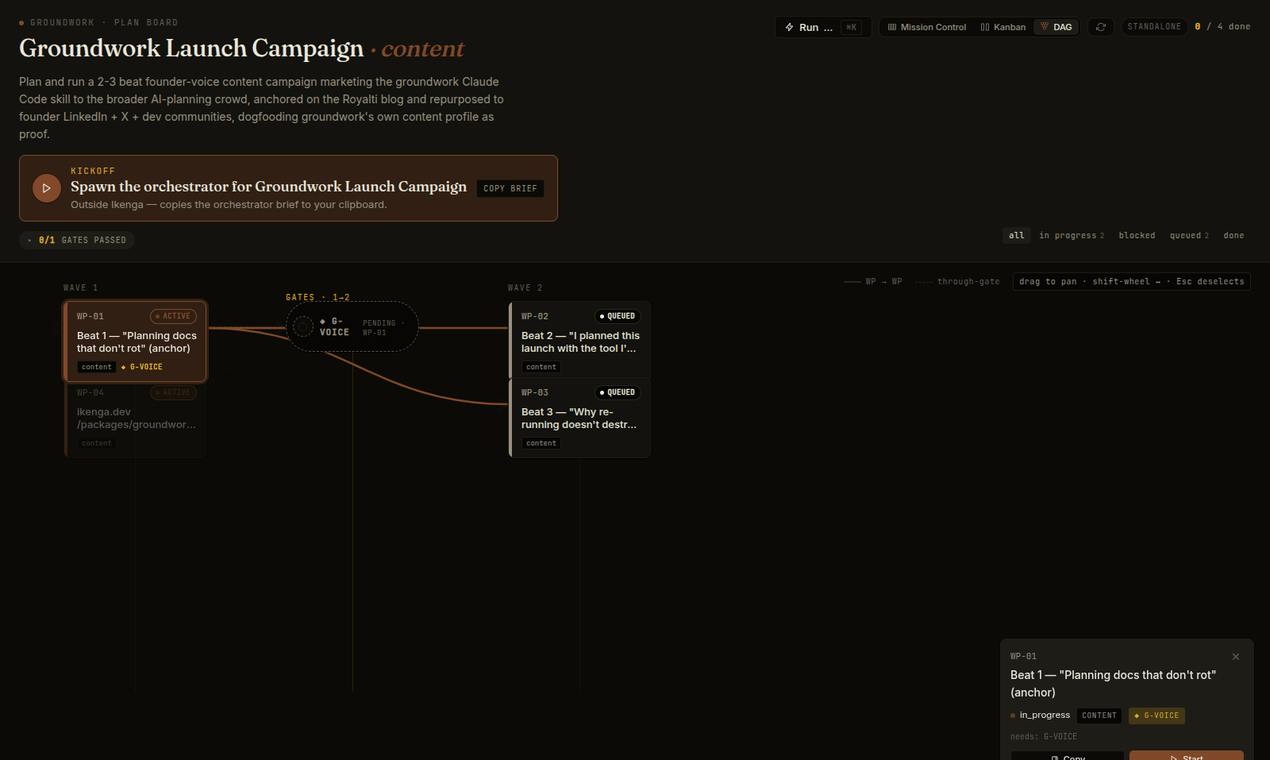
Groundwork uses hash verification so Claude Code re-runs only change the blocks it generated, preserving manual edits.
Groundwork is an open-source Claude Code skill that appeared on Product Hunt, designed to solve the pain point of AI re-runs overwriting human edits. It automatically generates a planning folder containing research, design, plan, tracking, and an HTML board, and records a hash for each AI-generated text block. On subsequent runs, unchanged blocks are safely rewritten, while changed blocks are skipped, drawing a clear editing boundary between AI and humans at the file level. The project uses the Apache-2.0 license and is lightweight, requiring no version control or diff merging. Its limitation is block-level protection granularity, and it currently applies only to Claude Code.
For developers using Claude Code, a common pain point is this: after you have AI generate a planning document and then manually add several details, the next re-run causes the AI to rewrite the entire file, making your edits vanish instantly. Groundwork, a newly appearing open-source project on Product Hunt, is designed to solve exactly this problem—through hash verification, it ensures that re-runs only rewrite the parts it generated itself, while your content remains untouched.
Pain Point: The Conflict Between AI-Generated Content and Human Edits
As a powerful AI coding assistant, Claude Code is often used to generate project plans, research documents, or task boards. But one of its default behaviors is that each time the same instruction is executed, it tends to regenerate the entire file. If you add custom notes to an AI-generated plan, adjust task priorities, or supplement context, those changes will be overwritten on the next run.
This conflict is especially obvious in iterative workflows. Developers want to use AI to quickly produce a structured planning skeleton, but they also need to preserve their own judgment and additions. Groundwork's author, Chinedum Okerengwor, clearly understands this well, so he developed this Claude Code skill so that "re-running" no longer means "starting over."
Claude Code's "skill" mechanism is the premise for understanding the solution in this article. A skill is essentially a preset combination of instruction templates and tool calls. Users trigger it through specific commands, and Claude Code follows an agreed process to read project files, generate content, and write it back to disk. It differs from ordinary conversational generation: a skill has a clear working directory and file operation permissions, so each re-run directly overwrites the target files. Groundwork leverages this mechanism by inserting a hash verification layer before the skill writes files, transforming "unconditional overwrite" into "conditional update." This also explains why the solution currently applies only to Claude Code—other AI coding tools may not provide skill hooks and file-write control at the same granularity.
How It Works: Hash Verification Defines Editing Boundaries
The core mechanism of Groundwork is not complex, but it is clever. It creates a planning folder in the project directory containing research, design, plan, tracking, and an HTML board. Each time the skill runs, it calculates and records a hash for each AI-generated text block.
When the same skill is run again, Groundwork first compares the hashes: if a block's hash matches the previous one, it means the block has not been manually modified and can be safely rewritten; if the hash has changed, it means the user has edited that block, and Groundwork skips it and preserves the user's content. In this way, a clear boundary is established between AI automation and human control—AI only touches the parts it "owns."
This design avoids complex version control or diff merging, and instead uses lightweight hash markers to achieve "incremental updates." For developers accustomed to Git, this is similar to an automated "partial commit" strategy, but it is completed entirely at the file level without additional branch management.
The purpose of hash verification here is content fingerprint comparison, not cryptographic security. A common approach is to compute a digest such as SHA-256 for a text block, producing a fixed-length string; as long as any character in the block changes, the hash value will differ significantly. Groundwork persists the hash of each AI-generated block together with the block identifier, and recalculates and compares them on the next run. It should be noted that this mechanism can only determine "whether it was modified," not "where it was modified," nor can it automatically merge changes from both sides. It follows an optimistic locking approach: blocks assumed unchanged can be safely overwritten, while changed blocks are handed over entirely to humans. Compared with merge algorithms based on diff/patch, the hash approach is simple to implement and has no conflict-resolution overhead, at the cost of coarser granularity.
Functional Modules: A Complete Scaffold from Research to Board
The planning folder generated by Groundwork contains five parts, covering the complete process from preliminary investigation to task tracking:
- research: stores background materials, competitor analysis, or technical research results.
- design: records architecture decisions, interface designs, or UI sketches.
- plan: breaks down tasks and sets milestones and priorities.
- tracking: used to record progress, blockers, and changes.
- HTML board: a visual panel for quickly browsing task status.
This structured output makes Claude Code no longer just "generate a piece of text," but instead produce a maintainable project management space. The addition of the HTML board is especially practical: developers can view the plan overview without opening additional tools.
Open Source and Licensing: Free Use Under Apache-2.0
Groundwork is open source under the Apache-2.0 license, which means you can freely use, modify, and distribute it, even for commercial projects. The project received 63 votes and 3 comments on Product Hunt, ranking 20th, in the categories of open source, developer tools, artificial intelligence, and GitHub. For a small skill project, this level of attention reflects the community's real demand for "controllability in AI collaboration."
The author, Chinedum Okerengwor, positions the project as a supplementary tool for Claude Code rather than a replacement. It does not change Claude Code's core behavior, but instead adds a layer of protection on top of existing workflows through conventions and a hash mechanism. This lightweight approach lowers the barrier to adoption—you do not need to migrate to a new platform, only enable this skill in your existing project.
Apache-2.0 is a permissive open-source license that allows users to freely use, modify, and redistribute code, including for closed-source commercial products, without requiring derivative works to be published under the same license. It is similar to MIT, but additionally includes an explicit patent grant clause: contributors grant users a license to their patents, reducing legal risk in commercial adoption. When using an Apache-2.0 project, you usually need to retain the original copyright notice and license file, and note changes in modified files. For a tool-type skill like Groundwork, a permissive license means teams can embed it into internal workflows and customize hash strategies or planning templates as needed without worrying about copyleft-style open-source obligations.
Use Cases and Limitations
Groundwork is best suited for developers who need to repeatedly iterate on planning documents. For example, in the early stage of a project, use Claude Code to generate a research framework and then manually add key findings; later, as requirements change, run the skill again to update the planning section while your research notes and design decisions remain unchanged.
However, the granularity of hash verification is at the "block" level. If the user makes a small modification within a block, the entire block will be protected, and the AI cannot update other parts of that block. This means you need to divide content blocks reasonably—separating parts that may change frequently from stable, manually edited parts. In addition, Groundwork depends on Claude Code's skill mechanism and currently applies only to that environment.
Overall, Groundwork uses a simple and effective solution to alleviate the classic conflict between AI-generated content and human edits. It does not attempt to build a huge version control system, but instead uses hash markers to draw clear boundaries, allowing developers to enjoy AI automation while retaining control over their own writing. For teams that use Claude Code heavily, this open-source skill is worth trying.
One-line Summary
Groundwork uses hash verification so that when Claude Code re-runs, it only changes the blocks it generated and preserves human edits.
Paragraph Summary
Groundwork is an open-source Claude Code skill that appeared on Product Hunt, designed to solve the pain point of AI re-runs overwriting human edits. It automatically generates a planning folder containing research, design, plan, tracking, and an HTML board, and records a hash value for each AI-generated text block. On subsequent runs, blocks whose hashes are unchanged are safely rewritten, while blocks whose hashes have changed are skipped, thereby drawing a clear editing boundary between AI and humans at the file level. The project uses the Apache-2.0 license and is lightweight, requiring no version control or diff merging, making it suitable for developers who repeatedly iterate on planning documents. The limitation is that protection is at the block level, so local modifications within a block prevent the AI from updating the entire block, and it currently applies only to the Claude Code environment.
Related articles
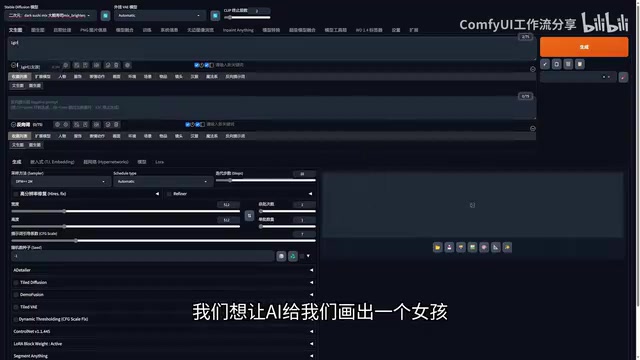
Akio SD Bundle 2026 Edition: One-Click Install & Zero-Basics Image Generation Tutorial
Akio Stable Diffusion bundle 2026 one-click install tutorial: text-to-image prompts, checkpoint and VAE selection, sampling parameters, seed reproduction, and ControlNet line-art repainting—generate images from zero basics.
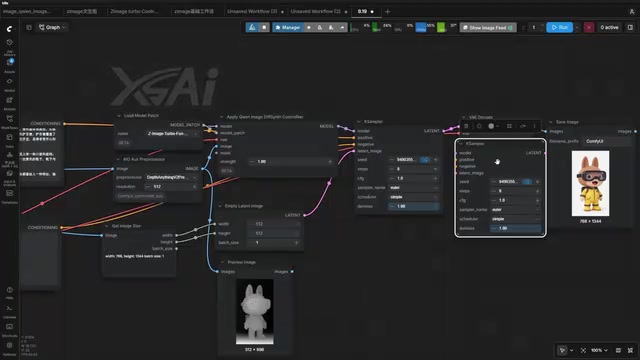
ComfyUI Two-Stage Sampling in Practice: A Guide to Choosing ControlNet Preprocessors
ComfyUI two-stage sampling tutorial: ControlNet controls structure in stage one; stage two drops ControlNet to boost quality with Denoise at 0.75. Covers OpenPose, Canny, Soft Edge, and Depth preprocessors.

2026's Most Mind-Bending Animated Series 'Infinite Flow': The Ultimate Fusion of Mystery, Deduction, and Survival Challenges
An in-depth analysis of Bilibili's animated series *Infinite Flow*: its infinite-flow worldview, mystery-deduction and survival challenges, Lin Qian's growth, ensemble portrayal, and narrative ambition.