Growing Potatoes in a Paper Bag: A 3-Month Harvest Big Enough to Feed a Family of Four

YouTuber grows three potatoes in a paper bag, harvesting enough for a family meal in three months.
A YouTube creator planted three Delaware potatoes in an ordinary paper bag. After three months, the bag held up and the harvest fed a family of four for one meal, though the potatoes were small—likely due to shallow planting. The experiment confirms paper bags work as short-term containers, especially on a budget, but better depth, hilling, and drainage are needed for higher yields.
Growing potatoes in a paper bag sounds like a gardening newbie's wild idea, but one YouTube creator actually did it—and harvested enough potatoes to feed a family of four for a meal. This experiment not only shows how fun growing food can be, but also reveals some key details about small-space gardening.
The Experiment: Three Potatoes, Three Months, One Paper Bag
The creator chose three Delaware potatoes and planted them directly into an ordinary paper bag. After three months of growth, the bag still "held up pretty well," with no tearing or falling apart. That alone is an interesting finding: a paper bag works as a temporary growing container for short-cycle crops.
However, the harvested potatoes were on the small side, and the creator wondered aloud: "Is this going to be a harvest of baby potatoes?" He speculated that planting deeper might have produced a better yield.
Delaware is a native American potato variety, an early-to-mid-season type with a growing period of roughly 70–90 days, well suited to temperate regions. Its tubers are oval with smooth skin and shallow eyes, and the texture is on the floury side—good for baking, boiling, or mashing. Choosing this variety for the paper bag experiment makes some sense: early-to-mid-season means the full cycle from planting to harvest fits within three months, and the bag's limited volume helps keep plant size in check. That said, Delaware wasn't bred specifically for container growing, so its yield potential takes a hit in confined spaces—one of the potential factors behind the small potatoes.
The Harvest: Small Potatoes, But Enough for a Meal
Opening the bag, the potatoes came tumbling out. Though not large, there were enough for a family of four to have a meal. The creator figured he'd "broken even" and called it "an easy meal."
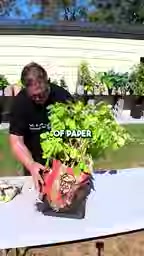
In terms of input versus output, three seed potatoes for a family meal is a decent result for balcony or small-space growing. Especially considering the paper bag costs essentially nothing, this approach feels more like a low-barrier gardening experiment.
Bag Durability and Planting Depth
The most surprising part of the whole experiment was the bag's durability. Over three months it withstood the pressure of soil, moisture, and roots and still "held up decent." This suggests a paper bag can substitute for a traditional pot with short-cycle crops (like potatoes and radishes), especially for budget-conscious or temporary growing setups.
But the creator also pointed out a key mistake: planting depth. Potato tuber formation needs enough soil cover; if planted too shallow, the stolons tend to reach the surface, resulting in smaller or green tubers. The small size of this harvest was very likely related to insufficient depth.
Potato tubers don't simply swell at the ends of roots—they form from the swollen tips of stolons. Stolons grow from the underground portion of the main stem, and if there isn't enough soil cover, they come close to or break the surface. Tubers exposed to light turn green and accumulate solanine, while their growth is also restricted, leaving them small. That's why the standard practice for growing potatoes is "plant deep + hill up repeatedly": start with about 10–15 cm of soil cover, then hill soil around the base 2–3 times as the plant grows, creating continuous underground space for the stolons. In a paper bag, the soil surface settles with watering, so the actual depth of cover often ends up shallower than expected—exactly the technical root cause behind the "planted too shallow, got small potatoes" outcome described here.
What Small Potatoes Tell Us: Room to Optimize Container Growing
So does this harvest count as "a bumper crop of baby potatoes"? The creator didn't give a definitive answer, but the footage shows the potatoes really weren't big.
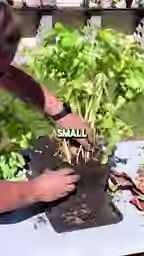
For growers who want to replicate this experiment, there are several things to improve: choose a deeper container or keep hilling soil as the plant grows; use a sturdier paper bag or add a liner inside; and ensure adequate light and drainage. Growing potatoes in a paper bag isn't a gimmick—it's a lightweight growing approach worth trying, provided you accept "small size, small yield" as the outcome.
Another key variable in container-grown potatoes is drainage. Potatoes dislike waterlogging; standing water can rot seed potatoes or cause scab on tuber skins. A paper bag itself isn't permeable, so if there are no holes in the bottom, excess water after watering will pool at the base, creating an anaerobic environment. The fix is to punch several drainage holes in the bottom and lower sides of the bag, and put a layer of gravel or coarse material at the bottom as a drainage layer. Also, paper bag material loses strength under prolonged moisture; adding a biodegradable liner inside or switching to a heavier kraft paper bag can extend its lifespan without significantly raising costs, making the whole growing season more stable.
Conclusion: A Workable Example of Low-Cost Growing
The value of this experiment isn't in how high the yield was, but in validating a simple idea: you can grow potatoes in a paper bag. Three Delaware potatoes, three months, one paper bag—and a meal for the whole family. For urban gardening enthusiasts, this might just be the most down-to-earth way to get started.
One-line Summary
A YouTube creator grew three potatoes in a paper bag and harvested enough for a family meal in three months, proving low-cost growing is feasible.
Paragraph Summary
A YouTube creator planted three Delaware potatoes in an ordinary paper bag. After three months, the bag was still intact and the harvest was enough for a family of four to have a meal—though the potatoes were small. The creator suspects shallow planting was the main cause, since tuber formation requires enough soil cover. The experiment shows a paper bag works as a short-term growing container, especially for budget or temporary setups, but improving yield requires optimizing depth, hilling, and drainage. Overall, it's a low-barrier, low-cost gardening example whose value lies in testing an idea rather than maximizing yield.
Related articles

Kimi K3.1 Pro Hands-On: Open-Source Model Nears Claude Opus 5.5
Moonshot AI releases Kimi K3.1 Pro: 3T parameters, 1M-token context, beating Claude Opus 5.5 on 9 of 14 benchmarks. Hands-on shows it nearing frontier closed models in 3D, frontend, and finance at a fraction of the cost, though robotics and complex reasoning remain weak.

Major US Banks Block AI Agents: Can AI Touch Your Money?
JPMorgan, Citibank, Bank of America, and Charles Schwab reportedly block AI agents from accessing customer accounts. This analysis examines why banks are blocking AI agents, the identity boundary problem, and the impact on AI financial assistants.

AI Agent Security Field Manual: Defending Against Injection, MCP Poisoning, and Zero-Click Leaks
AI Agent security field guide: from the lethal trifecta and prompt injection principles, with six real cases (Copilot zero-click leak, Slack AI, MCP poisoning, malicious NPM package, Glassworm invisible characters, OAuth supply chain attack), nine layers of defense controls (least privilege, sandboxing, default deny, egress monitoring), three-tier implementation roadmaps for individuals, teams, and enterprises, and a first-hour incident response checklist.