Guardians of the Python Ecosystem: PSF Year-End Fundraiser Launches

The PSF launches its year-end fundraiser, calling on companies and individuals who benefit from Python to donate in support of ecosystem health.
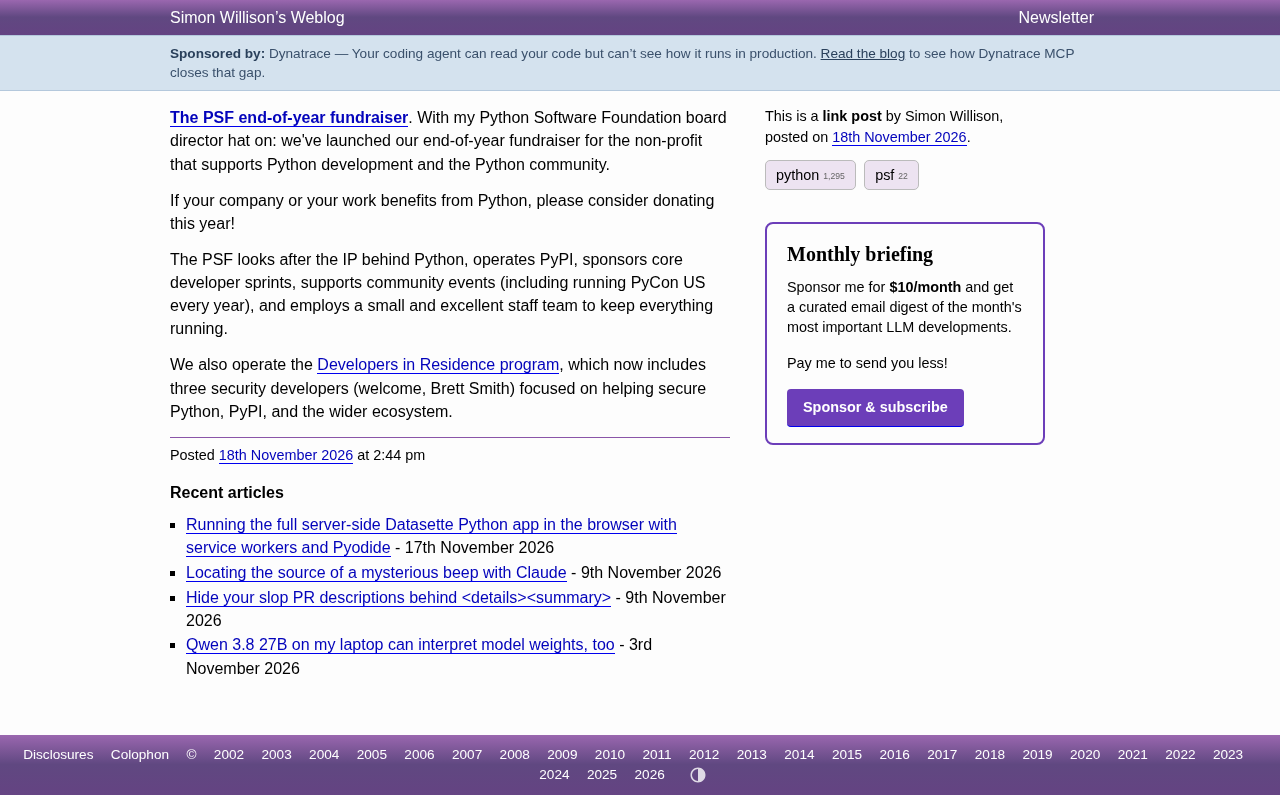
Simon Willison, a board member of the Python Software Foundation (PSF), announced the launch of the annual year-end fundraising campaign, calling on companies and individuals who benefit from Python to support this nonprofit organization. The PSF manages Python intellectual property, operates PyPI, sponsors CPython core developer sprints, supports community events such as PyCon US, and employs a professional team to keep operations running. Its Developers in Residence program recently expanded to three security developers focused on improving the security of Python, PyPI, and the ecosystem. Willison emphasized that if a company or job benefits from Python, it should consider donating—both as a way to give back to open source and as an investment in the stability of its technology stack. Donations can be made via donate.python.org.
Simon Willison, a board member of the Python Software Foundation (PSF), recently announced the launch of the annual year-end fundraising campaign, calling on companies and individuals who benefit from Python to support this nonprofit organization.
What Does the PSF Do?
The PSF is a nonprofit organization that supports Python development and community growth. Its core work includes:
- Managing Python intellectual property: Safeguarding the Python language's trademarks and copyrights to ensure its openness and neutrality.
- Operating PyPI: Maintaining the Python Package Index, the core infrastructure through which Python developers worldwide obtain dependency libraries.
- Sponsoring core developer sprints: Providing funding for CPython core developers' focused development activities.
- Supporting community events: Including hosting major conferences such as PyCon US each year and funding Python community events around the world.
- Employing a professional team: Maintaining a lean, efficient staff to keep the above work running continuously.
Much of this work happens behind the scenes, yet it forms the cornerstone of the Python ecosystem's prosperity.
PyPI (Python Package Index) is Python's official third-party package repository. Through the pip install command, developers can download and install hundreds of thousands of open-source libraries from it. It is not only the dependency distribution hub of the Python ecosystem but also one of the largest open-source package indexes in the world, supporting the build and deployment pipelines of millions of projects. The stable operation of PyPI directly affects the software supply chain security of countless enterprises, so its operations, bandwidth, and security protection costs are all borne by the PSF.
Developers in Residence Program: Strengthening Python Security
The PSF also operates the Developers in Residence program, which recently underwent an important expansion: the program now includes three security developers, with Brett Smith newly joining. They focus on improving the security of Python, PyPI, and the broader ecosystem.
As Python is widely used in critical infrastructure, the importance of security investment is increasingly prominent. This initiative reflects the PSF's commitment to the long-term health of the ecosystem.
CPython is the reference implementation of the Python language—that is, the standard interpreter most developers use every day. It is maintained by a team of core developers responsible for the evolution of the language syntax, standard library, and interpreter performance. The work of CPython core developers is largely voluntary, and the PSF supports these key contributors by sponsoring focused development activities such as "sprints," providing travel and venue support, thereby ensuring the continuous improvement and stable releases of the language itself.
Why Is Support Worthwhile?
In the announcement, Simon Willison emphasized: "If your company or work benefits from Python, please consider donating this year!"
For enterprises, the value brought by Python often exceeds expectations—from data analysis and machine learning to web development, Python is everywhere. Yet the funding the PSF needs to keep all of this running relies heavily on community donations.
Donating is not only a way to give back to open source but also an investment in the stability of a company's own technology stack.
Open-source software supply chain security refers to risk management across the entire chain, from introducing dependency libraries to building and distribution. Python projects typically depend on a large number of third-party packages, and if an upstream package is implanted with malicious code or has a severe vulnerability, the impact can spread rapidly along the dependency chain. The PSF's security developer team addresses this risk by auditing PyPI and core tools, responding to vulnerabilities, and promoting best practices, helping enterprises reduce the probability of security incidents caused by dependency contamination.
How to Participate?
Visit donate.python.org to make a donation. Regardless of the amount, every contribution will be used to maintain the healthy development of the Python ecosystem.
For individual developers, donating is a way to express gratitude; for enterprises, it is a wise move to ensure the continued maintenance of critical dependencies.
Related articles

Why Microsoft CEO Nadella Still Backs Nvidia After Jensen Huang's Departure
Microsoft CEO Nadella publicly expresses confidence in Nvidia interim CEO Colette Kress. This article analyzes Nvidia's power transition after Jensen Huang's departure, Microsoft's compute dependency, and the trust logic of the AI supply chain.

Nadella: Critical Infrastructure Is 'Unpatchable' as AI Cybersecurity Arms Race Escalates
Microsoft CEO Nadella addresses AI cyberattack fears, saying much critical infrastructure is unpatchable, downplaying the Outlook outage, and analyzing AI's dual role in cybersecurity.

Musk Backs Jensen Huang: Firing Him Is Like Cutting Jordan
Musk says Jensen Huang is loyal to the U.S. and likens firing him to cutting Michael Jordan—highlighting politicization anxieties in the AI chip industry and defending talent value.