Gudea: Using AI to Track Online Sentiment and Intercept Social Media Crises Before They Erupt

Gudea uses AI to trace rumor propagation paths, striving to issue early warnings before social media crises erupt.
Gudea positions itself as an 'internet storm tracker,' using AI to trace how stories and rumors propagate online, helping organizations take action before a social media crisis fully erupts. The article notes that traditional sentiment tools focus on content that has already gained traction, while the source of a crisis often appears in the time window before热度 builds up. As AI-generated misinformation, deepfakes, and mass bot accounts make rumor identification significantly harder, AI needs to handle both content authenticity judgment and propagation potential prediction. For organizations, the value of early warning lies in compressing reaction time from hours to minutes. But such tools also face the challenge of balancing false positives and missed detections, as well as privacy boundaries and compliance challenges when scanning public content.
A seemingly insignificant post — perhaps just an unverified rumor or an AI-generated fake image — can escalate into a full-blown PR disaster across the internet within hours. Gudea aims to sound the alarm before the storm takes shape. Positioning itself as an "internet storm tracker," the company uses AI to trace how stories and rumors propagate online, helping organizations take action before a social media crisis erupts.
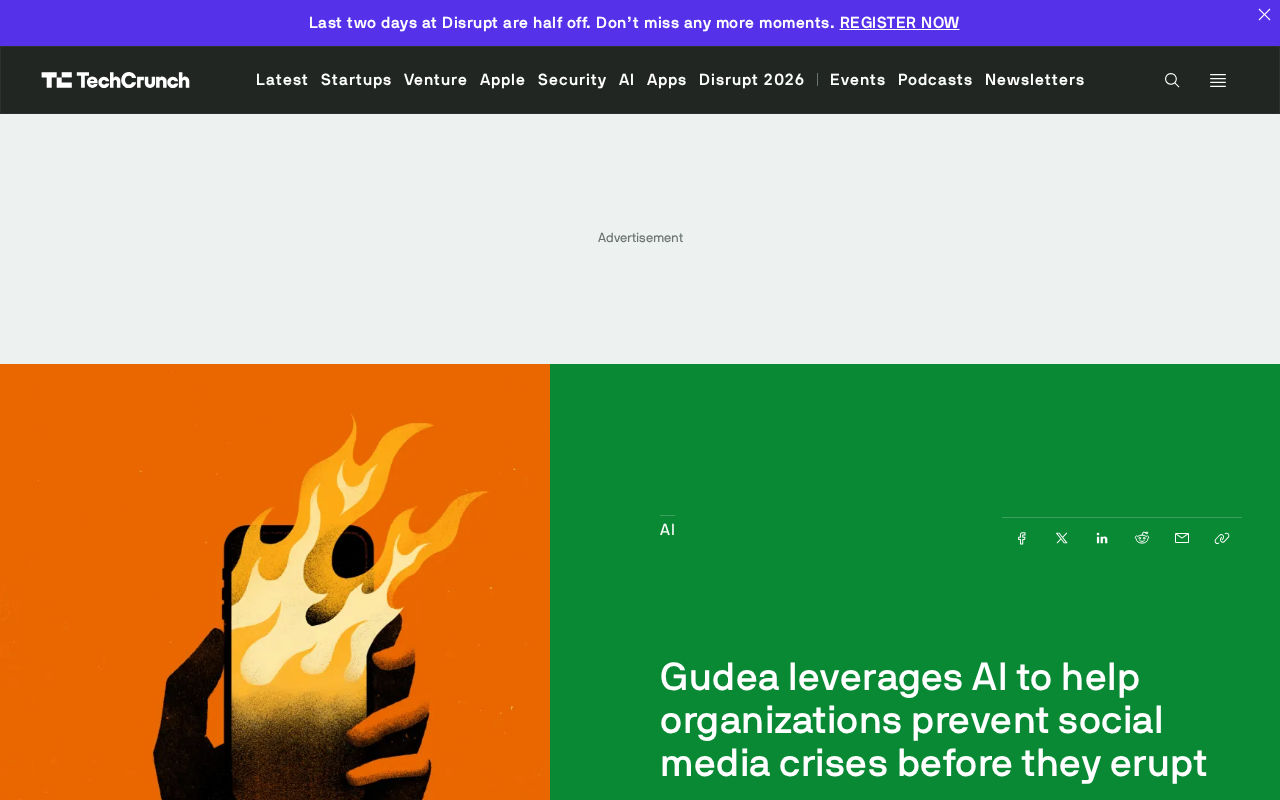
The Propagation Logic of Social Media Crises Is Changing
According to the report, conversations on social media and websites unfold continuously across the globe every day. A post that appears unremarkable — whether it involves AI-generated misinformation, hate speech, or destructive rumors — can quickly snowball into a broader public controversy.
This "small spark ignites a wildfire" pattern is precisely the blind spot of traditional sentiment monitoring tools. Most tools focus on content that has already gained traction — topics that have already been widely shared and commented on. But the true source of a crisis often emerges in the time window before热度 builds up. Whoever can identify "content with viral potential" earlier has a better chance of intervening before public opinion spirals out of control.
Gudea positions itself as an "internet storm tracker," and this metaphor itself illustrates its approach: rather than waiting for the storm to make landfall and then tallying the damage, it identifies the storm's path during the pressure-change phase.
What Role Does AI Play in Sentiment Early Warning
Based on the information provided in the report, Gudea's core capability is tracking the spread of stories and rumors online. This relies on continuous scanning and pattern recognition of massive volumes of social content.
Notably, the report specifically mentions "AI-generated misinformation" as one of the crisis triggers. This means today's sentiment environment is more complex than before: deepfake images, AI-generated inflammatory copy produced at scale, and bot accounts disguised as real users have all raised the difficulty of rumor identification by an order of magnitude. Traditional keyword filtering and manual review struggle to keep up with this generation speed.
AI takes on work in two directions here: first, identifying which content may be AI-generated disinformation; second, assessing whether that content has the potential for viral spread. The former is a judgment of content authenticity, the latter a prediction of propagation dynamics — only by combining both can effective early warning be achieved.
Propagation dynamics is a key background for understanding this type of early warning tool. It studies the speed, scope, and morphology of information diffusion in social networks, with core variables including the depth of sharing chains, the presence of bridging nodes across communities, and the emotional arousal intensity of content. Research generally finds that content with high-arousal emotions (such as anger and fear) spreads significantly faster than neutral content; and false information often travels farther and faster than true information. AI models learn from these historical propagation patterns to assign a "probability of eruption" score to newly emerging content. It's worth noting that predictive models rely on correlation rather than causation, so when platform algorithms, trending contexts, or bot strategies shift abruptly, the model's judgment may rapidly decay — this is also an important reason why sentiment prediction accuracy is difficult to maintain over the long term.
Deepfakes and AI-generated content have seen their technical barriers drop rapidly. Early face-swap videos required extensive material and computing power, but today's diffusion model-based tools need only a few photos or a text prompt to generate realistic images, audio, and even video. At the text level, large language models can mass-produce posts with natural tone and inflammatory stances, which, combined with automated account matrices, form coordinated publishing behavior that is difficult to identify manually. This creates a dilemma for detection: on one hand, the higher the generation quality, the harder it is to distinguish by eye or simple metadata; on the other hand, detection models themselves are engaged in continuous adversarial competition with generation models — a classic "cat-and-mouse game" where no single detection method can remain effective for long. Therefore, the industry trend is shifting toward multi-signal comprehensive judgment, such as anomalous account behavior, clustered posting times, and cross-platform synchronization.
Why Organizations Need "Lead Time"
For enterprises, government agencies, and nonprofits, the cost asymmetry in responding to social media crises is stark. Preemptive intervention may require only a clarification or a communication; post-hoc handling may involve stock price fluctuations, loss of brand trust, or even legal disputes.
What Gudea offers is essentially compressing reaction time from "hours" to "minutes" — or even earlier. This is not about helping organizations suppress public opinion, but about having the opportunity to intervene with facts while rumors have not yet solidified and public perception has not yet hardened.
From an industry perspective, the value of such tools also lies in changing the decision-making rhythm of PR and risk management. In the past, the KPI for sentiment teams was often "response speed"; now, "early warning accuracy" and "lead detection volume" may become more critical metrics.
The Challenges Are Equally Evident
Any sentiment early warning tool faces a fundamental difficulty: how to distinguish "what will blow up" from "what won't." Too many false positives, and teams fall into alert fatigue; too many missed detections, and the tool loses its meaning.
Moreover, tracking rumor propagation also involves issues of privacy boundaries and platform rules. The scope within which public content can be scanned, and how this data is stored and analyzed, are compliance issues such companies must confront. The report does not disclose Gudea's specific practices in this regard, which is also a direction worth watching going forward.
Summary
Gudea taps into a real and increasingly urgent need: AI makes it easier to produce disinformation, social media makes it spread faster, and organizations need earlier warning signals. Advancing sentiment monitoring from "post-hoc statistics" to "pre-event prediction" is a reasonable direction in itself. The real test lies in whether prediction accuracy can be stable enough to support decision-making, and whether such tools can operate sustainably within a framework of privacy and compliance.
One-line Summary
Gudea uses AI to trace rumor propagation paths, striving to issue early warnings before social media crises erupt.
Paragraph Summary
Gudea positions itself as an "internet storm tracker," using AI to trace how stories and rumors propagate online, helping organizations take action before a social media crisis fully erupts. The article notes that traditional sentiment tools focus on content that has already gained traction, while the source of a crisis often appears in the time window before热度 builds up. As AI-generated misinformation, deepfakes, and mass bot accounts make rumor identification significantly harder, AI needs to handle both content authenticity judgment and propagation potential prediction. For organizations, the value of early warning lies in compressing reaction time from hours to minutes. But such tools also face the challenge of balancing false positives and missed detections, as well as privacy boundaries and compliance challenges when scanning public content.
Related articles

Reinforcement Learning Takes On Getting Over It: Distributed Training Strategies Behind 63% Progress
A developer uses deep reinforcement learning to tackle Getting Over It. The agent climbs from the bottom to 63% progress but gets stuck at the anvil. The project is open-sourced, using divide-and-conquer training and CPU-only training, seeking community collaboration to break the bottleneck.

Sigma FP2 Released: The World's Smallest Full-Frame Camera Gets Sensor and Screen Upgrades
Sigma launches the FP2 full-frame camera, retaining its smallest-and-lightest design with three key upgrades: improved sensor, articulating LCD screen, and longer battery life—built for portable video creators.

AAAI 2027 Phase 2 Decisions Imminent: Community Debates Review Fairness and Submission Ecosystem
AAAI 2027 phase 2 review results are imminent, with the Reddit community debating reviewer consistency and process transparency. This article examines pre-decision sentiment, structural tensions in top conference review, and practical strategies for authors.