gutcheck: Validate Your Product Instincts with Web-Wide Data Inside Claude Code
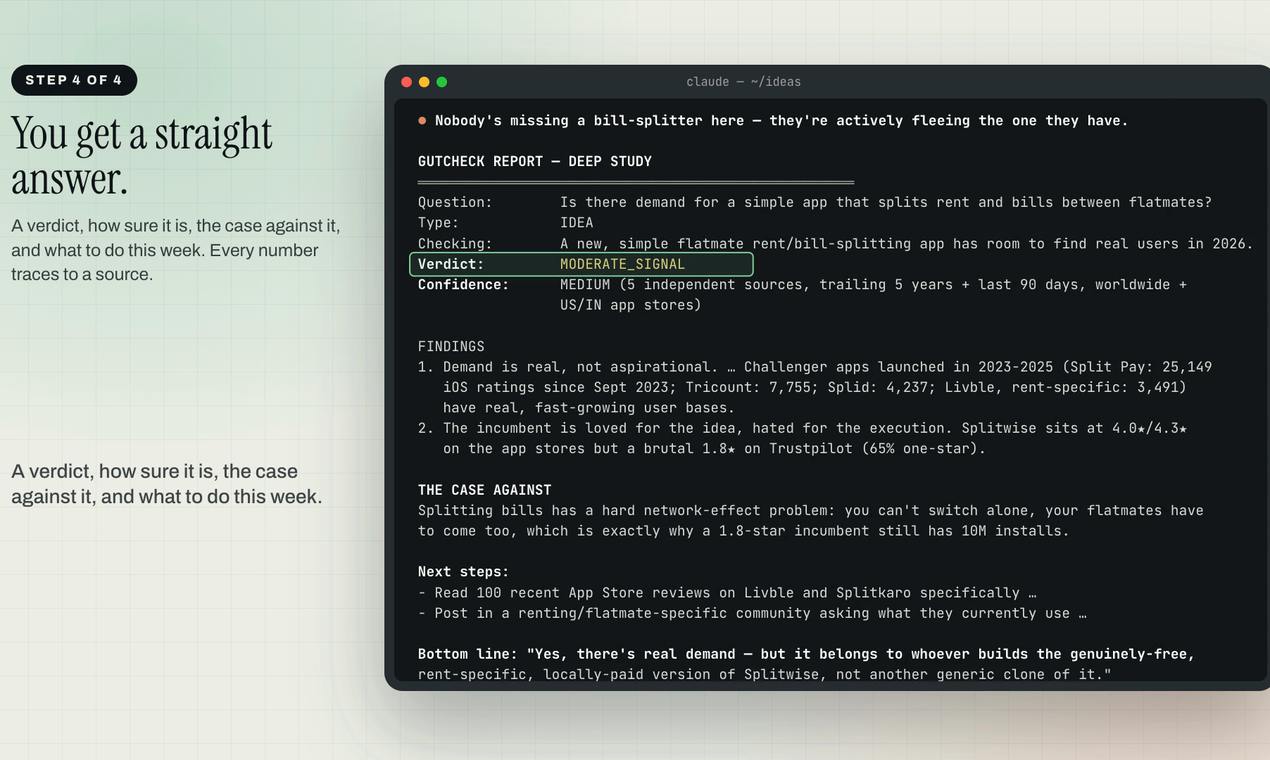
gutcheck compresses multi-source public-signal validation of product ideas into one command in Claude Code.
gutcheck is a command-style tool inside Claude Code: type /gutcheck plus an idea to launch a multi-source research run. It plans a research path and concurrently pulls from seven sources—Google Trends, Google News, Hacker News, GitHub, the App Store, Wikipedia, and public web pages—to cross-validate whether a hypothesis is worth pursuing. Output includes a verdict, confidence, counterarguments, and weekly action items. Free, open-source, local, and no API key needed. Best for quick screening—public signals reflect attention, not willingness to pay.
From "Gut Feeling" to "Web-Wide Research": What gutcheck Solves
Many product ideas die at the very first step: nobody verifies whether anyone actually needs them. Developers commit to a project on instinct, grind away for weeks or even months, and only after launch discover that the market is already saturated—or that there was never any demand to begin with. gutcheck tries to compress this step into a single command inside Claude Code: type /gutcheck followed by an idea, question, or decision, and it plans a "research" run, pulling real-time evidence from Google Trends, Google News, Hacker News, GitHub, the App Store, Wikipedia, and public web pages, then delivers a conclusion—including how confident it is, what the counterarguments are, and what to do this week.
The tool received 66 upvotes on Product Hunt, ranking 17th for the day. Its positioning is clear: not another general-purpose AI assistant, but a vertical tool built specifically for the high-frequency scenario of "validating a hypothesis."
How It Works: One Command, One Chain of Evidence
gutcheck's core interaction happens inside Claude Code. Users don't need to leave their coding environment to open a browser, scroll through forums, or check trend charts—every validation action happens in the same session. After entering the command and an idea, it first plans a research path, then concurrently pulls real-time information from multiple data sources.
The cleverness of this design lies in "in-place validation": when you're writing code or discussing architecture in Claude Code and suddenly want to confirm whether a feature direction is sound, you don't have to switch context—just ask. For developers used to working in the terminal, this is far more convenient than opening a pile of browser tabs.
The structure of the output is also worth noting: it doesn't just give a "yes" or "no," but provides confidence, counterarguments, and next-step action recommendations. These three points map exactly to what's most often missing in decision-making—many people just want a definitive answer and overlook "how certain is it" and "what if it's wrong."
Claude Code is a command-line AI coding assistant from Anthropic that runs in the terminal, capable of directly reading and writing project files, executing commands, and engaging in multi-turn conversations. Its key characteristic is an "agentic" workflow: the model can not only answer questions but also autonomously plan steps, invoke tools, and chain multiple operations to complete a task. gutcheck leverages this mechanism to package "plan the research path—fetch data concurrently—synthesize a judgment" into a single command callable from Claude Code, so users can complete validation without leaving their coding session. Understanding this helps clarify why gutcheck emphasizes "in-place validation": it isn't a standalone app, but a skill extension that rides on Claude Code's agentic capabilities.
The Data Source Mix: Cross-Validating with Public Signals
gutcheck integrates seven categories of data sources, each playing a different validation role. Google Trends reflects long-term search interest trends, showing whether a topic is heating up or cooling down; Google News and Hacker News provide recent discussion volume—the former skewing toward mainstream media, the latter toward tech communities; GitHub and the App Store gauge competitive density by "how many people are already building something similar"; Wikipedia and public web pages fill in background knowledge and long-tail information.
This multi-source cross-referencing approach is essentially using public signals to replace expensive market research. A single data source can easily mislead—for example, lively discussion on Hacker News doesn't mean ordinary users have a need, and many similar products in the App Store isn't necessarily bad; it could be a sign that the market has been validated. Only by looking at several sources together can you form a relatively three-dimensional judgment.
Still, it must be acknowledged that these signals reflect "publicly visible attention," not actual willingness to pay. There's still a considerable gap between a topic trending upward on a chart and users being willing to spend money on it.
Google Trends is a search-interest analytics service from Google that presents changes in keyword search volume over time as a relative index from 0 to 100, rather than absolute search counts. This relativized design makes it suitable for observing trend direction (rising, plateauing, or declining) but unsuitable for directly comparing the absolute popularity of different keywords. In addition, Trends data is sampled and normalized, short-period queries fluctuate significantly, and the choice of region and time range can markedly affect the shape of the curve. So gutcheck using Trends as a "long-term trajectory" signal is reasonable, but treating it as a quantitative basis for demand size can easily lead to over- or underestimation.
Hacker News is a technology and startup community operated by Y Combinator, centered on user-submitted links and vote-based ranking, with a discussion atmosphere skewed toward engineering and early-stage startups. Its signal value lies in quickly reflecting the tech community's attention to a topic, but its audience is heavily concentrated among developers, founders, and tech enthusiasts, with a clear bias relative to mass consumers. A post hitting the front page often brings a flood of comments within hours before rapidly sinking—a "pulse-like" burst of attention that is easily misread as sustained demand. Juxtaposing Hacker News with mainstream media signals like Google News helps correct for audience bias.
Onboarding Friction and Openness
gutcheck emphasizes that you can "get started without an API key" and that it runs entirely on your local machine. Free, open-source, and locally run—these three attributes together have a natural appeal for developers who care about privacy and data sovereignty. No account registration, no uploading your ideas to some centralized service; the validation process stays in your own environment.
Open source also means the research logic can be inspected and modified. If a data source's weighting seems unreasonable, or you want to add your own judgment rules, you can change the code directly. This flexibility is something closed-source SaaS tools struggle to offer.
In practice, "no API key required" means gutcheck obtains data not through paid or registration-required official interfaces, but more likely via public page scraping or free endpoints. This lowers the barrier to entry but brings two side effects: first, if a data source redesigns its site or adds anti-scraping restrictions, scraping may break; second, request frequency and coverage are constrained by public access policies, making results less complete and stable than solutions using formal API credentials. Open-source local execution lets users inspect the scraping logic, swap data sources, or adjust weights themselves, turning this uncertainty into a maintainable configuration issue.
Boundaries and Use Cases
gutcheck is better suited for "quick initial screening" than as a "final basis for decisions." It can tell you within minutes whether a direction is worth continuing to invest time in, helping you rule out obviously dubious ideas or surface overlooked counter-evidence. But real product decisions also involve team capability, resource constraints, business models, and other dimensions it can't cover.
Moreover, it relies on real-time scraping of public data, so result stability is affected by data source availability and network conditions. For scenarios requiring rigorous quantitative conclusions, this signal-aggregation-based judgment can only serve as a reference starting point.
Is It Worth Trying?
If you frequently work in Claude Code and are in the habit of doing a quick round of research before diving in, gutcheck offers a low-friction way to validate. It turns the act of "checking whether anyone has done this before" into a single command, saving the tedious costs of context switching and manual searching. For indie developers and small teams, this "validate before investing" habit itself may be more valuable than the specific conclusions the tool delivers.
One-line Summary
gutcheck compresses multi-source public-signal validation of product ideas into a single command in Claude Code.
Paragraph Summary
gutcheck is a command-style tool that runs inside Claude Code; type /gutcheck plus an idea to launch a multi-source research run. It plans a research path and concurrently pulls from seven data sources—Google Trends, Google News, Hacker News, GitHub, the App Store, Wikipedia, and public web pages—to cross-validate whether a hypothesis is worth pursuing. The output isn't just a "yes or no" but includes confidence, counterarguments, and action recommendations for the week. The tool is free, open-source, locally run, and requires no API key, making it friendly to privacy-conscious developers. The article concludes it's well suited for quick initial screening and reduces the cost of context switching and manual searching, but public signals reflect attention rather than willingness to pay and cannot replace full market research and business decisions.
Related articles

Anthropic Denies Claude Was Trained to Sabotage Work: The Controversy Exposes an AI Trust Crisis
Anthropic denies claims that Claude was trained to sabotage work but gives no specifics. This article examines the AI trust issue and the need for vendor transparency.

Gmail 'Send as' to Be Discontinued in 2027: Email Workflows Face Restructuring
Gmail's 'Send as' feature will be discontinued in January 2027, sparking Hacker News discussion. This article explains the feature's role, three affected user scenarios, and a practical preparation checklist for migrating custom sending addresses and reconfiguring domain authentication.

Character.ai Bankruptcy Auction: 21 Million Users' Private Conversations Up for Auction
Character.ai bankruptcy proceedings are auctioning 21 million users' private conversation records, triggering widespread concerns in the Hacker News community about data governance and user privacy in AI companionship products. This article analyzes the legal gray zone of data assets in bankruptcy liquidation, flaws in user agreements, and the AI industry's trust crisis.