H3 Acceleration Arena Adds Three New Models: Community Crowdsourced AI Performance Testing
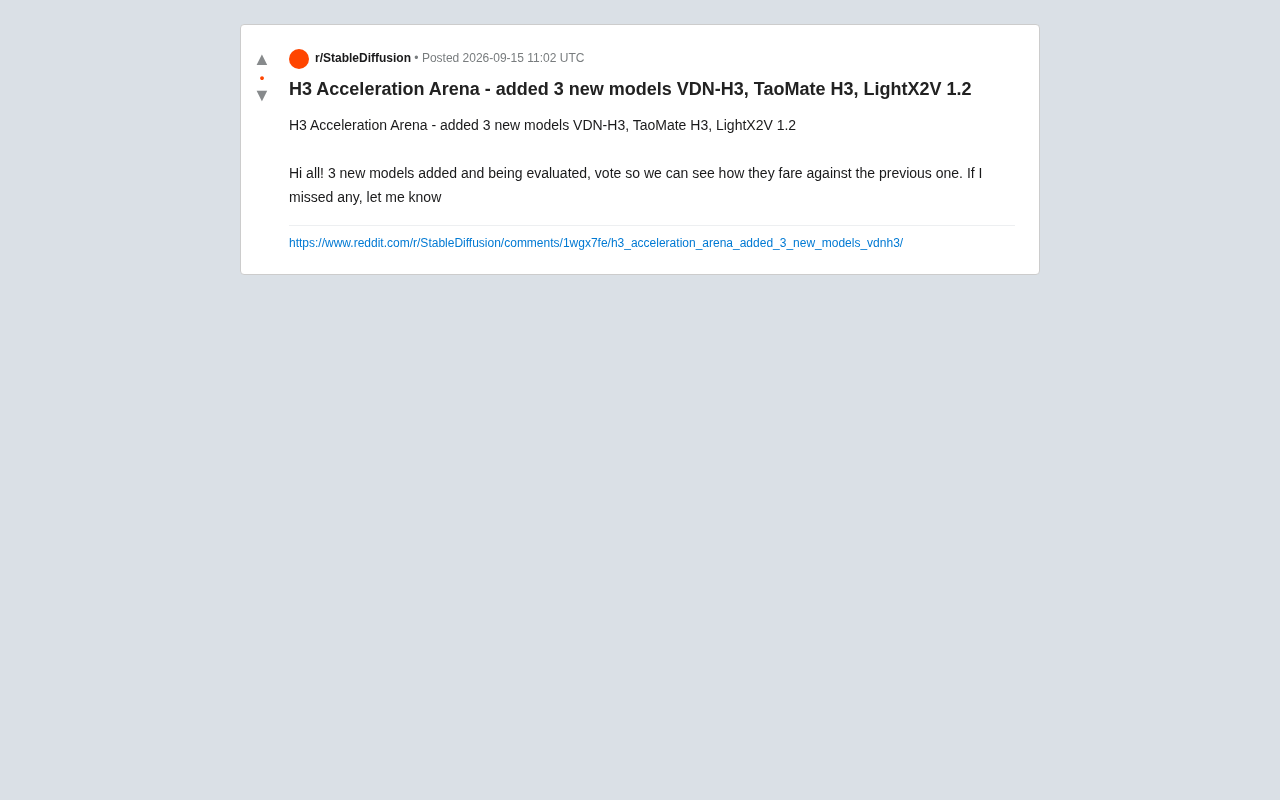
Three new models join the H3 Acceleration Arena for community-voted AI acceleration benchmarking.
The H3 Acceleration Arena is a community-vote-based model comparison platform that has added VDN-H3, TaoMate H3, and LightX2V 1.2 to its evaluation queue. The first two continue the H3 series acceleration approach, while LightX2V 1.2 targets lightweight video generation acceleration. Since no architecture details or parameter scales were disclosed, actual performance awaits voting data. Arena rankings can be skewed by sample bias and inconsistent test environments, so they're best used as an initial filter rather than a final selection criterion.
Three New Models Join the H3 Acceleration Arena
The H3 Acceleration Arena is a community-driven model evaluation platform that has recently added three new models to its assessment queue: VDN-H3, TaoMate H3, and LightX2V 1.2. The organizer posted on Reddit inviting community members to vote, comparing these new models against existing ones to get a clear picture of their relative performance on acceleration tasks.
This style of community-vote-based evaluation has become increasingly common in the AI ecosystem. Compared to closed benchmark tests, crowdsourced arenas can aggregate preference judgments from a large number of real users, reducing the bias that comes with relying on any single evaluation metric.
The "acceleration" that the H3 Acceleration Arena focuses on typically refers to inference acceleration for video or image generation models — that is, reducing the number of generation steps, time, or compute resources required while keeping output quality at an acceptable level. Common techniques include Consistency Distillation, Flow Matching, and step-compression methods for diffusion models (such as LCM, SDXL-Turbo, etc.). "H3" as a series name likely refers to a specific version of a distillation or acceleration framework, with each competing model representing a different optimization implementation built on top of that framework. Understanding this context clarifies the core dimension being evaluated in the arena: it's not about which model has the highest generative ceiling, but about finding the optimal trade-off between speed and quality.
What the Three New Models Bring
Judging by their names, the three models point to different technical approaches and teams:
- VDN-H3: Continues the acceleration direction of the H3 series; specific optimization details remain to be revealed by evaluation data.
- TaoMate H3: Also part of the H3 family, possibly fine-tuned for specific inference or generation scenarios.
- LightX2V 1.2: Based on the name, this appears to lean toward a lightweight, video-oriented acceleration solution (X2V likely refers to image/text-to-video); the version number 1.2 indicates this is an actively iterated project.
It's worth noting that the original post does not disclose detailed architecture, parameter scale, or specific acceleration metrics for any of the three models. For now, the act of entering the evaluation is itself the noteworthy development — actual performance still depends on the accumulation of community votes.
What is "X2V"? "X2V" is a common naming convention in the AI generation space, typically standing for "Anything-to-Video" — covering tasks like Image-to-Video and Text-to-Video. The "Light" in LightX2V suggests a lightweight design goal, which may manifest as reduced parameter counts, lower VRAM usage during inference, or optimization for mobile/edge deployment. The existence of version 1.2 indicates the project has gone through at least one round of public iteration, suggesting a certain level of engineering maturity and making it possible to track its evolution by comparing against versions 1.0 and 1.1.
The Value of Community Crowdsourced Evaluation
The organizer explicitly stated the goal: "vote so we can see how they fare against the previous one" — the purpose of voting is precisely to pit new models against their predecessors in head-to-head comparison. The core logic of this mechanism is:
Acceleration effectiveness is often difficult to capture with a single number. The same speedup ratio can lead to vastly different user experiences depending on the task, hardware, and tolerance for quality degradation. Having real users vote in blind tests or side-by-side comparisons captures preferences that are hard to quantify.
The organizer also opened a feedback channel, inviting the community to flag any models that may have been overlooked ("If I missed any, let me know"). This open approach helps continuously expand evaluation coverage and turns the arena itself into a dynamically updated reference pool.
How to Interpret These Evaluations Rationally
For developers and enthusiasts following model acceleration, arenas like this offer a low-barrier entry point for cross-model comparison. That said, a few caveats are worth keeping in mind:
Voting results reflect the preferences of the participating group and may carry sample bias; models update frequently, making rankings time-sensitive; and when there is no standardized testing environment, the comparability of acceleration data is limited.
It's best to treat arena rankings as a starting point for initial screening rather than a definitive basis for model selection. Real-world deployment evaluation should still involve hands-on testing under your own task requirements and hardware conditions.
Summary
The H3 Acceleration Arena's addition of VDN-H3, TaoMate H3, and LightX2V 1.2 reflects the active iteration pace and community-driven evaluation culture in the AI acceleration space. Given the limited information available, concrete performance results will need to wait for voting data to accumulate. Readers who are interested can head to the arena, cast their votes, and contribute real feedback to sharpen this ongoing cross-model comparison.
Related articles

SimpliSafe's New Video Doorbell: AI + Live Agents Actively Watching Your Front Door
SimpliSafe's $199.99 Video Doorbell Series 2 pairs with its Active Guard service to combine AI screening and live agents for proactive home security monitoring and intervention.

Fujifilm Instax Pal 2 Mini Camera: A Meaningful Upgrade That Finally Adds a Screen
Fujifilm's Instax Pal 2 mini digital camera adds a screen and viewfinder, fixing the original model's blind-shooting flaw and making it a more practical instant imaging device.

German Companies Are Almost Entirely Dependent on American AI Models and Services
German companies rely almost entirely on US AI vendors like OpenAI and Google. This article examines the causes, GDPR data sovereignty tensions, and Europe's path toward AI autonomy.