H3 Character Swap LoRA Tested: A More Stable Video Character Replacement Solution

MiniMax H3 Character Swap LoRA delivers more stable video character replacement than the vanilla model.
The H3 Character Swap LoRA is a fine-tuned plugin for MiniMax H3 video generation that addresses the "drift-back" stability problem in character replacement. Real-world testing shows that running it in ComfyUI with the ref2va int8 pruned base model at 20 steps and 1.2MP on an RTX 5090 yields noticeably better consistency than the vanilla model. Key prompting advice: use a "contrast-style" approach describing both the original and target characters separately, and specify who to replace in multi-person scenes. Main limitation is occasional source detail leakage on hands, fingers, and teeth. Speed-up LoRAs are not recommended — stability should take priority.
What Is the H3 Character Swap LoRA
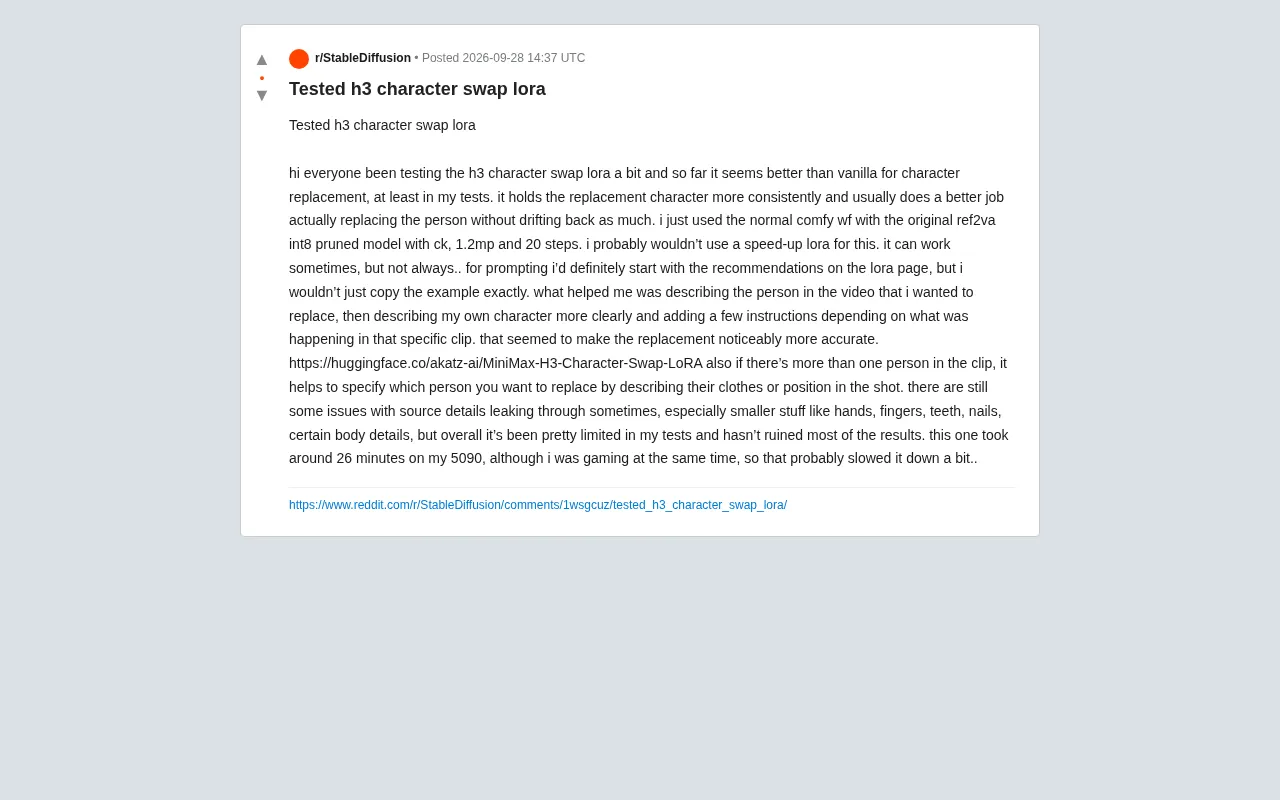
Replacing a character in a video with a custom one has always been a challenge in video generation — vanilla models tend to "drift" back to the original character after just a few frames, making it difficult to maintain the swap. A Reddit user recently put the MiniMax-H3-Character-Swap-LoRA to the test and shared their firsthand experience.
This LoRA was released by akatz-ai and is specifically fine-tuned for character swapping with the MiniMax H3 model. According to the tester, it performs noticeably better on character replacement tasks compared to the vanilla model.
LoRA (Low-Rank Adaptation) is a parameter-efficient fine-tuning technique. The core idea is to modify model behavior by inserting a small number of trainable low-rank matrices, without altering the original model weights. For video generation, LoRAs can be trained for specific tasks — such as character swapping or style transfer — and then applied on top of the base model as a "plugin," balancing flexibility with resource efficiency. MiniMax H3 is MiniMax's video generation foundation model, capable of reference-image-driven character consistency (i.e., ref2video). The Character Swap LoRA builds on this by specifically strengthening the sub-task of "replacing an existing character in a video with an input reference character," giving the model a stronger ability to maintain the swapped character's identity across frames over time.
Real-World Performance: More Stable Character Retention
The tester's core finding is that this LoRA "locks in" the target character more consistently during replacement, without drifting back to the original person as frequently as the vanilla model does. This means the swapped character maintains better continuity throughout the entire video — which is precisely the most critical metric for character replacement tasks.
"It more consistently keeps the swapped character and usually actually swaps out the person instead of drifting back as easily."
In other words, the LoRA doesn't just solve "can it swap" — it solves "can the swap hold." For creators working with longer clips, this kind of stability offers far more value than improvements to single-frame quality.
Workflow and Parameter Configuration
The tester used a standard ComfyUI workflow with the following setup:
- Base model: Original ref2va int8 pruned model (with ck)
- Resolution: 1.2MP
- Steps: 20 steps
- Hardware: Single RTX 5090
One notable takeaway: avoid using a speed-up LoRA for this task. The tester noted that the speed-up LoRA "sometimes works but doesn't always," and that sacrificing speed for stability is the better trade-off when prioritizing swap quality.
Generating one result took approximately 26 minutes, though the tester mentioned they were gaming at the same time, which likely slowed things down — so actual generation time should be shorter.
ComfyUI is an open-source, node-graph-based frontend for AI image/video generation. Users build generation workflows by connecting different functional nodes, offering greater customizability than tools like WebUI. It's one of the most popular choices for running local LoRA combination workflows. The ref2va int8 pruned model mentioned in the article is a quantized and pruned version of MiniMax H3: int8 refers to quantizing model weights from float16/float32 to 8-bit integers, significantly reducing VRAM usage; pruned means redundant parameters have been trimmed. These two optimizations make it feasible to run large video generation models on a single consumer-grade GPU, though they may introduce minor precision loss on fine details — which is mechanistically related to the occasional hand, teeth, and detail leakage observed in the test.
Prompting Tips: Description Beats Copy-Pasting
On the prompting side, the tester shared several highly practical tips that directly improve swap accuracy:
1. Start from the official examples, but don't copy them verbatim
The sample prompts on the LoRA page are a good starting point, but copying them wholesale is not recommended. The tester found that what actually improves results is writing customized descriptions tailored to the specific clip.
2. Describe both the person being replaced and the target character separately
An effective approach is: first describe the person in the video you want to replace, then more clearly describe your own target character, and finally add a few instructions based on the action happening in the clip. This "contrast-style" description noticeably improved swap accuracy.
3. In multi-person scenes, specify who to replace
If multiple people appear in the frame, you need to clearly indicate which one to replace by describing their clothing or position in the shot. This is especially critical in complex compositions.
Limitations and Caveats
Despite the generally strong performance, the tester was candid about current shortcomings:
Source detail leakage is the main issue. Some details from the original character occasionally "bleed" into the output, particularly on smaller body parts like hands, fingers, teeth, nails, and certain body details. However, the tester emphasized that in their testing these issues were "fairly limited" and didn't ruin most results.
This is a reminder that while H3 Character Swap LoRA performs reliably for overall appearance and primary subject replacement, close-up shots or scenes requiring fine limb detail still warrant careful evaluation or post-processing correction.
Conclusion
While this is a single-user test with a limited sample size, it provides a genuinely useful hands-on guide. For creators working on video character replacement, the stability improvement of H3 Character Swap LoRA over the vanilla model is worth trying. Paired with "contrast-style" prompting and a conservative configuration of 20 steps at 1.2MP, you can achieve more reliable swap results. The main caveat to keep in mind remains the occasional detail leakage on hands, teeth, and similar fine features.
Related articles

AI Is Not a Replacement: Human-AI Collaboration Through the Lens of Factory Root Cause Analysis
Starting from factory root cause analysis, this article explains how AI accelerates evidence chain construction rather than replacing human experts, exploring the pragmatic implementation logic and business value of 'AI supporting people rather than replacing them.'

AI Agent Decision Auditing: Building an Evidence Chain in Regulated Workflows
Starting from a Reddit discussion, this article analyzes three core issues in AI agent decision auditing within regulated workflows: what fields audit records should contain, how to handle feedback latency for erroneous decisions, and how to continuously calibrate LLM judge consistency with human judgment.

Apple Opens Multiseat Subscription Purchasing: App Subscriptions Can Now Be Sold in Bulk to Businesses and Schools
Apple opens multiseat purchasing for auto-renewable subscriptions: businesses and schools can bulk-buy via Apple Business and Apple School Manager, adding or removing seats anytime. Enabled by default in App Store Connect—developers should verify settings; group purchasing sandbox testing opens October 2026.