Habitix Review: A New Approach to Habit Building — From Pressure to Systems

Habitix replaces pressure-driven habit tracking with a system-driven approach built on behavioral science.
Habitix is a new habit-tracking app that shifts from pressure-based motivation to system-driven design. Its four core mechanisms — clear daily rituals, visual streak grids, timed challenges with real stakes, and restrained reminders — are grounded in behavioral science principles like implementation intentions, loss aversion, and nudge theory, offering a fresh approach for users tired of traditional check-in apps.
The Common Flaw of Habit Apps: Trading Pressure for Persistence
Most habit-tracking apps on the market share a fundamental problem — they essentially manufacture pressure. Red crosses for failed check-ins, broken streaks, and constant pop-up reminders were designed to motivate users, but in practice they often backfire, creating anxiety or causing people to give up entirely.
This isn't an isolated phenomenon. The global health and fitness app market was valued at approximately $33 billion in 2023, with over 1,000 apps labeled as "habit trackers" on the App Store and Google Play, though market concentration remains low. Despite continuous market growth, habit-tracking apps typically have a 30-day retention rate of only 10-15%, far below social or entertainment apps — the "pressure-driven" design paradigm deserves much of the blame.
From a user psychology perspective, the "extrinsic motivation" design approach adopted by most apps (such as consecutive check-in counts and leaderboards) works in the short term but gradually erodes users' "intrinsic motivation" — a phenomenon known in psychology as the "Overjustification Effect." When external rewards disappear or lose their novelty, users lose even their original intrinsic drive. Additionally, within that $33 billion market, most revenue is concentrated in meditation apps like Calm and Headspace, and fitness tracking apps like Strava and MyFitnessPal. Pure habit-tracking tools face greater monetization challenges due to fragmented use cases, low willingness to pay, and competition from built-in phone features (such as iOS Reminders).
Habitix, which recently launched on Product Hunt, proposes a different approach: rather than adding pressure, build a system. Its core philosophy can be summarized in one sentence — helping you keep the promises you make to yourself.
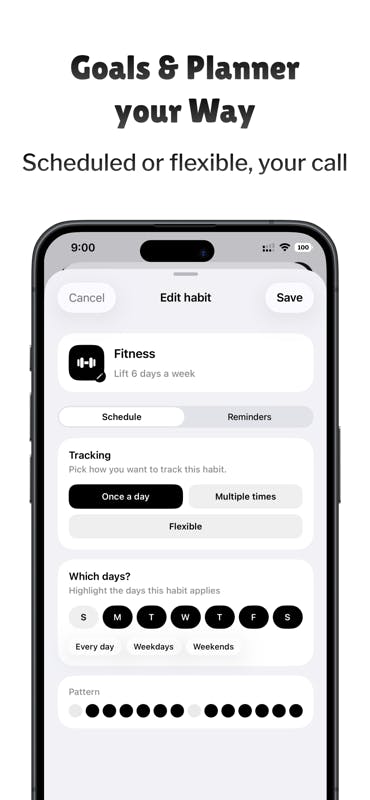
Habitix's Four Core Mechanisms Explained
Based on its product introduction, Habitix isn't simply a check-in tool but rather features four interconnected modules designed around behavioral science.
For useful context, the theoretical foundations of contemporary behavioral design primarily come from three scholars' work: Charles Duhigg's "habit loop" (cue-routine-reward), BJ Fogg's "tiny habits" theory (Behavior = Motivation × Ability × Trigger), and James Clear's "four-step habit loop" from Atomic Habits — Cue, Craving, Response, and Reward. These theories converge on a core insight: habit formation isn't a willpower problem but a system design problem. Habitix's four mechanisms can be viewed as a product-level attempt to implement these academic frameworks.
Clear Daily Rituals
Habitix emphasizes "clear daily rituals," breaking habits down into specific, actionable daily behaviors rather than vague goals. This design reduces the cognitive burden of execution — users don't need to think about "what should I do today" because the system has already laid out the path.
This aligns with the concept of "implementation intentions" emphasized in Atomic Habits. Implementation Intention is a concept proposed by psychologist Peter Gollwitzer in 1999, referring to pre-setting specific plans like "if situation X occurs, I will execute behavior Y." Extensive experimental research shows that people who merely set goals (such as "I want to exercise more") have far lower execution rates than those who set implementation intentions (such as "Every morning at 7 AM, I'll do 20 minutes of yoga in the living room"). This works because implementation intentions shift the decision-making from the moment of execution to the planning stage, reducing the cognitive resources and willpower needed during execution. Habitix's "clear daily rituals" design is precisely this academic concept productized — users complete their thinking during the setup phase and only need to follow system guidance during execution.
From a cognitive science perspective, this design also leverages a "Decision Fatigue" avoidance strategy. Psychologist Roy Baumeister's research shows that people have limited cognitive resources for daily decision-making, with each decision consuming a portion. When a habit app pre-fixes "what to do, when to do it, and how to do it," it effectively saves users precious cognitive bandwidth, allowing them to direct their limited willpower toward execution rather than planning.
Streak Grids Visible at a Glance
"Streak grids you can see at a glance" is Habitix's visual core, similar to GitHub's contribution graph. GitHub's Contribution Graph uses green squares of varying intensity to represent daily code commits, forming a full-year activity heatmap — one of the most classic visual motivation designs in the developer community. This design works because of "Gestalt tendency" in psychology — the human brain naturally tends to pursue visual completeness and continuity. When users see a gap in an otherwise continuous block of color, they experience a strong urge to "fill it in."
Visual continuity provides powerful positive feedback: when you see an entire grid lit up, you instinctively don't want to break that continuity. Compared to traditional check-in apps' simple numerical counts, grid-based presentation makes progress perception more intuitive and more easily triggers the psychological drive to "not break the chain." Research shows the human brain processes image information 60,000 times faster than text, meaning a grid image delivers motivational signals with far more emotional impact than text descriptions like "21 consecutive days."
From a neuroscience perspective, grid-based visual feedback has even deeper mechanisms. When users see continuous completion records, the nucleus accumbens in the brain releases dopamine, producing pleasure. More importantly, this visual design leverages "intrinsic circuits" — the brain's ability to associate visual patterns with self-identity. When users repeatedly see their completion records, they gradually internalize "I am a person who exercises consistently" as an identity, rather than merely "I am executing a task." This identity shift is considered the key turning point where habits transition from extrinsic to intrinsic motivation — and this is one of the most central arguments in Atomic Habits: truly lasting behavioral change begins at the identity level.
Timed Challenges with Real Stakes
This is Habitix's most differentiated design — "timed challenges with real stakes." By introducing some form of cost or commitment mechanism, habit formation is no longer a zero-cost self-agreement.
The behavioral economics theory of "loss aversion" shows that people's fear of losing is often stronger than their desire to gain. This concept was proposed by Nobel laureate Daniel Kahneman and Amos Tversky in Prospect Theory, with research showing that people's sensitivity to losses is approximately 2-2.5 times that of equivalent gains. In the habit formation space, this principle has been validated by multiple products: Beeminder lets users preset monetary penalties, and StickK allows users to stake money that goes to an organization they dislike. A Yale University study found that dieters with financial stakes had success rates approximately 3 times higher than the control group. Habitix's challenge mechanism leverages precisely this psychological principle to strengthen users' execution motivation.
The concept of Commitment Devices can be traced back to ancient Greece — Odysseus had his sailors tie him to the mast to resist the Sirens' song. In the digital age, this mechanism has gone through multiple iterations: the earliest form was simple public commitment (like announcing goals on social media), then it evolved into economic penalty models (like Beeminder and StickK), and more recently into "positive incentive pool" models (users pre-deposit funds that are returned or augmented upon goal completion). The emergence of blockchain technology has also spawned decentralized commitment protocols, with some Web3 projects attempting to use smart contracts to automatically execute commitment terms. Each mechanism faces the "calibration challenge" — stakes too low fail to generate sufficient motivation, while stakes too high lead to anxiety or avoidance.
However, it's worth noting that such mechanisms are also controversial — excessively high stakes may cause users to experience stronger frustration after failure, or simply cheat to avoid losses. How to set a reasonable stakes threshold is the key to this feature's success or failure. Behavioral scientists suggest that ideal stakes should be "enough to get attention, but not enough to cause panic" — for most people, this ranges around 5-10% of daily income.
Reminders That Nudge Without Nagging
Finally, there's the restrained design of the reminder system — "reminders that nudge without nagging." Good reminders should be gentle nudges, not annoying pestering.
The "Nudge" concept was systematically articulated by economist Richard Thaler and legal scholar Cass Sunstein in their 2008 book of the same name, and Thaler won the 2017 Nobel Prize in Economics partly for this work. The core of nudging is guiding people toward better decisions by changing the choice architecture without restricting freedom of choice. Academically, this approach is called "Libertarian Paternalism" — respecting individual freedom while promoting better decisions through environmental design. In app notification design, this means reminders should appear at the moment users are most likely to take action (such as optimal timing predicted from historical behavior data), use positive rather than accusatory language, and give users a simple "later" option rather than forcing interaction.
In notification design practice, Duolingo is a benchmark for restrained notifications — its notification copy has gone through hundreds of A/B testing iterations, evolving from early straightforward "You haven't studied today" messages to more emotionally connected anthropomorphized expressions. Netflix's notification strategy demonstrates another extreme of restraint: only sending notifications at high-value moments (such as when a followed show releases new episodes), preferring to send fewer rather than too many. Academic research categorizes effective digital nudges into three types: timing nudges (reminding during behavioral windows), framing nudges (reframing information with positive language), and default nudges (presetting optimal options).
This directly addresses the most common user complaint about habit apps: overly frequent notifications that make people want to uninstall. Research shows that more than 3-5 daily app notifications trigger "notification fatigue," causing users to disable notification permissions or even uninstall apps. The most advanced notification systems combine machine learning, dynamically deciding notification timing and wording based on multidimensional data including users' historical response times, current location, and calendar events. Finding the balance between "effective reminding" and "excessive disturbance" is a dual test of a product team's algorithmic capability and user insight.
Habitix's Product Positioning and Competitive Comparison
Habitix is categorized on Product Hunt under Health & Fitness, Productivity, and Lifestyle, built by developers Ghadeer R. and Majeed.
From a competitive landscape perspective, habit tracking is a fairly crowded space:
- Habitica: Takes the gamification route, motivating users through RPG elements, converting task completion into character leveling and gear acquisition. Its design is based on the competence and relatedness needs in "Self-Determination Theory," creating social accountability through guild systems and boss battles
- Streaks: Minimalist design, focused on consecutive records, an Apple Design Award-winning app. Its core design philosophy is "reducing friction" — displaying a maximum of only 12 habits on the interface, forcing users to focus on the most important behaviors
- Loop Habit Tracker: Open-source and free, feature-rich, the benchmark product on Android. Its data visualization capabilities are powerful, supporting multiple chart types and data export, deeply beloved by the Quantified Self community
Habitix's path to breaking through relies not on feature accumulation but on philosophical differentiation — shifting from "pressure-driven" to "system-driven."
This positioning addresses a genuine current user need. More and more people realize that pure willpower cannot sustain long-term habits — what truly works is environmental design and system support. As Atomic Habits author James Clear says: rely on systems rather than motivation. The scientific basis behind this statement is that motivation is inherently volatile, fluctuating with mood, energy, and external environment; while systems (such as fixed triggers, preset action paths, and immediate feedback loops) don't depend on one's current psychological state and can maintain behavioral continuity even during motivational low points. BJ Fogg's research at Stanford's Behavior Design Lab further confirms: when the "ability threshold" required for a behavior is low enough (i.e., the system design is good enough), behavior can still occur even when motivation is at its lowest.
Key Questions Worth Watching Before Use
As a newly launched product, Habitix's community data is still in its early stages, and its actual reputation and retention performance still need time to validate.
Several core questions worth monitoring:
- The specific form of "real stakes": Is it monetary betting, social commitment, or another mechanism? This directly determines the effectiveness and user acceptance of the challenge feature. From industry precedent, monetary betting models (like Beeminder) are effective but have high user thresholds and compliance risks (some jurisdictions view them as gambling), social commitment models (like public declarations) have milder effects but broader acceptance, and different mechanisms suit user groups with different personality traits. The "Big Five" personality model in psychology suggests that users high in Conscientiousness may only need light reminders, while users low in Conscientiousness need stronger external constraints.
- The intelligence level of the reminder system: "Not nagging" is easy to say but requires fine-grained control over timing and frequency to achieve, possibly needing personalized algorithm support. Ideally, the system should learn users' behavioral patterns, send reminders during optimal time windows, and dynamically adjust strategies based on user response rates. This requires accumulating sufficient user behavioral data, and for a new product, notification strategy design during the cold-start phase particularly tests the team's capabilities.
- Long-term retention solutions: Habit apps face a unique "Cure Paradox" — the more successfully a product helps users form habits, the less users depend on the product. This is similar to the healthcare industry's dilemma: the best medicine cures patients but also loses them. Current industry solutions mainly follow three paths: continuously introducing new habit goals to position the product as a "lifelong growth companion" (like Fabulous), shifting toward community-driven operations where users stay for social relationships (like Habitica's guild system), or adopting subscription models that monetize during active periods and accept high churn as an inherent characteristic of the business model. Which path Habitix chooses will determine its long-term commercial sustainability.
Conclusion: Who Is Habitix Best For?
Habitix represents a meaningful pivot in habit app design philosophy — from manufacturing pressure to building systems. Its four mechanisms (daily rituals, streak grids, timed challenges, and restrained reminders) are conceptually coherent and aligned with behavioral science principles.
If you fit the following user types, Habitix is worth trying:
- You've repeatedly tried to build habits but keep failing
- You're tired of the "oppressive" feeling from traditional check-in apps
- You believe in the "systems over willpower" approach to behavior change
- You need moderate external accountability to push yourself forward
Of course, whether advanced philosophy can translate into real user value ultimately needs to be validated by the market and time. During this window period where no absolute leader dominates the habit-tracking space, if Habitix's "system-driven" philosophy is paired with solid product execution, it has the opportunity to carve out its own mental space among users in a crowded market. It's worth noting that the ultimate competitor in the habit formation space may not be other apps, but users' default tool chains on their smartphones — Apple's "Reminders" + "Shortcuts" and Google's "Calendar" + "Tasks" combinations can already cover basic habit management needs. What Habitix needs to prove is that a specialized behavioral design system can deliver value far exceeding that of general-purpose tools.
Related articles
Serving Markdown Content Directly to AI Agents via Accept Headers
How HTTP Accept header content negotiation can serve Markdown to AI Agents and LLM crawlers, reducing token costs and improving information extraction efficiency.

The Turbulent AI Era Has Arrived: How to Seize Opportunities and Manage Risks Amid Technological Upheaval
Deep analysis of the turbulent AI era: accelerating tech iterations, career restructuring, regulatory lag, and global competition. How practitioners can seize opportunities and manage risks.

VMs Can't Contain AI Hacker Agents: The Security Isolation Myth Is Shattered
Deep analysis of why VMs can't truly isolate AI agents with cyber attack capabilities. Covers VM isolation failures, new AI security paradigms, and defense-in-depth strategies.