Hacker Remotely Controls Robot Lawn Mower to Run Over Journalist: How Terrifying Are IoT Security Vulnerabilities

Security researcher remotely hacks robot lawn mower, exposing IoT physical security threats
Security researcher Andreas Makris remotely hacked a 200-pound robot lawn mower from 6,000 miles away, causing it to climb onto a journalist's body and demonstrating the real physical harm that IoT device vulnerabilities can inflict. The experiment reveals widespread security shortcomings in consumer robotic devices, calling on manufacturers to incorporate Security by Design throughout their development processes while urging consumers to strengthen their device protection awareness.
A Bone-Chilling Security Experiment
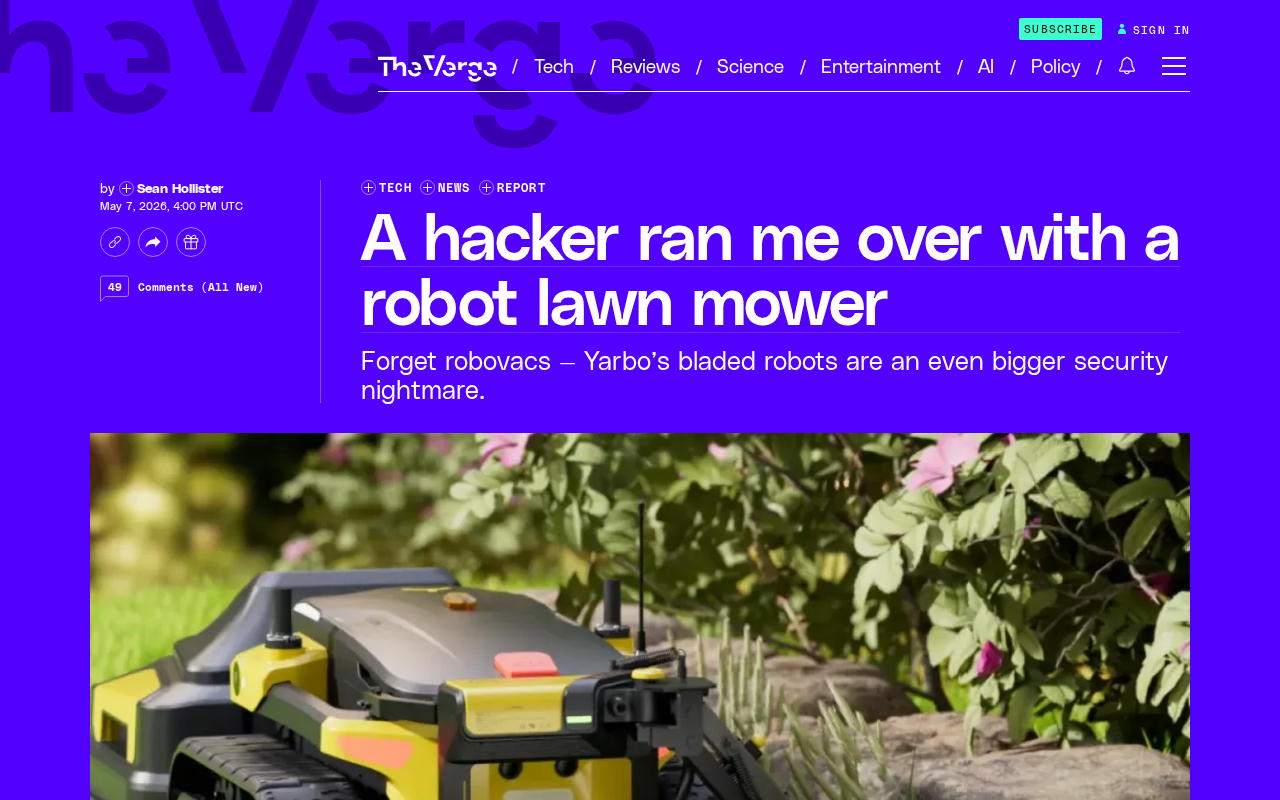
Imagine this: you're lying on the ground, and a 200-pound robot lawn mower is heading straight toward you. It climbs onto your chest, its sharp blades ready to slice across your body at any moment. And the hacker controlling all of this is nearly 6,000 miles away.
This isn't a scene from a sci-fi movie — it's a real vulnerability demonstration conducted by security researcher Andreas Makris. The experiment exposed serious cybersecurity risks in IoT devices, particularly robotic devices capable of causing physical harm.
Notably, Makris's demonstration followed the "Responsible Disclosure" conventions standard in security research: before publicly showcasing a vulnerability, researchers typically notify the manufacturer in advance and allow a remediation window (the industry standard is usually 90 days, a practice popularized by Google's Project Zero team). This mechanism aims to balance the public's right to know against the manufacturer's need for repair time, making such extreme demonstrations a legitimate means of driving industry improvement rather than purely destructive acts.
Remote Control: A Lethal Threat from 6,000 Miles Away
The most unsettling detail of this experiment is the attack distance. Makris wasn't on-site — he couldn't reach over and press an emergency stop button because he was controlling the robot lawn mower from nearly 6,000 miles away. This means that if anything went wrong, the people on the ground had to deal with an out-of-control heavy mowing machine on their own.
This remote attack capability demonstrates that any internet-connected robot lawn mower could become a potential attack tool. An attacker doesn't need physical access to the device — they only need to find a software vulnerability to turn an everyday gardening tool into a dangerous weapon.
Why Are IoT Devices So Vulnerable?
The Dangerous Intersection of Physical and Digital Worlds
Traditional cybersecurity vulnerabilities typically lead to data breaches or system outages, but when vulnerabilities exist in devices with physical execution capabilities, the consequences are fundamentally different. To understand the nature of this risk, we need to introduce the concept of "Cyber-Physical Systems" (CPS) — systems that deeply integrate computation, communication, and physical processes. Robot lawn mowers are a textbook example: they are both networked computers and mechanical devices with real physical destructive power. Unlike ordinary IoT sensors, security vulnerabilities in CPS devices can directly translate into physical-world harm.
A compromised robot lawn mower isn't just a controlled computing device — it's a 200-pound, blade-equipped, autonomously mobile mechanical apparatus. Once such a device is hijacked by hackers, the damage is no longer virtual — it's real, tangible bodily harm.
The Security Shortcomings of Consumer IoT Devices
This incident has sparked serious discussion about security standards for consumer robotic devices. As more and more households adopt robot lawn mowers, robot vacuums, and other automated equipment, the question arises: is their cybersecurity keeping pace with their growing physical capabilities?
The reality is far from encouraging. Many consumer IoT devices prioritize functionality and user experience during design, with security often relegated to secondary importance. Common issues include:
- Delayed firmware updates, leaving known vulnerabilities unpatched for extended periods
- No mandatory requirement to change factory default passwords
- Lack of encryption in device-to-cloud communication protocols
- Absence of intrusion detection and abnormal behavior alerting mechanisms
The root cause of these issues lies in the industry's long-standing lack of mandatory security standards. The EU's recently introduced Cyber Resilience Act has begun attempting to change this landscape through legislation, requiring connected device manufacturers to meet baseline security requirements — a pioneering effort on a global scale.
From Lawn Mowers to Autonomous Vehicles: Broader Security Implications
This experiment isn't just about robot lawn mowers — it represents an accelerating trend: as robotics technology permeates every aspect of daily life, security threats are extending from the virtual world into the physical world.
From autonomous vehicles to industrial robots, from drones to home service robots, every connected physical device is a potential attack surface. Through extreme demonstrations like this, security researchers aim to raise awareness among manufacturers and consumers about IoT security issues.
What Consumers and Manufacturers Should Do
What consumers can do:
- Choose brands with strong security track records and vulnerability response mechanisms
- Update device firmware promptly and don't ignore security patches
- Set strong passwords for IoT devices and avoid using default credentials
- Place smart devices on a separate network segment, isolated from the main network
Regarding the last point, it's worth elaborating: Network Segmentation is the security practice of dividing a home network into multiple isolated subnets. The recommendation is to place IoT devices on a dedicated VLAN (Virtual Local Area Network) or guest network. This measure effectively curbs "lateral movement" attacks — where hackers compromise one low-security IoT device and then infiltrate the entire home network. Modern home routers typically have this feature built in, and consumers can enable it without specialized knowledge.
Responsibilities manufacturers must bear:
- Incorporate Security by Design throughout the entire product development lifecycle
- Establish comprehensive vulnerability disclosure and rapid response mechanisms
- Implement end-to-end encryption for device communications
- Provide long-term security update support
Security by Design is not an abstract slogan — its core comprises several actionable engineering principles: the Principle of Least Privilege (devices only obtain the minimum permissions needed to complete tasks), Secure by Default (security configurations are enabled out of the box rather than requiring users to manually activate them), Defense in Depth (multiple layered security mechanisms so that a single point of failure doesn't lead to total compromise), and Fail-Safe (systems default to a safe shutdown state upon failure rather than continuing to execute the last instruction). For robotic devices with physical execution capabilities, the last principle is particularly critical.
Final Thoughts
The image of that robot lawn mower climbing onto a journalist's chest may become the catalyst that drives industry security standards upward. In an era where robots coexist with humans, ensuring these devices cannot be maliciously manipulated is no longer a topic we can postpone discussing — it's an urgent challenge we must confront right now.
Key Takeaways
- A security researcher remotely hacked and controlled a 200-pound robot lawn mower from 6,000 miles away
- The compromised robot lawn mower climbed onto a journalist's body, demonstrating the physical harm potential of IoT device vulnerabilities
- The experiment revealed severe cybersecurity deficiencies in consumer robotic devices
- As robotics technology enters everyday life, cybersecurity threats are extending from the virtual world into the physical world
- Manufacturers need to incorporate Security by Design throughout the product development lifecycle to address growing security risks
Related articles
 Tech Frontiers
A Rare Quiet Day in AI: Recursive Self-Improvement Stirs Beneath the Surface
A rare quiet day in AI sees multiple sources go silent simultaneously. Behind the calm, Recursive Self-Improvement (RSI) research continues. What this means for the industry.
 Tech Frontiers
Reve 2 vs. Ideogram 4: A Deep Dive into Layout Control in AI Image Generation
A deep comparison of Reve 2 and Ideogram 4's layout control capabilities, covering technical approaches, real-world use cases, and industry trends for designers and creators.
 Tech Frontiers
In the Weights: Check Your Influence Score in the AI World
In the Weights is an AI influence search engine that quantifies your presence in the AI world with a score. Explore how it evaluates practitioners and what it means for digital identity.