Hackers Break into iPhone: A Clash Between Technical Exploration and Security Boundaries

Security team Calif announces an iPhone breach, sparking Hacker News discussion and security community debate over vulnerability disclosure.
Security research team Calif announced on its blog that it successfully broke into an iPhone, a claim that received 352 points and 204 comments on Hacker News and drew widespread attention. The article analyzes various attack surfaces that may be involved (such as kernel vulnerabilities, sandbox bypass, and physical interfaces) and notes that specific technical details have not been disclosed, leaving completeness and reproducibility unknown. The security community is ambivalent about such achievements: they push vendors to patch vulnerabilities, but there are also concerns that public methods may be maliciously exploited. For ordinary users, the gap between laboratory breaches and real-world exploitation is huge, so excessive panic is unnecessary; the key lies in responsible vulnerability disclosure and rapid vendor response. Mobile security attack and defense are a long-term cycle, and establishing effective mechanisms for vulnerability discovery, disclosure, and remediation is the core of risk control.
Recently, a blog post titled "Today We Broke What We Set Out to Break: The iPhone" sparked heated discussion on Hacker News, garnering 352 points and 204 comments. The authors, from the security research team Calif, announced they had successfully broken into an iPhone—a move that not only demonstrates the fragility of mobile device security protections but also once again thrusts the contest between "white hat hackers" and vendors' security mechanisms into the spotlight.
What Does Breaking into an iPhone Mean?
The iPhone has long been regarded as one of the most secure consumer mobile devices. Its closed hardware and software ecosystem, strict app review mechanisms, and continuously updated security patches form a multi-layered defense system. Because of this, any publicly claimed achievement of "breaking into an iPhone" attracts significant attention in the security community.
From a technical perspective, the term "break into" may cover various attack surfaces: it could involve exploiting an iOS kernel vulnerability to achieve privilege escalation, bypassing the sandbox mechanism to access sensitive data, or gaining unauthorized access through physical interfaces or wireless protocols. Since the original article did not disclose specific technical details, the outside world cannot yet judge the completeness and reproducibility of this breach. But regardless of the specific path, this achievement means the iPhone's security defenses are not insurmountable.
The iOS sandbox mechanism is an isolated runtime environment that Apple creates for each app. An app can only access resources within its own container and cannot directly read other apps' data or critical system areas. The sandbox is implemented through kernel-level mandatory access control. Even if an app is infected with malicious code, an attacker needs additional vulnerabilities to break through the sandbox boundary before they can reach sensitive information such as user photos and contacts. Therefore, in iOS attack chains, "sandbox bypass" is often a key step in achieving data theft and an important indicator of the completeness of a breach.
Kernel vulnerabilities and privilege escalation refer to attackers exploiting memory corruption, logic flaws, and other issues in the iOS kernel (XNU) to elevate from ordinary app privileges to the highest system privileges (root), thereby gaining full control of the device. Because the iOS kernel attack surface is relatively narrow and protected by the hardware Secure Enclave, exploit chains for such vulnerabilities usually require combining multiple vulnerabilities and are extremely costly. This is why publicly disclosed iPhone breaches often attract great attention—it means attackers have broken through the layers of protection carefully designed by Apple.
The Double-Edged Sword of Security Research
The security research community's attitude toward such achievements is often contradictory. On the one hand, breaking into mainstream devices helps expose potential risks and pushes vendors to patch vulnerabilities and improve product security; on the other hand, publicly disclosed attack methods may be exploited by malicious actors, increasing the risks faced by ordinary users.
The discussion on Hacker News reflects this tension. Some commenters focused on technical details and the ethics of vulnerability disclosure, while others questioned the practical impact of such research—after all, there is still a huge gap between a breach in a laboratory environment and large-scale exploitation in the real world. This divergence also shows that the social value of security research depends not only on technical difficulty but also on the manner and timing of vulnerability disclosure.
Responsible disclosure is a core ethical principle in the security research field. It usually means that before publicly disclosing vulnerability details, researchers first notify the vendor privately and give them a reasonable amount of time to fix the issue (commonly 90 days in the industry). This process aims to balance knowledge sharing and user security: vendors can release patches before vulnerabilities are maliciously exploited, and researchers can publish their results after the fix to drive technological progress. If researchers violate this process and disclose too early, it may trigger "zero-day vulnerability" attacks, meaning the vulnerability is exploited by hackers before the vendor has fixed it. Therefore, the ethical debate on Hacker News is essentially a disagreement over the timing and manner of disclosure.
Impact on Ordinary Users
For most iPhone users, such news can easily cause unnecessary panic. It should be made clear that breaches achieved by professional security teams under controlled conditions usually require specific device states, system versions, or physical access conditions, which are far removed from everyday usage scenarios. Apple will also continue to patch known vulnerabilities through security updates.
What truly deserves attention is the response speed and patching efficiency after vulnerability disclosure. If research teams follow a responsible disclosure process and give vendors a reasonable remediation window, such research will ultimately translate into enhanced security for users. Conversely, if vulnerability details are made public too early, it may bring short-term risks.
Long-Term Trends in Mobile Security Attack and Defense
From a broader perspective, the iPhone being broken into is not an isolated event but a microcosm of the ongoing evolution of mobile security attack and defense. As mobile devices carry more and more sensitive information, attackers' motivations and resource investments are also rising. That said, vendors' security architectures are constantly evolving as well—from hardware-level Secure Enclave to runtime protection mechanisms, defense in depth continues to deepen.
This cycle of attack and defense will not end. Every publicly disclosed breach is a stress test of the existing defense system and provides a reference for next-generation security design. For security researchers, vendors, and users, the key is not whether absolutely secure devices exist, but whether effective mechanisms for vulnerability discovery, disclosure, and remediation can be established to keep risks within an acceptable range.
According to discussions in the Hacker News community and information from the Calif team's blog, the specific technical details and scope of impact of this breach still await further disclosure. We will continue to follow subsequent developments.
One-line Summary
Security team Calif announced a breach of the iPhone, sparking heated discussion on Hacker News and debate in the security community about vulnerability disclosure.
Paragraph Summary
Security research team Calif announced on its blog that it had successfully broken into an iPhone. The news received 352 points and 204 comments on Hacker News and attracted widespread attention. The article analyzes various attack surfaces that may be involved in breaking into an iPhone (such as kernel vulnerabilities, sandbox bypass, and physical interfaces) and notes that specific technical details have not yet been made public, so the completeness and reproducibility are unknown. The security community has mixed feelings about such achievements: on the one hand, they push vendors to patch vulnerabilities; on the other hand, there are concerns that public methods may be maliciously exploited. For ordinary users, there is a huge gap between laboratory breaches and real-world exploitation, so there is no need for excessive panic; the key lies in responsible vulnerability disclosure and rapid vendor response. Mobile security attack and defense are a long-term cycle, and establishing effective mechanisms for vulnerability discovery, disclosure, and remediation is the core of risk control.
Related articles
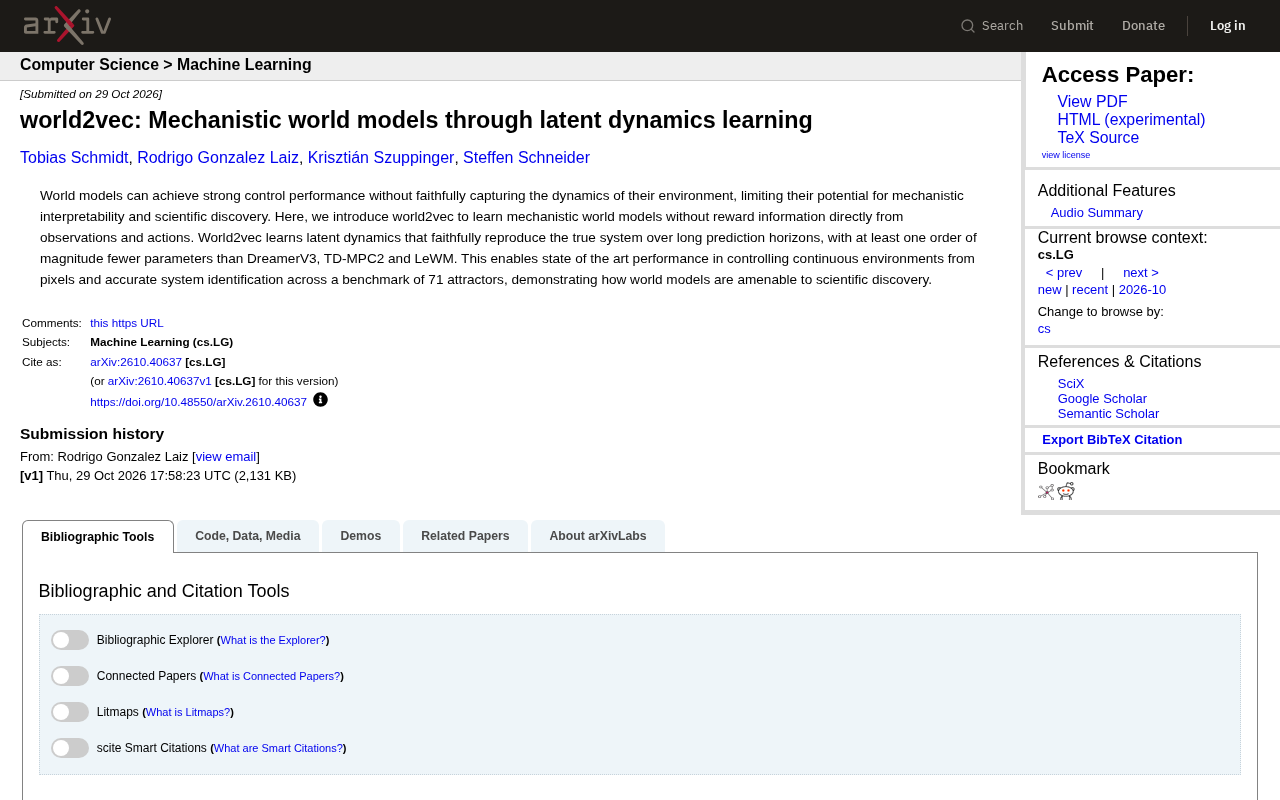
world2vec: Building Mechanistic World Models with Latent Dynamics Learning
world2vec proposes a reward-free method for learning mechanistic world models via latent dynamics, faithfully reproducing systems over long horizons with at least an order of magnitude fewer parameters than DreamerV3, TD-MPC2, and LeWM, and achieving accurate system identification on 71 attractor benchmarks.

A New KL-DRO Paradigm: Adaptive Scenario Generation Around a Learned Density Model
KL-DRO research proposes centering the KL ball on a learned density model instead of the empirical distribution, with adaptive scenario generation guiding sampling toward the worst case. Experiments show lower cost under distribution shift when records are scarce and the model can extrapolate, with comparable in-distribution cost.

ODE Samplers for Discrete Diffusion Models: Exponential Residual Flows Accelerate Generation
Discrete diffusion models lack deterministic ODE sampling? This article introduces Exponential Residual Flows (ERFs), which introduce continuous residual variables per token to construct piecewise ODEs for deterministic sampling and support consistency distillation acceleration. Superior to prior methods on code and text generation tasks.