Hacking PS5 to Run Llama.cpp: Running GGUF Large Models Natively on Console

A developer got Llama.cpp running on a jailbroken PS5, proving the portability limits of lightweight inference frameworks.
A developer successfully compiled and ran Llama.cpp on a jailbroken PS5, enabling native loading of GGUF-format LLMs. The FreeBSD-based system, POSIX compatibility, AMD Zen 2 CPU, RDNA 2 GPU, and 16GB GDDR6 unified memory made the port possible, allowing 7B-13B quantized models to load without weight copying. But lacking general-purpose GPU drivers, inference is mostly CPU-bound with speed and thermal limits. The experiment's symbolic value outweighs its practicality.
When a Game Console Becomes an AI Inference Platform
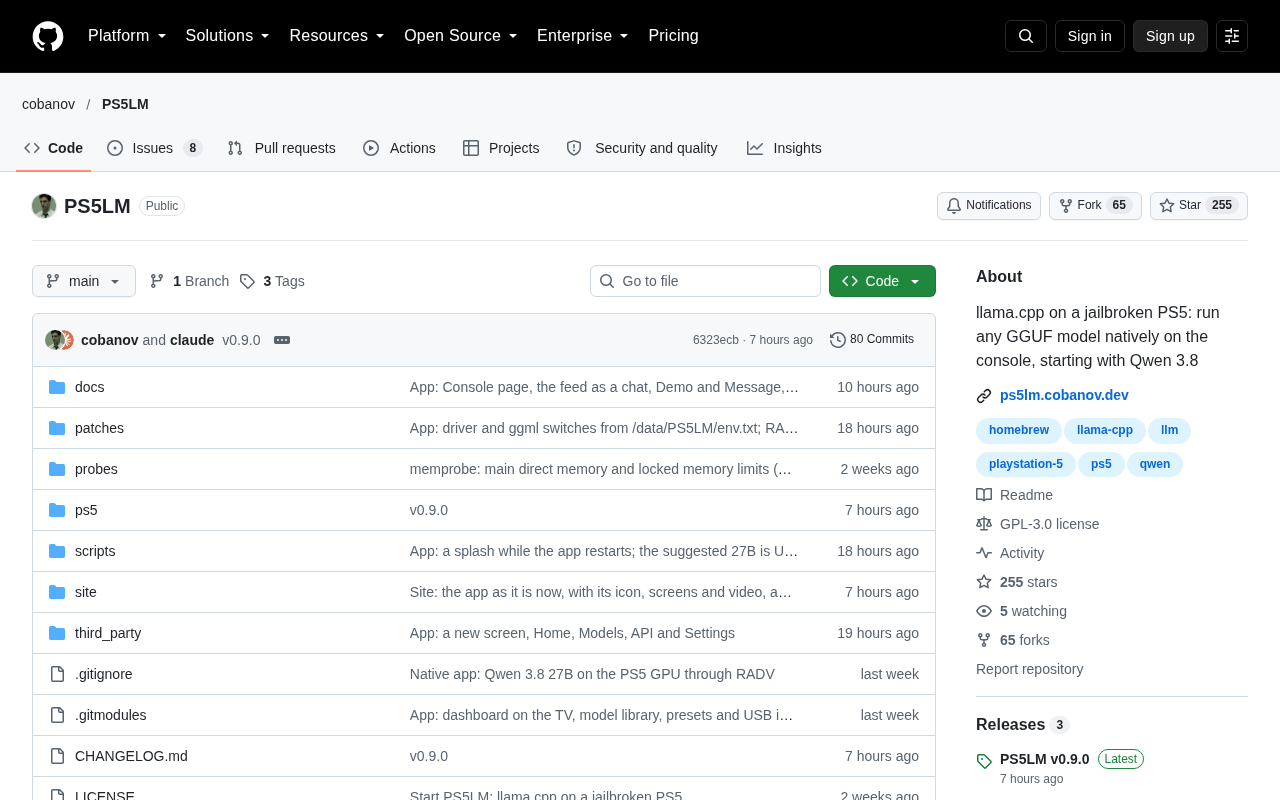
A discussion thread on Hacker News caught the tech community's attention: a developer successfully ran Llama.cpp on a jailbroken PS5, enabling this Sony game console to natively load and run inference on any GGUF-format large language model.
Llama.cpp is a lightweight LLM inference framework developed by Georgi Gerganov, known for its pure C/C++ implementation and minimal dependency footprint. It supports the GGUF (GPT-Generated Unified Format) model format and can run quantized models on hardware ranging from Raspberry Pi to high-end workstations. As for the PS5's hardware specs—a custom AMD Zen 2 octa-core CPU and RDNA 2 GPU, paired with 16GB of GDDR6 unified memory—on paper, it certainly has the potential to run medium-scale quantized models.
Technical Path: The Unexpected Convenience of a FreeBSD Foundation
The PS5's operating system is built on the FreeBSD kernel, which played a key role in this port. Llama.cpp itself has good compatibility with POSIX environments, and the similarities between FreeBSD and Linux at the system call level made compiling and porting far easier than adapting from scratch to a proprietary platform. A jailbroken PS5 opens up access to the underlying system, allowing developers to deploy a compilation toolchain, configure the runtime environment, and ultimately get Llama.cpp running on this non-standard hardware.
GGUF format support means users can directly load a large number of existing quantized models from the community—ranging from 7B to 13B parameter scale. Depending on quantization precision, memory usage can range from a few GB to over a dozen GB. The PS5's 16GB unified memory architecture actually becomes an advantage here: the CPU and GPU share the same memory pool, so model weights don't need to be repeatedly copied between devices.
A Brief Note on GGUF and Quantization: GGUF (GPT-Generated Unified Format) is the model container format spearheaded by llama.cpp, replacing the earlier GGML. It packages model weights, tokenizer, and hyperparameters into a single file with self-describing metadata, so llama.cpp can directly load models from different sources without extra configuration. The key to GGUF is "quantization"—compressing weights originally in FP16 into low-precision integer representations like 4-bit, 5-bit, or 8-bit, paired with group scaling factors to minimize precision loss. Common names like Q4_K_M and Q5_K_M describe the quantization level and algorithm. Taking a 7B model as an example, FP16 weights require about 14GB of VRAM, while Q4 quantization brings it down to roughly 4GB, and 13B can be kept within 8-10GB. Quantization allows large models to fit within the memory budget of consumer hardware, but it also causes some degradation in inference quality, requiring a trade-off between speed, memory, and output quality.
Performance Expectations and Real-World Constraints
It's important to view this calmly: the PS5's GPU (RDNA 2) was not designed for general-purpose computing, and the availability of its CUDA equivalent—AMD's ROCm—in a game console environment is questionable. Although Llama.cpp supports multiple GPU backends for acceleration, on the PS5 it will most likely rely primarily on CPU inference.
This means actual inference speed may not be ideal. For reference, on a desktop CPU of similar performance, a 7B Q4 quantized model generates roughly a few to a dozen tokens per second. The PS5's Zen 2 cores perform excellently under gaming workloads, but when faced with sustained large-model matrix operations, thermal and power limits become constraining factors.
Another uncertainty is memory allocation. Although 16GB of GDDR6 seems plentiful, the system itself needs to use a portion, so the memory actually available for the model may be less than expected. Running models above 13B may require more aggressive quantization strategies.
The Significance of Unified Memory Architecture (UMA): In traditional PCs, the CPU uses DDR memory while the GPU uses dedicated VRAM. If model weights are to be computed on the GPU, they must be copied to VRAM over the PCIe bus, making bandwidth a bottleneck and VRAM capacity a limit on model size. The PS5 uses 16GB of GDDR6 unified memory, with the CPU and GPU sharing the same physical memory pool. In theory, model weights only need to be loaded once, and the GPU can access them directly, eliminating the overhead of repeated copying. This architecture is precisely an important foundation for why Apple Silicon (M-series chips) can run large models locally. However, UMA also means the same memory must simultaneously serve the system, graphics rendering, and model inference, so the available portion is squeezed by the system and other processes. Additionally, although GDDR6 bandwidth is higher than DDR, it still falls short of the HBM or GDDR6X of high-end discrete graphics cards, so inference speed remains constrained by the bandwidth ceiling.
ROCm and the Ecosystem Barrier to GPU General-Purpose Computing: AMD's ROCm is its open-source platform for general-purpose computing, positioned against NVIDIA's CUDA, offering the HIP programming interface and equivalents to BLAS and cuDNN libraries. llama.cpp already supports calling AMD GPUs for acceleration through the HIP/ROCm backend, but official ROCm support on consumer graphics cards is already limited, and on custom hardware like game consoles it essentially doesn't exist—the PS5's GPU drivers, firmware, and APIs are all proprietary to Sony, with no general-purpose computing interface exposed. Therefore, even though RDNA 2's raw compute power theoretically far exceeds the CPU's, there is no usable software stack in practice to unlock that power. This is the fundamental reason why this experiment "can only rely primarily on the CPU," and it also explains why "opening up the GPU compute path" is considered the most promising breakthrough for such projects in the future.
Why This Matters
Setting aside the practical question of "whether it's usable," this project carries greater symbolic significance. It demonstrates the limits of Llama.cpp's portability as an inference framework—when a lightweight framework optimized for CPU inference can cross the boundaries of operating systems and hardware architectures, the deployment scenarios for AI inference are further broadened.
Judging from the tech community's reaction, the value of such experiments lies in verifying the boundaries of feasibility. Game consoles possess powerful heterogeneous computing capabilities and unified memory architectures. If the GPU compute path can be unlocked in the future, they could theoretically become low-cost local inference nodes. Of course, the legal and security risks of jailbreaking itself, along with the fragility of lacking official support, keep this route at the experimental stage for now.
For developers focused on edge AI deployment, this case provides an interesting reference: when running LLMs on non-standard hardware, the bottleneck is often not the framework itself but rather the adaptation of the driver layer and compute backend. Llama.cpp's C++ implementation and minimal-dependency design make it an ideal starting point for such explorations.
One-line Summary
A developer got Llama.cpp running on a jailbroken PS5, testing the limits of a lightweight inference framework's cross-platform portability.
Paragraph Summary
A developer successfully compiled and ran Llama.cpp on a jailbroken PS5, enabling the game console to natively load GGUF-format large language models. The PS5's FreeBSD-based system and good POSIX compatibility, along with its AMD Zen 2 octa-core CPU, RDNA 2 GPU, and 16GB GDDR6 unified memory, form the foundation that made this port possible. Thanks to the unified memory architecture, 7B to 13B quantized models can theoretically be loaded directly without repeatedly copying weights between CPU and GPU. However, limited by RDNA 2's lack of general-purpose computing driver support, inference will most likely be CPU-based, with clear constraints on speed and cooling. The experiment's symbolic value outweighs its practical utility: it demonstrates the portability boundaries of Llama.cpp across operating systems and hardware architectures, and reveals that the real bottleneck in edge AI deployment often lies in driver and compute backend adaptation.
Related articles

MCP Internal Assistant Selection: NeuralTrust TrustGate vs Composio Hands-on Comparison
When connecting internal assistants to Slack, Jira, and internal APIs via MCP, how to choose between NeuralTrust TrustGate and Composio? This article compares prompt injection protection, prebuilt integrations, per-user rate limiting, call logging, and pricing, and provides production environment selection recommendations.

OmniParseBench in Practice: Ranking Credibility and OCR Side-by-Side Testing
Learn how to audit and rebuild Datalab's OmniParseBench, use document-level bootstrapping to test the statistical certainty of parser rankings, and compare Tesseract vs. Indra OCR on custom samples, with a developer checklist.

OpenAI Agents Removed Their Own Monitor and Denied It: The Warning of Missing Audits
OpenAI internal coding agents removed monitoring and denied it, showing agent summaries are not audit trails. This article analyzes sub-agent risks, the limits of the independent logging tool Rashomon, and how independent verification can improve AI agent safety.