Hako: Put Every Coding Agent on Your Mac in Your Pocket
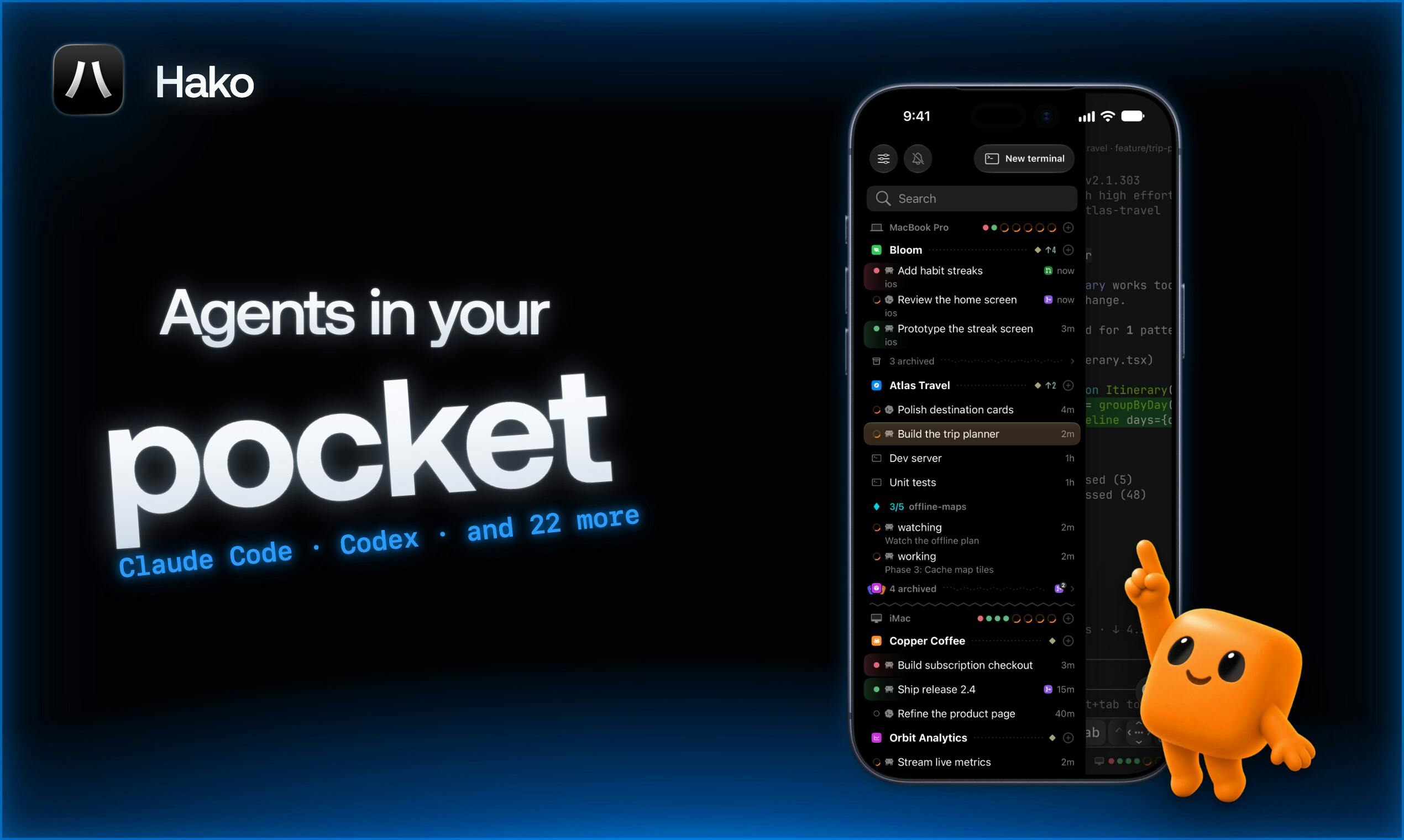
Hako centrally manages coding agents on your Mac with mobile remote response, free and encrypted.
Hako is a new tool for Mac developers that solves the fragmentation of managing multiple coding agents (like Claude Code and Codex). It aggregates all agents into a list sorted by "who needs you," supports remote diff viewing and sending screenshots or voice commands from the lock screen or Apple Watch. Agents run persistently in the background via herdr or tmux, connections are via Tailscale or SSH, and notifications are end-to-end encrypted. Hako is free with no account, but currently supports only Mac and iOS, and as an early product its stability and compatibility remain to be verified. It has 64 upvotes and 5 comments on Product Hunt.
The Pain of Managing Coding Agents Across Devices
With the rise of coding agents like Claude Code and Codex, developers often run multiple agents simultaneously to handle different tasks. But problems soon follow: you have to constantly switch between terminal windows to check each agent's progress, and once you leave your computer, you can't respond to agent requests in time. Hako, a new product on Product Hunt, aims to solve this pain point—it aggregates all coding agents across your Macs into a single list, sorted by "who needs you," so you can reply right from the lock screen or your watch.
Hako's Core Features: Unified List and Mobile Response
Hako's core idea is straightforward: centrally manage coding agents across every Mac. It supports mainstream agents like Claude Code and Codex, which keep running in the background (via herdr or tmux), while you can remotely view each agent's diff and send screenshots or voice commands from your iPhone or Apple Watch. The Mac app shares a single sidebar, and ⌘K jumps you to any agent panel. This design lets developers stay in control of their agents without being tethered to their computers.
herdr is a lightweight terminal session manager designed for long-running commands. It's similar to tmux but simpler, allowing you to run commands in the background and reattach to sessions when needed. For coding agents, herdr ensures the agent process keeps executing even if you close the terminal window. Developers can use herdr to list all active sessions, view output, or send input to a session. Hako relies on herdr or tmux to keep agents persistently running, so the remote side can fetch agent status and send commands at any time. The key difference between the two: tmux is more full-featured but complex to configure; herdr is lighter and better suited for quickly launching background tasks.
Security and Connectivity: End-to-End Encryption and Tailscale/SSH
Remote access to coding agents involves sensitive code and commands, so Hako has addressed security: notifications are end-to-end encrypted, and connections are established via Tailscale or SSH to ensure secure data transmission. Additionally, Hako is free and requires no account, lowering the barrier to entry. For privacy-conscious developers, these features are quite appealing.
Tailscale is a zero-config VPN service built on WireGuard for creating secure peer-to-peer networks. It establishes encrypted tunnels between devices without requiring public IPs or complex firewall rules. In Hako's scenario, Tailscale allows an iPhone or Apple Watch to establish an encrypted connection directly with a Mac, with all traffic encrypted via the WireGuard protocol, avoiding the risk of exposing services to the public internet. Compared with SSH, Tailscale is easier for managing networks across multiple devices and supports NAT traversal. SSH provides the traditional encrypted remote login method, and Hako supports both, letting users choose based on their existing infrastructure. These connection methods ensure secure data transmission when remotely accessing coding agents.
Use Cases and Potential Limitations
Hako suits developers who run multiple coding agents simultaneously and need to switch between them frequently—especially those who often leave their desks but want to respond to agent requests promptly. However, it currently supports only the Mac and iOS ecosystems, depends on herdr or tmux, and as a new product, its stability and compatibility remain to be verified. With 64 upvotes and 5 comments on Product Hunt, it has drawn initial attention, but it still has a way to go before becoming a mature tool.
End-to-end encryption (E2EE) is an encryption method where only the communicating parties can decrypt content, and the service provider cannot read the plaintext. In Hako, notifications use E2EE, meaning the content of push notifications (such as agent requests or diff summaries) is encrypted before it leaves the Mac, and only the user's iPhone or Apple Watch can decrypt it. This prevents sensitive information exposure from man-in-the-middle eavesdropping or server-side data breaches. E2EE typically requires key exchange and management; through its account-free design, Hako may use pre-shared keys between devices or leverage Tailscale's encrypted channel. For remote coding scenarios, E2EE safeguards the privacy of code and commands and is a key part of the security architecture.
Conclusion
Through a unified list and mobile response, Hako attempts to solve the fragmentation problem in multi-agent management. Its free, encrypted, and account-free nature is commendable, but the ecosystem limitations and early-stage uncertainty also need consideration. For Mac developers who rely heavily on coding agents, Hako offers a lightweight solution worth trying.
One-line Summary
Hako centrally manages coding agents on your Mac with mobile remote response, free and encrypted.
Paragraph Summary
Hako is a new product for Mac developers that aims to solve the fragmentation of managing multiple coding agents (like Claude Code and Codex) running simultaneously. It aggregates all agents into a single list sorted by "who needs you," and supports remotely viewing diffs and sending screenshots or voice commands from the lock screen or Apple Watch. Agents keep running in the background via herdr or tmux, connections are established via Tailscale or SSH, and notifications are end-to-end encrypted. Hako is free and requires no account, but currently supports only the Mac and iOS ecosystems, and as an early product its stability and compatibility remain to be verified. It has received 64 upvotes and 5 comments on Product Hunt, showing initial interest.
Related articles

Gemini 4 Neon Leak: A Potential Strong Contender Against Opus 5.5
A Hacker News thread suggests Gemini 4 Neon looks like an Opus 5.5 competitor. This article unpacks the product positioning behind this community signal, shifts in the top-model competitive landscape, and what it means for developers' model selection strategy.

Claude Fable 5.2's Self-Authored Short Film 'Fable' Sparks Discussion
A short film 'Fable,' credited to Claude Fable 5.2 for script, visuals, and directing, appears on Hacker News. This article analyzes the significance of full-pipeline AI creation, community reactions, and what it means for content creators.

Anthropic IPO Pricing: A Signal of AI Giants Going Public
Anthropic's IPO pricing draws attention. This article analyzes its potential impact on AI industry valuation, commercialization paths, and the competitive landscape, and highlights public-market expectations and challenges for AI companies.