Half of Nvidia GPUs Sitting in Warehouses? The AI Compute Bubble Controversy Behind Altman's Memory Complaint

Ed Zitron claims over half of Nvidia GPUs idle in warehouses, conflicting with the compute shortage narrative but lacking corroboration.
A Reddit post juxtaposes Sam Altman's remarks on users' PC memory configurations with tech writer Ed Zitron's claim that "more than half of Nvidia GPUs are non-productively backlogged in warehouses," creating a sharp contrast. The article notes that this claim currently has only a single source, lacking statistical scope and third-party data, and should be treated as an unverified assertion. GPU backlog may stem from channel stockpiling, supporting bottlenecks such as power and data center space, or demand expectations falling short. If partially true, it could depress GPU rental prices and affect cloud providers' pricing and investor expectations. The article recommends watching signals such as Nvidia's financial report inventory turnover, rental market prices, and cloud providers' capital expenditures, rather than rushing to take sides.
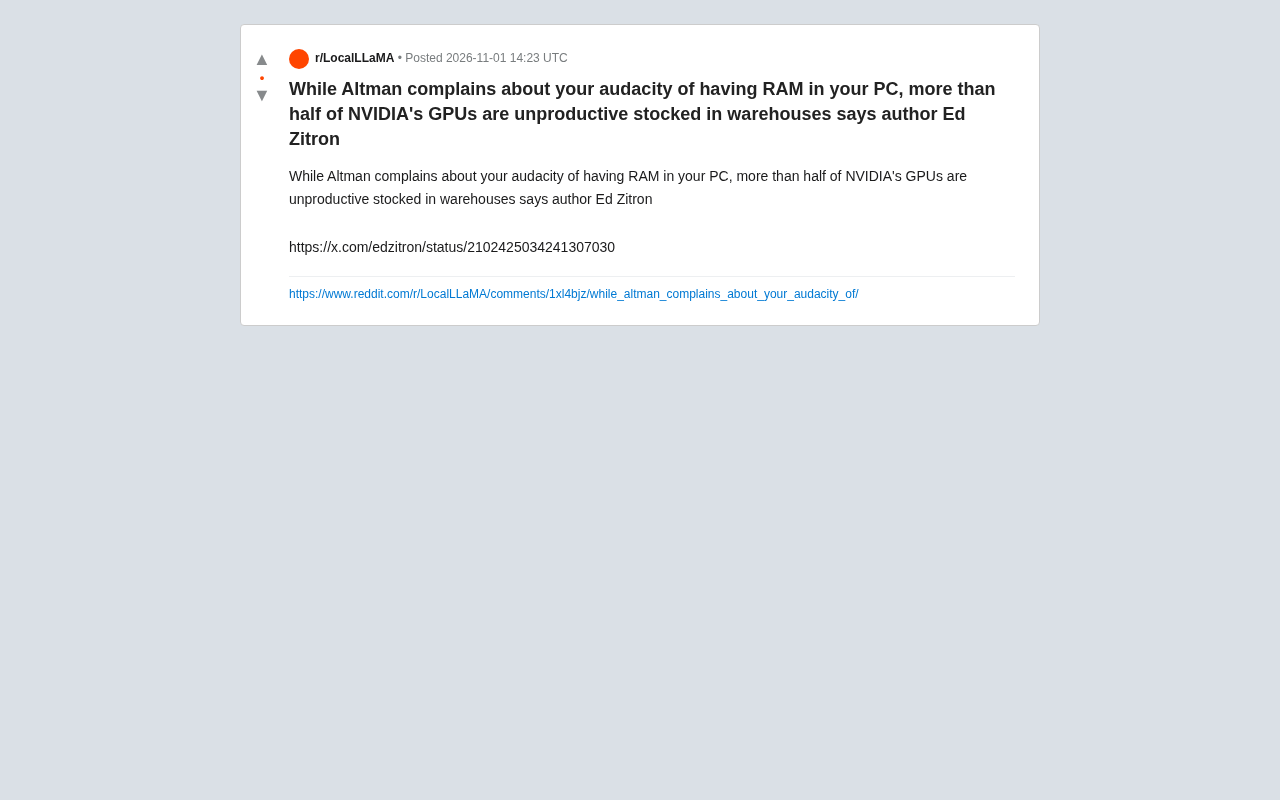
A post from Reddit brings together two seemingly unrelated things: on one side, OpenAI CEO Sam Altman's "complaint" about the memory configurations of ordinary users' PCs; on the other, tech writer Ed Zitron's startling claim that more than half of Nvidia GPUs are piling up in warehouses in a non-productive state. Is this alarmist fearmongering, or does it puncture a corner of the AI compute frenzy?
1. Where the Controversy Comes From: The Intersection of Two Threads
According to the Reddit post, Ed Zitron stated on social media that more than half of Nvidia GPUs are not in use but sit idle as inventory in warehouses. The post also mentions that Altman expressed some dissatisfaction with users having memory in their PCs—though the original text doesn't elaborate on the specific context, the contrast itself is sharply ironic: on one hand, cloud compute may be largely idle; on the other, there's criticism of end-device resources.
It should be noted that this thread currently comes mainly from Zitron's personal statement and Reddit community relay—a single-source viewpoint—with no direct corroboration yet from Nvidia official or independent third-party audit data.
What Altman's "Memory Complaint" Means
The original material does not provide the specific scenario or full wording of Altman's remarks, so overinterpretation is inadvisable. But inferring from the AI industry context, such statements are usually related to the narrative that "compute should be centralized in the cloud." If cloud compute really has massive idle capacity, then this narrative needs to be re-examined.
Understanding this controversy requires distinguishing several concepts that are often conflated: inventory refers to unsold chips held by manufacturers or channel partners; shipment refers to the quantity delivered from Nvidia to customers; deployment refers to GPUs actually installed in data centers and powered on. The "data center business revenue" in financial reports reflects shipments and sales, while "whether they are put to use" depends on the customer-side infrastructure construction progress. What Zitron calls "piling up in warehouses" is closer to channel inventory or customer stockpiling, and does not directly contradict Nvidia's confirmed sales revenue—chips may have been sold but still not put into production. This distinction is the key premise for judging whether the claim of "half of GPUs idle" holds.
2. Credibility Analysis of the "Half of GPUs Backlogged" Claim
Ed Zitron has long focused on business models and bubble phenomena in the tech industry, and his statements carry a clear critical stance. Logically, "GPUs piling up in warehouses" could point to several scenarios:
- Stockpiling and speculation: During supply shortages, channel partners or enterprises may over-purchase, leading to high inventory;
- Supporting infrastructure bottlenecks: GPUs require power, data center space, cooling, and other infrastructure to be put into production; there is a time lag between procurement and deployment;
- Demand expectations falling short: Some buyers place orders based on optimistic expectations, but actual business demand fails to keep up.
But these are only speculative possibilities. Zitron's statement does not provide statistical scope, sample sources, or time range, so the "more than half" ratio should be treated as an unverified claim rather than established fact.
Tension with the Mainstream Narrative
The current mainstream narrative in the AI industry is that compute is in short supply, and Nvidia's data center business is consistently described as growing rapidly. Zitron's claim directly conflicts with this narrative. The two are not necessarily irreconcilable—inventory and shipments, deployed and sold are different concepts—but this tension itself is worth noting.
There is a significant infrastructure time lag between GPU procurement and production. An AI data center needs to complete power capacity expansion, liquid cooling or air cooling system construction, network interconnection (such as InfiniBand or high-speed Ethernet), and data center renovation, with cycles often measured in quarters or even years. Nvidia's new-generation chips (such as H100, B200) have power consumption of 700W to over 1000W, far exceeding traditional servers in power supply and cooling requirements, further lengthening deployment cycles. Therefore, even if demand is real, it is logically possible in the short term to have GPUs "sold but not powered on" piling up; this does not necessarily mean demand is fake, but it does distort the intuitive perception of "compute shortage."
3. What It Means for the AI Industry
If the GPU backlog claim is even partially true, its impact will ripple through the industry chain.
For the Compute Rental Market
If idle inventory flows into the rental market, it could depress GPU rental prices and change cloud providers' pricing strategies. For intermediary companies that rely on reselling high-priced compute, this would directly compress profit margins.
GPU rental prices are a sensitive indicator for observing compute supply and demand. Major cloud providers (AWS, Azure, CoreWeave, etc.) rent GPU instances by the hour, with prices fluctuating with supply and demand. When idle compute increases, spot market prices often loosen first, then transmit to long-term contract pricing. For intermediary companies (neoclouds, compute brokers) that rely on "buying compute low, reselling high," profit margins depend on price spreads; once rental prices decline, their business models are directly impacted. Therefore, tracking rental quote trends for flagship models like H100 reflects true supply and demand better than single-source inventory claims.
For Nvidia and Investors
There is a contradiction between high inventory and the "supply shortage" narrative. Investors need to distinguish "who it was sold to" and "whether it is put to use"—the former appears in financial reports, while the latter determines whether long-term demand is real.
For Ordinary Users
This is also the ironic point in the post title: when compute sits idle in warehouses, arguments about personal device memory configurations seem somewhat misplaced. Resource allocation for end devices and utilization efficiency of cloud compute are fundamentally issues at two different levels.
4. Stay Cautious: Limitations of a Single Source
The credibility of this information is currently limited by its source structure. The Reddit post is a relay of Zitron's statement, and the original tweet itself does not include data links. Before cross-verification with Nvidia's inventory turnover data in financial reports, third-party channel research, or supply chain information, any conclusion should be prefixed with "allegedly."
Signals worth continuing to watch include: changes in the inventory-to-shipment ratio in Nvidia's financial reports, GPU rental market price trends, and the pace of adjustment in cloud providers' capital expenditures. These are the key indicators for testing the "compute bubble" argument.
For readers, a more valuable approach is not to rush to take sides, but to treat this controversy as a reminder: the true utilization rate of AI compute may be more worth questioning than the numbers in promotional materials.
One-line Summary
Ed Zitron claims more than half of Nvidia GPUs are idle in warehouses, conflicting with the compute shortage narrative but lacking corroboration.
Paragraph Summary
A Reddit post juxtaposes Sam Altman's statement about users' PC memory configurations with tech writer Ed Zitron's claim that "more than half of Nvidia GPUs are non-productively backlogged in warehouses," creating a sharp contrast. The article analyzes that this claim currently has only a single source, lacking statistical scope and third-party data, and should be treated as an unverified assertion. GPU backlog may stem from channel stockpiling, supporting bottlenecks such as power and data center space, or demand expectations falling short. If partially true, it could depress GPU rental prices and affect cloud providers' pricing and investor expectations. The article suggests watching signals such as Nvidia's financial report inventory turnover, rental market prices, and cloud providers' capital expenditures, rather than rushing to take sides.
Related articles

beacon.sh: Giving AI Coding Assistants a Self-Evolving Memory
beacon.sh is an open-source, self-evolving memory layer for AI coding agents, supporting Claude Code, Cursor, Codex and 20+ harnesses—turning agent sessions into a compounding knowledge layer.

Xmind 2027 Launches: Mind Mapping Evolves into an AI Thinking Partner
Xmind 2027 launches on Product Hunt as an "AI thinking partner." It adds Xmind Agent for research with local documents and mind maps, and connects mind map context to ChatGPT, Claude, and other AI workflows via MCP. This article analyzes its product logic, differentiation, and open questions.

Display 1.0: Build Docs and Apps with Any Agent
Display 1.0 launches on Product Hunt, letting any Agent create docs, prototypes, and apps in one workspace, organized via Spaces and Folders into a team knowledge base with flat pricing.