Halloween Robot Bob Deploys to Hand Out Candy: Edge AI and AgenticROS in Practice

Halloween candy robot Bob shows how AgenticROS enables contextual robot interaction.
This article breaks down the tech stack of Bob, a Halloween candy-distributing robot shared by a Reddit user. Hardware-wise, Bob uses a RealSense D457 stereo depth camera as its eyes, NVIDIA Jetson AGX Orin as its edge compute brain, and an AVerMedia integration kit to connect modules, forming a perception-to-action loop. Software-wise, it's driven by the new AgenticROS Trick or Treat Skill, layering agentic capabilities on ROS so the robot responds based on context rather than fixed scripts, with tone—e.g., warning those who grab too much candy. The article analyzes key physical AI points this scenario covers: close-range interaction safety, edge compute necessity, and personality-driven interaction design, noting the project hasn't disclosed implementation details and its generalization remains to be assessed, but it shows the trend of lowering the barrier to physical AI prototype assembly.
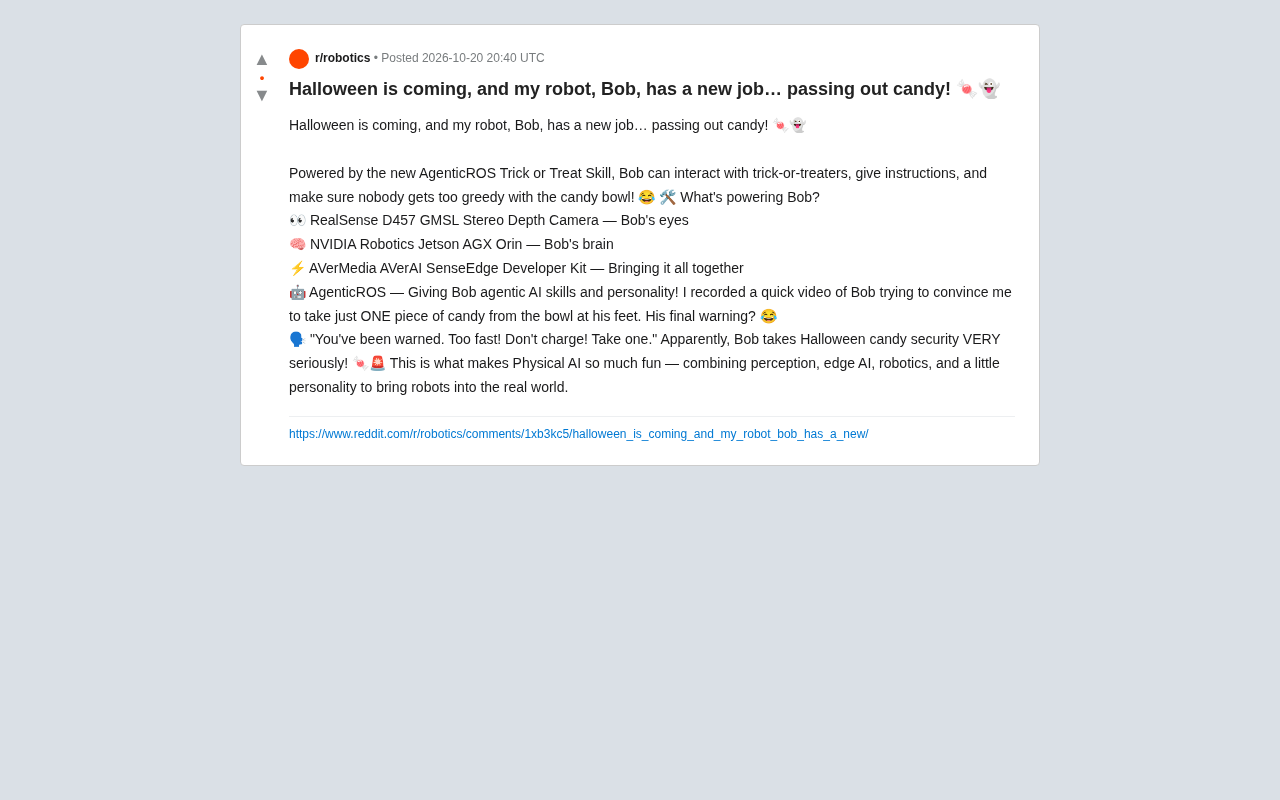
On Halloween night, a robot named Bob took on the task of handing out candy. Shared by a Reddit user, this project didn't stop at a lab demo—it packed perception, edge computing, robot control, and a bit of "personality" into a real, interactive scenario. Its tech stack is worth breaking down—especially the newcomer AgenticROS, and how it moves a machine from "executing commands" to "understanding context and responding."
Bob's Hardware: A Sensory System Built for Physical Interaction
Based on the configuration the author disclosed, Bob's hardware combination points to a clear goal: to reliably "see" and "respond" to people in a real environment.
- RealSense D457 GMSL stereo depth camera serves as the eyes. Compared to an ordinary RGB camera, a depth camera provides not just images but distance information. This is crucial for a candy-distribution scenario—the robot needs to judge where a hand is reaching, the boundary of the candy bowl, and whether someone is too close.
- NVIDIA Jetson AGX Orin is the brain. As an edge computing platform designed for robots, it puts inference capability on-device, avoiding the need to send all perception data back to the cloud, thereby meeting the latency requirements of real-time interaction.
- AVerMedia AVerAI SenseEdge developer kit handles "connecting everything." Kits like this solve engineering integration problems: cameras, compute modules, and the robot body need a unified carrier for signals and power, otherwise the prototype gets stuck on wiring and compatibility issues.
The highlight of this configuration isn't how powerful any single component is, but that together they form a closed loop: perception input → edge inference → action and voice output. The fun of physical AI comes precisely from this loop running in the real world.
GMSL (Gigabit Multimedia Serial Link) is a high-speed serial interface for automotive and robotics scenarios, capable of simultaneously transmitting high-bandwidth video, control signals, and power over a single coaxial cable. Compared to USB connections, GMSL supports longer cable distances and stronger interference resistance, and can connect multiple cameras to the same compute platform via deserializer boards. The RealSense D457's GMSL interface means it is better suited for embedding into a mobile robot body rather than relying on short-distance USB cables—this has practical significance for the physical layout of the camera and compute module in a candy-distribution scenario.
AgenticROS: Giving Robots "Agentic" Skills
The original post mentions that Bob is driven by the new AgenticROS Trick or Treat Skill. The name AgenticROS itself reveals the direction—layering "agentic" capabilities on top of ROS (Robot Operating System).
Traditional robot programs are usually deterministic workflows: detect a person → trigger voice → open the candy bowl. The difference with agentic AI is that the robot is given goals and constraints, then decides how to respond in context. The details the author describes illustrate exactly this: Bob interacts with trick-or-treating children, gives instructions, and ensures no one takes too much from the candy bowl. When the author tried to take extra, Bob's response was "You've been warned. Too fast! Don't charge! Take one."—this isn't a simple fixed-line trigger, but feedback with judgment and tone.
In other words, AgenticROS here is responsible for encapsulating underlying robot capabilities (perception, motion, voice) into composable "skills," which the agent layer then invokes based on context. This layered approach is developer-friendly: hardware abstraction and intelligent decision-making are decoupled, so switching scenarios doesn't require rewriting the lower layers.
ROS (Robot Operating System) is not an operating system in the traditional sense, but a middleware framework for robot development, providing hardware abstraction, inter-process communication, package management, and visual debugging capabilities. It abstracts sensor drivers, motion control, navigation, and other modules into reusable "nodes" that communicate via topics, services, and other mechanisms. ROS 2 further improved real-time performance and distributed communication, making it more suitable for product deployment. AgenticROS is clearly an upper-layer framework built on the ROS ecosystem; understanding ROS's layered philosophy helps grasp its design logic of "encapsulating lower-level capabilities as skills, with the upper agent layer scheduling based on context."
Physical AI in Practice, Seen Through Candy Distribution
Halloween candy distribution may seem like a joke project, but it happens to cover several key challenges of physical AI.
Safety in close-range human-robot interaction. Trick-or-treaters are mostly children with unpredictable movements. The robot must continuously perceive distance and set soft boundaries—Bob's "Too fast! Don't charge!" is exactly the external expression of such boundaries.
The necessity of edge computing. If speech recognition, visual detection, and interaction decisions relied on cloud round-trips, latency and network stability would ruin the experience. Jetson AGX Orin completes these tasks on-device, which is a prerequisite for smooth interaction.
Personality as part of interaction design. The author specifically emphasizes Bob's "personality." In service robot scenarios, tone and wording directly affect people's acceptance. Using agentic AI to generate responses with attitude is more flexible than pre-recorded voice, and makes the robot feel more "present."
It should be noted that the above analysis is based on the author's disclosed hardware list and interaction description. The project itself has not yet revealed specific implementation details of AgenticROS, such as how skills are orchestrated, what model drives decisions, and how failure cases are handled. This lack of information means we can only observe its behavior externally, without being able to evaluate its generalization capability.
Physical AI refers to the technological direction of enabling agents to perceive, decide, and execute actions in the real physical world, distinct from software AI that operates only in digital environments. It requires systems to simultaneously handle sensor noise, real-time constraints, human safety, and irreversible physical consequences. Companies like NVIDIA have been pushing this concept in recent years, emphasizing the combination of simulation training, edge inference, and robot bodies. Bob's candy task, though small, fully implements the core chain of physical AI: real perception input, on-device decision-making, physical action output—making it a miniature sample for observing how this direction takes shape in practice.
What It Means for Developers
The signal this project sends is that the barrier to physical AI is shifting from "can it be done" to "how to assemble it quickly." Depth cameras, edge compute modules, integration kits, and agentic frameworks—each layer has relatively mature options, and combining them can produce a demonstrable interactive robot within days.
But there's still a gap between demo and product. Real deployment requires handling exceptions, multiple concurrent users, long-term stability, and safety compliance—especially for products aimed at children. Bob's Halloween experiment is more of a directional sample: it proves that the stack of perception + edge AI + agentic skills is feasible in real scenarios, and also exposes what needs engineering work next.
For developers focused on robotics and edge AI, it's worth watching whether AgenticROS will open up more skill interfaces and documentation. A framework that lets robots "complete tasks with personality" could, if its ecosystem catches up, change the cost structure for small teams building interactive robots.
One-line Summary
Halloween candy robot Bob shows how AgenticROS enables contextual robot interaction.
Paragraph Summary
This article breaks down the tech stack of Bob, a Halloween candy-distributing robot shared by a Reddit user. On the hardware side, Bob uses a RealSense D457 stereo depth camera as its eyes, NVIDIA Jetson AGX Orin as its edge compute brain, and an AVerMedia integration kit to connect the modules, forming a closed loop from perception to action. On the software side, it is driven by the new AgenticROS Trick or Treat Skill, layering agentic capabilities on top of ROS so the robot responds based on context rather than fixed scripts, with tone—for example, warning those who take too much candy. The article further analyzes the key physical AI points this scenario covers: close-range human-robot interaction safety, the necessity of edge computing, and personality-driven interaction design, noting that the project has not disclosed implementation details and its generalization capability remains to be evaluated, but it demonstrates the trend of lowering the barrier to assembling physical AI prototypes.
Related articles

A Single Prompt Triggers a Global PHP Security Storm: Is AI a Savior or a Hidden Risk?
A single AI prompt triggered a global PHP security crisis affecting Wikipedia and the Internet Archive. This article reviews the incident, analyzes the OpenAI-Amazon controversy, and explores the security paradox of lowered vulnerability discovery barriers in the AI era and developer response strategies.

When AI Is Taken Away: How Reliance on Shortcuts Undermines Your Problem-Solving Resilience
A study of 1,222 people found that after using AI to answer questions, once AI was removed, people gave up on more problems than a control group that never used AI. The article analyzes the impact of AI reliance on learning resilience and metacognition, and explores design implications for AI learning tools.

Carta and NewView Partner to Let Startup Employees Cash Out Equity Early
Carta and NewView Capital partner to simplify startup tender offers, helping employees sell equity early. Analysis of the mechanism, liquidity pain points, and impact.