Handcrafting the Perfect Pencil: When DIY Meets Stationery Geek Culture

A stationery geek drills, cuts, and glues his favorite eraser onto a lead holder that never had one.
This article documents a small but satisfying stationery mod. The creator carries two pencils daily — a Pentel Kerry and a Koh-I-Noor Versatil 5228 lead holder — but the latter has a sharpener where an eraser should be. To fix this, he harvested the eraser from a Rite in the Rain mechanical pencil, drilled out the sleeve to fit, trimmed the excess length, sanded the cut smooth, and glued everything together permanently. The result is a fully functional lead holder with a replaceable eraser — proof that the best tool is the one you make yourself.
Why Pencils, Not Pens
Some people feel compelled to write down every thought that crosses their mind. The creator behind this project is one of them — he writes down nearly everything. He used to be a fountain pen person, but after one particular "incident," he switched to pencils and never looked back.
His preference for mechanical pencils is no secret. He carries two daily: a Pentel Kerry (.5mm 2B lead) and a Koh-I-Noor Versatil 5228 (2mm 2B lead). The reasoning is practical: both are compact and won't poke you in the pocket. The Kerry has a cap, and the Koh-I-Noor is a lead holder that similarly retracts its tip.
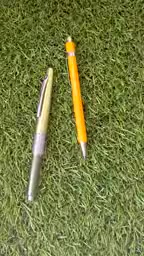
This kind of careful attention to everyday tools is classic stationery-geek thinking — it's not about spending more, it's about finding what actually works.
The Problem: No Eraser
Both pens have their shortcomings. The Kerry has an eraser at the end; the Koh-I-Noor does not. In its place sits a "cute but annoying" lead sharpener. For a 2mm thick-lead holder, sharpening is genuinely necessary — but the trade-off is that every mistake means reaching for a separate eraser.
That small inconvenience became the seed of the entire modification project. The creator decided to go full mad scientist and permanently marry his favorite pencil to his favorite eraser. The eraser of choice? The one that comes with the Rite in the Rain 1.3mm mechanical pencil.
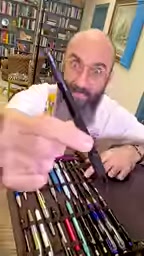
The problem became immediately apparent: while the eraser tubes can be bought separately, the sleeve fit too tightly to slide into the Koh-I-Noor's tail end. A great idea, but a frustrating reality.
Rite in the Rain is an American stationery brand known for "all-weather writing" — their paper and writing instruments are designed for outdoor and wet conditions. Their 1.3mm mechanical pencil comes with a highly regarded eraser that has developed its own following in the stationery community: smooth, clean erasing with a satisfying feel. Importantly, Rite in the Rain sells replacement eraser tubes separately, which was a key factor in this project — the parts are obtainable and replaceable, not a one-time consumable. That replaceability was one of the main reasons this eraser was chosen over others.
The Build: Drill, Twist, Cut, Sand
The first step in solving the "too tight" problem was using a drill to widen the inner diameter of the eraser sleeve. This went surprisingly smoothly — once drilled out, the sharpener could finally seat inside the eraser holder.
But a new problem emerged: when he screwed the sharpener back onto the pencil body, the pen now had an eraser, but it was too long — there was an awkward extra section sticking out above the clip, and it looked off.
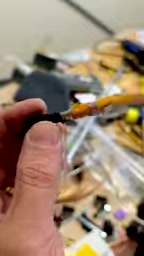
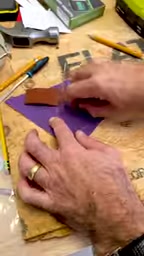
Functionally, things still worked — the eraser wasn't seated as deep, but the clutch mechanism still released properly and the lead still extended freely. The real fix was simple: cut it. He trimmed off the excess, then sanded the rough cut edge smooth, filing it down where needed.
The Koh-I-Noor Versatil line is a classic product from Czech stationery veteran Koh-I-Noor Hardtmuth, designed specifically for 2mm lead holders. Unlike standard mechanical pencils, lead holders use a collet-style chuck mechanism — press the tail end to release the chuck and advance the lead, then use a dedicated sharpener to keep the tip sharp. Because the lead diameter is far larger than a typical 0.5mm pencil, it wears faster and writes thicker, so the sharpener was built into the tail end by design. Functional, yes — but it takes up exactly the space where an eraser could live, creating the central tension of this whole project.
Making It Permanent: Clean and Bond
To make the union truly permanent, he wiped both components clean with an alcohol wipe to remove any oils from the surfaces, then packed adhesive into the eraser seat. Apply glue, align the parts, let it set — then leave it to time.
A day later, the finished piece felt and looked exactly as he'd hoped. He finally had a pencil that paired his favorite lead holder with a replaceable eraser he actually loved. This pen would go into his back pocket, ready for anything.
The Ritual of the Tinkerer
This project isn't technically complex — no circuits, no code, just drilling, cutting, sanding, and gluing. But it captures something genuinely compelling about the DIY modification culture: the obsessive refinement of everyday tools almost always starts with a tiny, almost trivial pain point.
The creator even jokes that the pencil "looks a little weird," then adds that "maybe that's why it reminds me of myself" — a strange but useful little oddity. That pragmatism-in-imperfection is at the heart of the DIY ethos: tools should serve the person, not the other way around.
For anyone who enjoys tinkering with stationery or everyday objects, this small project offers a simple but resonant idea: rather than tolerating something that's "almost right," just make it exactly right yourself.
Related articles

Tencent WorkBuddy Hands-On: How AI Agents Crush Traditional Chat Assistants
WorkBuddy vs Doubao tested: how AI Agents directly operate computers to convert PPT to PDF, archive files and more. Analysis of WorkBuddy's low barrier, domestic ecosystem, pricing and plugin marketplace, plus AI Agent selection advice.

Azure Cross-Tenant Attack Chain: Root Cause Analysis of Five Paths
Binary Security analyzes five full cross-tenant compromise paths in Azure, trending 271 points on HN. This article interprets their shared root cause perspective and offers defense recommendations for cloud tenant isolation and reflections on responsibility boundaries.

Recreating a Real Bubble Tea Station in Isaac Sim: Script-Driven Unitree G1 Brews Tea
Developers recreated a real self-service tea station in NVIDIA Isaac Sim, using scripts to drive a Unitree G1 through a five-step tea-brewing process, exploring whether physics simulation can be a source of synthetic robot demonstration data and discussing contact stability and imitation learning.