Hands-On Testing Meta's Open-Source Muse Glimmer: A Lopsided Agent-Specific Model

Meta's Muse Glimmer excels at vision tasks but falls short in reasoning and complex applications.
Meta's newly open-sourced 30B Muse Glimmer model, built for agents, delivers impressive vision capabilities and fast inference with D-Spark speculative decoding (3x speedup on RTX 5090). However, hands-on testing reveals severe weaknesses in logical reasoning, creative writing, and complex applications. Its 128K context limit is a critical bottleneck for real agent scenarios, and it scores second-to-last in comprehensive benchmarks against competitors including Qwen.
Meta's Urgent Move: Muse Glimmer Enters the Stage
Meta recently open-sourced a 30B-parameter local model — Muse Glimmer — with a single official tagline: Build for Agents. From its naming to its positioning, everything screams "purpose-built for intelligent agents."
From a timing perspective, this release carries a sense of urgency. The general industry consensus is that Meta wanted to stake its claim before Qwen 3.8 27B's release. For a long time, the title of "strongest local model that runs on a single GPU" has been firmly held by the Qwen series. Muse enters the battlefield armed with an official quantization scheme and speculative decoding acceleration (D-Spark), clearly aiming to snipe its competitor's next release.
The open-source community's reaction has been interesting — many veterans from the Llama era immediately proclaimed "Llama is finally back!" The rallying power accumulated since the first generation of local deployment remains remarkable. But hype aside, whether the model actually delivers requires hands-on testing.
Muse Glimmer Technical Architecture: Designed to Save VRAM
Muse Glimmer's training path is straightforward: distillation from the previously released Muse Spark model, followed by post-training, supervised fine-tuning (SFT), and reinforcement learning (RL). This four-stage "pre-training → distillation → SFT → RL" training paradigm has become standard practice for commercial-grade large models. The core idea of knowledge distillation is to have a smaller student model (Glimmer) learn the teacher model's (Spark) output probability distribution rather than merely fitting hard labels from training data, thereby retaining as much knowledge as possible in fewer parameters. The SFT stage builds conversational and instruction-following capabilities through high-quality human-annotated instruction-response pairs, while the final RL stage (typically using RLHF or DPO methods) further polishes output quality and safety through human preference signals. Data quality and training hyperparameters at each stage significantly affect the final model's capability distribution — which partially explains Muse's notably lopsided performance profile.
From the technical specifications, the model has several distinctive features:
- 52-layer structure, supporting text and image input, covering over 100 languages;
- Only 2 KV heads, meaning extremely efficient KV Cache usage, very VRAM-friendly for local inference;
- Vision capabilities are specifically enhanced, with mixed image-text processing as a strong suit.
The choice of KV head count deserves deeper explanation. KV Cache (Key-Value Cache) is the primary source of VRAM consumption during autoregressive inference in Transformer architectures — when generating each new Token, the model needs to compute attention against the Key and Value vectors of all previous Tokens, which are cached in VRAM and grow linearly with context length. In traditional Multi-Head Attention (MHA), each attention head has independent KV pairs, while Muse's Grouped Query Attention (GQA) compresses KV heads down to just 2, having all Query heads share a minimal number of KV groups. For a 30B model with 128K context, traditional configurations might require tens of GB of KV Cache, while the 2 KV head design might only need 1-2GB. This is the key design decision enabling it to fit into a 24GB consumer GPU, though such aggressive compression may come at a cost for tasks requiring fine-grained context differentiation.
However, the most critical weakness is also hidden in the spec sheet: native context of only 128K. At this point in time, mainstream large models are advancing toward millions or even tens of millions of tokens, and local models should start at 256K minimum. 128K is particularly awkward for a model marketed as "agent-focused" — system prompts, tool call records, conversation history, and document content can easily approach 100K when stacked together, leaving almost no room for complex task planning.
Specifically, in a typical Agent interaction, system prompts (defining roles and tools) usually take 5K-15K Tokens, tool definitions and API schemas may occupy 10K-30K, multi-turn conversation history can accumulate to 20K-50K, and when the Agent needs to process documents, codebases, or execute multi-step planning, additional working memory space is needed. This means 128K context in real Agent scenarios may only support 3-5 rounds of complex tool calls before approaching saturation. In comparison, Gemini already supports 2 million Tokens, Claude supports 200K Tokens, and Qwen in the open-source space has pushed to the million-Token level. For Agent tasks requiring long-term memory and complex multi-step reasoning, the 128K limitation forces developers to implement additional memory compression, conversation summarization, and other engineering solutions, increasing system complexity while potentially losing critical information.
Deployment Options: Running Muse Glimmer on 24GB GPUs
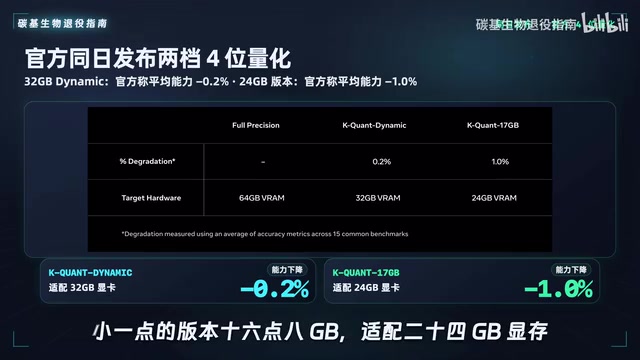
A 30B model at full precision requires over 50GB of VRAM, clearly beyond consumer GPUs. Fortunately, Meta simultaneously provided two 4-bit quantized Dynamic versions:
| Version | VRAM Usage | Compatible GPU | Precision Loss |
|---|---|---|---|
| Large | 19.7GB | 32GB VRAM | ~0.2% |
| Small | 16.8GB | 24GB VRAM | ~1% |
The "Dynamic quantization" here deserves special explanation. Traditional quantization schemes (like GPTQ, AWQ) typically apply uniform bit-width across all model layers, such as all 4-bit. Dynamic quantization is a more refined mixed-precision strategy: different quantization bit-widths are assigned based on each layer's sensitivity to final output quality. Critical layers with high output impact (such as the first and last few layers, certain weight matrices in attention layers) maintain higher precision (6-bit or 8-bit), while intermediate layers insensitive to output are compressed to lower bit-widths (3-bit or 4-bit). Meta providing this quantization version officially means they performed Quantization-Aware Training during the training phase, and controlling precision loss to 0.2%-1% is indeed a solid result.
Combined with the extremely small KV cache, remaining VRAM can simultaneously accommodate the vision encoder and draft model.
Additionally, Meta simultaneously released a draft model called D-Flash for speculative decoding — simply put, a small model "guesses" a string of Tokens first, then the main model confirms them in one pass, thereby accelerating generation. Speculative Decoding is one of the most important technical breakthroughs in LLM inference acceleration over the past two years. In traditional autoregressive generation, the model can only generate one Token at a time, each requiring a full forward pass through the model, with generation speed severely constrained by model depth and parameter count. Speculative decoding introduces a draft model with far fewer parameters than the main model, which rapidly predicts multiple Token sequences in succession, then the main model judges which predictions are acceptable through a single parallel verification. Since verifying multiple Tokens costs nearly the same computation as generating a single Token (both are one forward pass), as long as the draft model's prediction accuracy is high enough, multi-fold speedup is achievable. Official data shows that using D-Flash speculative decoding on RTX 5090 achieves over 3x speedup; Mac M4/M5 improvements range from 1.5x to 1.8x.
The open-source community's execution speed deserves praise: within the first hour of model release, llama.cpp merged the compatibility PR into the main branch, with model, vision input, and D-Flash support all landed at once. llama.cpp is an open-source project initiated by Georgi Gerganov, implementing an LLM inference engine in pure C/C++ without dependencies on heavy frameworks like Python or CUDA, supporting CPU, Apple Metal, CUDA, Vulkan, and other backends. The project's greatest contribution is standardizing the GGUF quantization format, enabling large models to run at various low precisions on consumer hardware. A vast local deployment ecosystem has formed around it, including Ollama, LM Studio, and koboldcpp. Whether a model gets llama.cpp support on launch day often directly determines its adoption speed in the open-source community. Simply update llama.cpp to the latest version and you can start running immediately — for quantized files, choose the largest size your hardware can handle.
Hands-On Results: A Lopsided Report Card
For this test, a cloud 5090 server was rented (32GB VRAM, 64GB DDR5 RAM, costing approximately ¥60), using the latest llama.cpp and the 19.7GB Dynamic quantized version, completing the full benchmark suite including preliminary and final rounds.
Preliminary Round: Long Thinking Time, Questionable Quality
- Chinese creative writing (6 points): Content was mediocre, creativity essentially zero, with excessively long thinking time before output;
- Logical reasoning (3 points): Thinking alone consumed 15,000 tokens, taking nearly 20 minutes, yet the result still had two fatal logical flaws — a classic case of "thinks long, answers poorly," satisfying neither speed nor quality;
- Invoice recognition (10 points): All fields accurately extracted, vision capabilities impressive.

The preliminary round total of 19 points would rank dead last on historical leaderboards, normally not qualifying for the finals. As a launch-day "green light," the tester allowed it to complete the full final round.
Final Round: Strong Vision, Weak Applications
- Advanced image recognition (10 points): Complex layouts, mixed image-text content, structured extraction — all nailed. Vision capabilities now rival Qwen;
- Long context needle-in-haystack (10 points): Using the full 127K context, information extraction and reasoning completed beautifully;
- Office applications (9 points): Sorting 171 multimedia files into an Excel spreadsheet with high completion rate but minor detail flaws;
- Full-stack application (7 points): This was the most embarrassing item — a 9B small model from the previous round scored 10 points.

In the full-stack application task, although Muse achieved a one-pass compilation in 20 minutes and 36 seconds with high execution efficiency and implemented all requirements from the prompt, the output was a crude prototype with an interface resembling a webpage from 20 years ago, with core functionality completely non-functional (for example, the novel reader wouldn't open at all). This reveals that it was trained to excel only at basic tasks, completely failing at slightly complex design and interactions.
Muse's final score was 36 points, ranking second-to-last among 6 models — 4 points lower than even Qwen 3.6 27B, which was hampered by hardware limitations.
D-Spark Acceleration Testing: The Speed vs. Quality Tradeoff
To ensure output quality, the above tests were all conducted without D-Spark enabled. When enabled (speculative decoding parameter set to 15, meaning the draft model proposes up to 15 candidate Tokens per round), things changed noticeably.

Speed-wise, D-Spark on the 5090 pushed output speed to nearly 3x, over 6x faster than Qwen 27B — arguably its only tangible advantage over Qwen. But the costs are equally apparent:
- Prefill stage slowed by approximately 30% — if input is long and output is short, enabling D-Spark can actually make things slower overall;
- Output quality noticeably declined — after re-running the full test suite, scores dropped across the board.
The reason for slower prefill requires additional explanation: the prefill stage is where the model processes all input Tokens and generates the first output Token — no autoregressive generation is involved, so speculative decoding's acceleration mechanism is entirely inapplicable at this stage. The prefill slowdown with D-Spark enabled occurs because the system needs to simultaneously load the draft model into VRAM and initialize its state, with additional memory bandwidth and compute resource allocation reducing the main model's prefill efficiency. This also explains why speculative decoding is better suited for "short input, long output" scenarios — shorter input means less prefill overhead, longer output means greater acceleration benefits.
The conclusion is clear: enable D-Spark for batch generation and simple tasks; disable it for high-quality deliverables. No speedup comes for free — the cost is almost always quality.
What Kind of Local Agent Model Do We Actually Need?
Overall, Muse Glimmer is an extremely lopsided model: excellent vision capabilities, impressive speed with acceleration enabled, but numerous weaknesses in logical reasoning, creative writing, and complex applications. Combined with the 128K context hard limitation, it paradoxically underperforms in its marketed "agent" scenario.
The local model truly worth anticipating should be a dense model around 30B parameters with capabilities approaching frontier levels — only then does it justify its deployment cost. Muse is clearly still far from this target. And its prospects of sniping the upcoming open-source Qwen 3.8 27B with current capabilities are slim.
For local deployment enthusiasts, Muse Glimmer's significance may lie more in being "another vision-friendly, extremely fast option" rather than the heir to "strongest single-GPU local model." The real suspense will have to wait for the next showdown.
Key Takeaways
Related articles

Big Mike: The AI Sports Betting Advisor Living Inside iMessage
Big Mike is an AI product that delivers sports betting advice via iMessage, covering MLB, NFL, NBA with real-time odds analysis, public track records, and fantasy lineup advice.

Joy: A Mac Menu Bar App That Automatically Showers Confetti to Celebrate Your Every Small Win
Joy is a macOS menu bar app that monitors GitHub stars, Stripe orders, Docker pulls and more, automatically showering confetti on screen when milestones are hit. Designed for indie devs and SaaS founders.

FileRouter: A Productivity Powerhouse for Customizing Default File Openers on Mac
FileRouter is a macOS menu bar tool that lets users precisely control default file-opening apps via a radial picker and custom rule system. Think Velja, but for files.