Harness AI Engineering Programming: A Practical Guide to Building Enterprise-Grade Projects with Claude Code

AI programming requires an engineering framework to truly harness its power, not just conversational use.
The article argues that AI programming has become mainstream in enterprises, but most developers struggle due to a lack of systematic methodology. Core issues include context window limitations leading to uncontrollable code and missing engineering standards. It introduces the Harness AI Engineering Programming framework with four pillars: structured prompt engineering, layered task decomposition, automated quality gates, and incremental development workflows — emphasizing the shift from code writer to architecture designer and quality controller.
AI Programming Has Gone Mainstream in Enterprises — Are You Ready?
While many developers still cling to "old-school programming" — the traditional approach of writing all code by hand — top global tech companies have quietly completed a transformation in their development workflows. Reports indicate that over 90% of code at companies like Anthropic and OpenAI is now generated by AI large language models. This isn't a distant vision — it's happening right now.
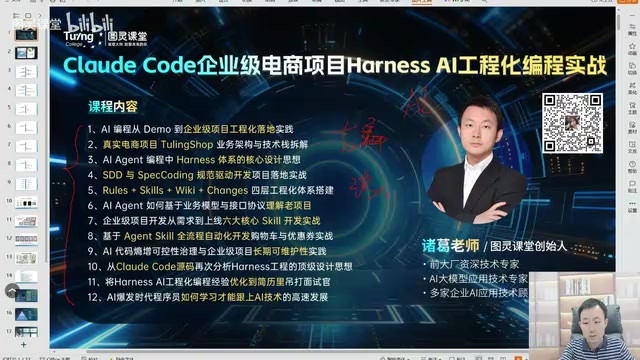
However, many developers give up on AI programming after trying it, reverting to their old hand-coding habits. Where does the problem lie? It's not that AI isn't powerful enough — it's the lack of a systematic engineering methodology. This article provides a detailed breakdown of the Harness AI Engineering Programming framework, explaining how to use Claude Code to truly achieve efficient enterprise-grade project development.
Why Many People Struggle with AI Programming
Common Failure Patterns
Most developers' use of AI programming remains at the rudimentary stage of "conversational programming": open ChatGPT or Copilot, describe a requirement, then copy-paste the generated code. This approach works fine for writing small scripts or solving isolated problems, but when facing enterprise-grade projects — involving complex business logic, multi-module coordination, database design, API specifications, and more — its limitations are quickly exposed.
The core bottleneck of conversational programming lies in the context window limitation of large language models. In each conversation, the amount of information the model can "see" is measured in tokens. Early models only supported 4K–8K tokens, and even though mainstream models have now expanded to 100K or even 200K tokens, they still cannot load an entire codebase at once when facing enterprise projects with hundreds of thousands of lines of code. This means AI often generates code with no awareness of the project's overall architecture, implementation details of existing modules, or cross-file dependencies — easily producing "hallucinated code" that is syntactically correct but logically contradicts other parts of the project. This directly leads to several typical problems:
- Context loss: AI cannot understand the project's full architecture and constraints
- Uncontrollable code: Generated code has inconsistent styles and uneven quality
- Lack of engineering standards: No unified project structure, naming conventions, or testing standards
- Difficult iteration: Changing one thing has cascading effects, and AI struggles to grasp the global impact
The root cause: AI programming doesn't mean letting AI write code — it requires a complete engineering framework to harness AI's capabilities.
The Human Role Hasn't Disappeared

There's a key perception that needs clarifying: even when 80%–90% of code is generated by AI, the human workload hasn't decreased — the nature of the work has fundamentally changed. The developer's role shifts from "code writer" to "architecture designer" and "quality controller." Requirements analysis, architecture design, code review, testing strategy, deployment planning — these high-level engineering decisions still need to be made by humans, and the capability requirements are actually higher than before.
The Harness AI Engineering Programming Framework Explained
What Is Harness AI Engineering Programming?
The word "Harness" precisely captures the core philosophy of this methodology: don't be led by AI — harness AI to serve your purposes. It's a systematic approach for integrating AI programming capabilities into traditional software engineering workflows, with the goal of ensuring AI-generated code meets enterprise-grade requirements for quality, maintainability, and scalability.
This framework comprises four core elements:
- Structured prompt engineering: Through carefully designed prompt templates, AI gains full understanding of project context, tech stack constraints, and coding conventions
- Layered task decomposition: Breaking complex projects into granularities that AI can handle efficiently, with clearly defined inputs and outputs for each task
- Automated quality gates: After AI generates code, quality is enforced through automated testing, static analysis, and other mechanisms
- Incremental development workflow: Progressing module by module, verifying each step before moving to the next
Five Levels of Structured Prompt Engineering
Prompt Engineering was initially viewed as a "technique," but as AI has been deployed at scale in production environments, it has evolved into a systematic engineering discipline. Structured prompt templates typically encompass five levels: Role definition (telling AI what expert role to assume), Project context (tech stack, architectural constraints, existing code summaries), Task description (what specifically needs to be accomplished), Constraints (what cannot be done, what standards must be followed), and Acceptance criteria (what verifiable conditions the output should meet). This structured approach transforms "natural language requirements" into "repeatable engineering instructions" — a critical leap from individual experimentation to team collaboration in AI programming.
The Automated Quality Gate Toolchain
Automated Quality Gates are critical checkpoints in CI/CD pipelines that automatically verify code quality before merging or deployment. In AI code generation scenarios, quality gates are especially important because AI may generate code that is syntactically correct but contains security vulnerabilities, performance issues, or coding standard violations. A typical quality gate toolchain includes: static code analysis (ESLint, SonarQube, Pylint) for detecting coding standard violations and potential defects; security scanning (Snyk, Semgrep) for identifying known vulnerability patterns; unit test coverage checks to ensure AI-generated code has sufficient test coverage; and type checking (TypeScript, mypy) to catch type errors at compile time. Integrating these tools into an automated pipeline enables multi-dimensional quality verification within seconds after AI generates code, forming an efficient closed loop of "AI generation → automated detection → human review."
The Claude Code + VS Code Practical Combination

For tooling, Claude Code combined with VS Code forms an efficient AI development environment. Claude Code's advantages lie in its excellent code comprehension and generation capabilities, particularly when handling complex business logic and large-scale codebases.
It's worth noting that Claude's native model has access restrictions in mainland China. For actual enterprise deployment, you can consider domestic alternatives — for example, using Zhipu GLM as the backend model paired with Claude Code's workflow framework, which can still achieve solid results.
The Zhipu GLM series (including GLM-4, ChatGLM, etc.) are large language models jointly developed by Tsinghua University and Zhipu AI, with strong capabilities in code generation, Chinese language understanding, and enterprise applications. From a technical architecture perspective, combining domestic models with the Claude Code workflow framework essentially leverages the "model-agnostic" nature of AI programming tools.
Related articles
 Tutorials
ChatGPT Plus Subscription Guide: Are GPT-5.5, image-2, and Codex Worth the Upgrade?
A detailed look at ChatGPT Plus features — GPT-5.5, image-2, and Codex — with a Plus vs Pro comparison and a complete step-by-step subscription guide for users outside the US.
 Tutorials
Harness AI Engineering in Practice: Using Claude Code to Master Enterprise-Level E-Commerce Development
Deep dive into Harness AI Engineering: master enterprise e-commerce development with Claude Code using the Rules, Skills, Wiki, and Changes framework.
 Tutorials
Cursor + Codex Dual-IDE Collaboration: A Practical Methodology for Open-Source Project Customization
A complete methodology for open-source project customization based on real-world experience, detailing the Cursor+Codex dual-IDE workflow, seven-stage process, MVP validation, and AI source code reading techniques.