Harness Engineering: A New Paradigm for Agent Development
Agent development is evolving from prompt engineering to Harness Engineering — building complete infrastructure around LLMs.
This article traces the evolution of agent development paradigms — from Prompt Engineering to Context Engineering to Harness Engineering. "Harness" refers to all infrastructure in an agent system beyond the LLM itself, including tool calling, memory, planning, safety, and state management. Attributed to Anthropic and reflected in Claude Code's architecture, Harness Engineering systematically addresses pain points like context explosion, state loss, and security vulnerabilities in long-horizon agent tasks.
From Prompt Engineering to Harness Engineering
The focus of agent development has been constantly evolving. Early on, developers cared most about Prompt Engineering — crafting high-quality prompts to steer model outputs closer to expectations. Then Context Engineering became the dominant topic. In many job interviews, candidates were quizzed on context management: how to organize information and maintain state within a limited context window.
According to one analysis, the core focus of agent development is now shifting toward Harness Engineering. This concept is said to have originated at Anthropic and is considered the next key paradigm in the agent development space. Rather than replacing the previous two approaches, it encompasses both prompt engineering and context engineering within a more complete system.
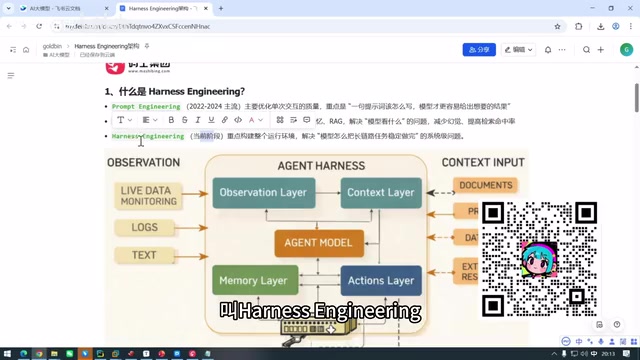
In short, the relationship can be summarized as: Harness Engineering contains Context Engineering, which in turn contains Prompt Engineering. It's a layered, nested relationship — but Harness Engineering casts a much wider net, covering far more than just context management.
Prompt Engineering originated in the GPT-3 era, with core techniques like few-shot examples, Chain-of-Thought, and role-setting — all aimed at optimizing wording to get better outputs in a single interaction. Context Engineering emerged with the rise of long-context models (like Claude's 200K token window) and multi-turn agent tasks, focusing on how to dynamically organize information within a limited token budget — such as when to compress conversation history, how to inject retrieved external knowledge into context, and how to preserve critical state across multi-step tasks. Both share a common blind spot: they concentrate solely on "what gets sent to the model" while ignoring the entire runtime environment outside the model.
What Does "Harness" Actually Mean?
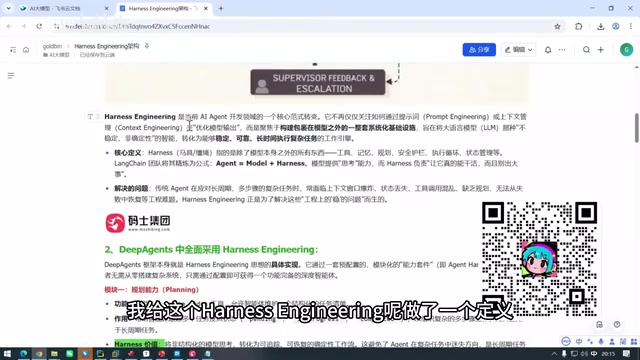
"Harness" literally means reins or a restraining system — an apt metaphor for constraining, guiding, and controlling the powerful "horse" that is a large language model. Its core definition is: everything in an agent system except the LLM itself is collectively called the Harness.
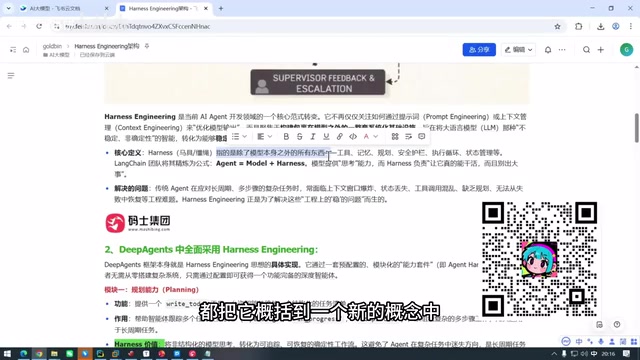
In other words, developers shouldn't limit their focus to prompts or context alone. Instead, they should concentrate on building a comprehensive, systematic infrastructure that wraps around the model — integrating tool calling, memory, planning, safety, execution loops, state management, skills, sandboxing, file systems, and permission control into a unified architectural layer.
This shift in mindset is significant. It means that the capability ceiling of an agent increasingly depends on the maturity of the surrounding engineering infrastructure, not just the intelligence of the model itself. Take Claude Code as an example: its effectiveness stems from the team building an entirely new agent architecture in TypeScript — an architecture that embodies the principles of Harness Engineering.
Seven Core Capabilities Form a Complete System
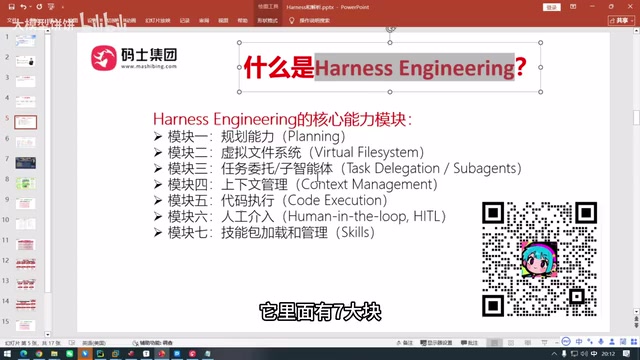
Harness Engineering is composed of seven core modules that together support a complete agent runtime framework.
While the original source doesn't exhaustively detail the implementation of each module, the key dimensions this architecture addresses can be summarized as follows:
- Context Engineering: Managing the organization of model inputs and outputs
- Storage & Memory: Giving agents persistent memory across tasks
- Multi-task Planning: Breaking down complex goals into executable steps
- Actions & Observations: Executing actions and observing feedback to form a closed loop
- Tool Calling: Enabling agents to invoke external tools to complete tasks
- Safety & Permissions: Guarding against malicious code and controlling file operation permissions
- State Management & Execution Loops: Maintaining consistency across long-horizon tasks
These modules don't exist in isolation — they work together to form an "operating system"-level infrastructure for agent execution.
The Core Pain Points Harness Engineering Addresses
Why do we need such a system? Because traditional agents frequently run into a series of stubborn problems when handling long-horizon, multi-step complex tasks:
Context explosion — The more steps a task involves, the more context accumulates, quickly exceeding the model's window limit.
State loss — After multiple rounds of interaction, agents tend to "forget" critical prior states and decisions.
Chaotic tool calling — Without a unified scheduling mechanism, tool calls are prone to errors and conflicts.
Lack of planning capability — Agents struggle to effectively decompose complex tasks, causing execution to go off track.
Security vulnerabilities — This is frequently overlooked but critically important. A telling example: if a script contains malicious code, an agent cannot simply ignore it. Security mechanisms like file operation controls, permission management, and sandbox isolation must be built into the architecture from the start — not bolted on as afterthoughts.
The value of Harness Engineering lies in consolidating these scattered problems into a single, unified architecture for systematic resolution. For enterprise-scale multi-agent collaboration scenarios, this kind of systematic infrastructure is especially critical — as multiple agents cooperate, the complexity of state consistency, permission isolation, and task planning grows exponentially.
The context explosion problem is particularly prominent in real-world engineering: even with 128K–200K token windows (as in GPT-4o or Claude 3.5 Sonnet), a complex task involving dozens of tool calls can exhaust context capacity within hours — and token consumption scales directly with cost. Common industry mitigations include sliding window truncation, summarization compression, and externalized vector database memory (RAG). However, without a unified architectural layer to coordinate them, information loss becomes unpredictable. State loss is even more severe in multi-agent collaboration scenarios: when different agents each maintain independent context, collaborative tasks easily fail due to state inconsistencies if there's no shared state store (such as Redis or a structured database). One of Harness Engineering's key contributions is providing architecture-level unified solutions to these problems, rather than relying on scattered ad hoc patches.
Implications for Developers
The evolution from prompts to context to Harness reflects a broader shift in agent development — from "tuning the model" to "building engineered systems." For engineers looking to go deep in agent development, mastering prompt techniques is no longer enough. Understanding and building complete infrastructure around the model is the real key to creating reliable, scalable agents.
It's worth noting that this article is based on a single video source. Harness Engineering is currently more of a conceptual framework than a formally defined specification, and the specific implementation details of its seven modules still await more systematic documentation. Developers interested in exploring these ideas can look to the architectural design of existing products like Claude Code to see this philosophy in action.
Related articles
Codex vs. Claude Code: A Beginner's Guide to AI Coding Agents
Codex vs. Claude Code: which AI coding agent should you use? This guide compares both tools and walks beginners through GPT account setup, virtual number platforms, US App Store switching, and subscription cost-saving tips.
Pi-chat in Practice: Connecting External Tools to AI Agents via MCP Protocol
Learn how to integrate external tools into AI Agents using MCP protocol with Pi framework. Covers pi-mcp-adapter setup, .mcp.json config, Extension Factory initialization, and a live 12306 train ticket query demo.
AI Large Model Engineering Careers Decoded: Algorithm Research vs. Engineering Deployment — Which Path Is Right for You?
AI large model jobs split into algorithm research and engineering deployment. Learn the skill requirements, core competencies like RAG and Multi-Agent, and why Harness architecture is the 2026 interview differentiator.