Harness Engineering Explained: The Third Paradigm Shift in AI Engineering

AI engineering's paradigm evolution from Prompt to Context to Harness Engineering
AI engineering has undergone three paradigm shifts: 2023's Prompt Engineering focused on communicating with models, 2025's Context Engineering managed model input context, and 2026's Harness Engineering builds complete runtime systems for AI models at the architectural level. Harness Engineering addresses three core problems — Agent goal drift, self-evaluation deficiencies, and cross-session memory loss — with Anthropic and OpenAI offering practical solutions from two different angles: introspective evaluation loops and industrial-grade governance architecture respectively.
From Prompt to Harness: The Three-Act Evolution of AI Engineering
The AI engineering field recently reached an important milestone — Anthropic and OpenAI published articles in the same week, both pointing to the same concept: Harness Engineering. Some call it the third paradigm shift in AI engineering, while others dismiss it as CI/CD in a new coat of paint. What's the real story?
Let's first map out the evolution of AI engineering:
- 2023: Prompt Engineering — Teaching AI how to speak
- 2025: Context Engineering — Managing the context well
- 2026: Harness Engineering — Building the racetrack
These three stages aren't just a naming game — they correspond to real leaps in AI capability boundaries. Prompt Engineering originated during the exploration period after GPT-3's release in 2020 — researchers discovered that the same model could produce outputs varying several-fold in quality depending on how the input was worded. This gave rise to a systematic methodology for prompting, including techniques like few-shot examples, Chain-of-Thought reasoning chains, and role-playing instructions. Between 2022 and 2023, Prompt Engineering was widely regarded as the most important emerging skill of the AI era, with dedicated "Prompt Engineer" job titles appearing. However, as model capabilities improved and instruction-following abilities strengthened, the marginal returns of pure prompting techniques diminished rapidly, and the engineering focus began shifting toward more systematic approaches.
Context Engineering is an engineering paradigm that emerged during 2024-2025, centered on the fine-grained management of the model's input window. Modern LLM context windows have expanded from the initial 4K tokens to 128K or even million-level capacities, but "what you put in" matters more than "how much you can fit." Context Engineering encompasses RAG (Retrieval-Augmented Generation) architecture design, memory compression and summarization strategies, formatted injection of tool call results, and layered system prompt management, among other technical practices. Its essence is bringing information engineering methodologies into the AI interaction layer, solving the problem of "what the model knows" rather than "how the model talks."
Harness literally translates to the equipment used to control a horse. The AI model is that powerful wild stallion, but it doesn't know where to run or how fast. The Harness is the complete system you build for it — the reins, the saddle, the racetrack.
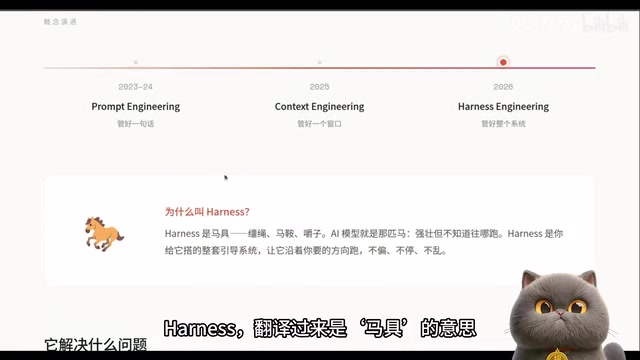
Now the engineer's core job has shifted from "taming the horse" to "building the racetrack." The model is the engine, and the Harness is the track — the same engine on different tracks produces vastly different results.
The Three Core Problems Harness Engineering Solves
Problem One: Agent Goal Drift
Models drift from their objectives after working for extended periods. Once the context window fills up, they start going off track or even wrap up prematurely. This is especially pronounced in complex multi-step tasks, where Agents often "forget" the original goal as execution progresses.
This phenomenon has clear technical causes. Large language models are fundamentally autoregressive sequence prediction systems, where each output step depends on the preceding context. When the context window gets filled with numerous intermediate steps, the weight of the original task goal in the attention mechanism gets diluted — a phenomenon researchers call "Lost in the Middle" (Liu et al., 2023). Additionally, models exhibit a "hallucination accumulation" effect during long-sequence reasoning: small deviations early on get amplified by subsequent steps, ultimately causing outputs to deviate significantly from the original goal. This is a common challenge facing all long-horizon Agent systems today, and one of the core problems that Harness Engineering needs to solve at the architectural level.
Problem Two: Systematic Flaws in Self-Evaluation
When you ask a model to evaluate its own work, it almost always says "good job" — even when the output has obvious problems. This isn't an occasional slip; it's a systematic flaw.
The root cause of this phenomenon can be traced back to training mechanisms. During RLHF (Reinforcement Learning from Human Feedback) training, models learn to generate outputs that align with "human preferences" — and human evaluators tend to give higher scores to confident, fluent, and complete responses regardless of their actual correctness. This inadvertently reinforces the model's "self-affirming" tendency. Anthropic's research team calls this "sycophancy" — the model's tendency to tell users what they want to hear. In self-evaluation scenarios, this manifests as systematic over-optimism; models inherently lack genuine critical scrutiny capabilities.

Problem Three: Cross-Session Memory Loss
You told it last time not to use a certain API, and next time it uses it again. Every new session is a blank slate, with all previously accumulated constraints and preferences lost. This makes sustained engineering projects extremely difficult.
Harness Engineering is the engineering practice that systematically solves these three problems.
Different Practice Paths: Anthropic vs. OpenAI
What's most interesting is that the two major companies took completely different entry points, yet they perfectly piece together the full picture of Harness Engineering.
Anthropic's Approach: Solving the Agent Introspection Problem
Anthropic focuses on "introspection" — they discovered that Agent self-evaluations are almost entirely self-congratulatory. So their solution is to build a Generate-Evaluate Loop:
- Planner handles planning
- Generator handles implementation
- Evaluator uses Playwright for real-world acceptance testing
Playwright is Microsoft's open-source end-to-end web testing framework, supporting automated testing across Chromium, Firefox, and WebKit browsers. In this system, Playwright serves as the execution layer for "real-world acceptance" — it doesn't rely on the model's subjective judgment, but instead evaluates output quality through objective means like actually running code, screenshot comparison, and DOM state verification. This philosophy of "Executable Truth" is one of the core design principles of Harness Engineering: anything that can be verified with code should not rely on model self-evaluation. It's like introducing an adversarial QA system that replaces the model's self-assessment with external, verifiable standards, injecting the rigor of software testing engineering into the AI generation pipeline.
OpenAI's Approach: Industrial-Grade Governance Architecture
OpenAI took the industrial governance route. They ran a remarkable experiment: three people, five months, one million lines of code — all written by AI, zero handwritten.
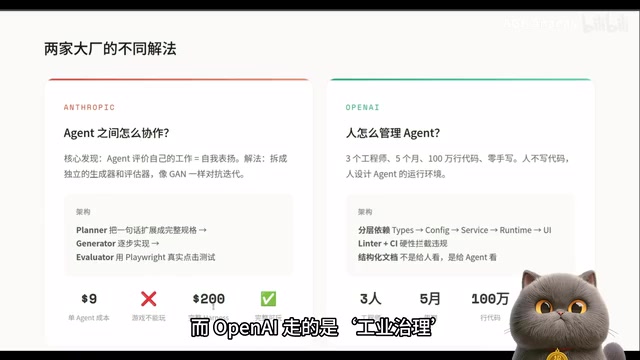
What was their secret? Layered architecture and Docs as Source of Truth. The "Docs as Source of Truth" philosophy originates from the traditional software engineering concept of "Infrastructure as Code
Related articles
Deep Dive into AI Agent Skill Design: …
Deep Dive into AI Agent Skill Design: Engineering Practices from Anthropic and Perplexity
A deep dive into Skill design philosophy from Anthropic's Claude Code team and Perplexity's Agent team, covering the Tax Test, Gotchas Flywheel, progressive disclosure, and Eval-First practices for building high-quality AI Agent skill systems.
Deep Dive into OpenAI's Official GPT-5…
Deep Dive into OpenAI's Official GPT-5.6 Prompting Guide: The Shift from Manual to Automatic
A deep dive into OpenAI's official GPT-5.6 Sol prompting guide: conciseness-first, outcome-oriented design, autonomy boundaries, tool routing, and reasoning intensity tuning.
 Deep Dives
Deep Dive into How OpenClaw (Open-Source Crayfish) AI Agent Works
Deep analysis of OpenClaw AI Agent internals: System Prompt, tool calling, SubAgents, Skill system, memory, and Context Engineering explained.