Harness Engineering: The Core Engineering Methodology for Taking AI Agents from Demo to Production

The key gap preventing AI Agents from reaching production isn't the model—it's the Harness around it.
This article argues that the core bottleneck taking AI Agents from demo to production isn't model capability, but the Harness—the control system outside the model. AI development has evolved through three paradigms: Prompt Engineering (how to ask), Context Engineering (what to feed), and Harness Engineering (how to run). A Harness comprises six core components: task orchestration, state management, tool call adaptation, output validation, error recovery, and observability, plus two foundational pillars of security controls and execution runtime. Models are becoming commoditized, while the Harness is the true technical moat.
Same Model, So Why Can't Your Agent Make It to Production?
Same model, same API—why do some teams have AI Agents running stably in production while others can only ever showcase theirs in demos, with everything falling apart the moment it's actually put to use?
Many people's first instinct is "the model isn't powerful enough," so they swap models and tweak parameters. But after switching models, you'll find the problems remain the same. The real gap isn't in the model itself—it's in the layer outside the model: the Harness.
The Harness concept was first systematically proposed by a prominent engineer in a February 2025 blog post, and was rapidly adopted by the industry. It has since become a core term in the AI engineering field.
What Is a Harness? A Precise Analogy
The word "harness" originally refers to the reins and saddle gear placed on a horse when riding. A horse is powerful and fast, but without reins to control it, it might run in any direction—or throw you off entirely. The harness's purpose is to channel the horse's power in the right direction.
Mapping this to AI: large language models are the horse—incredibly strong in reasoning, fast in generation, but with poor sense of direction, prone to errors, hallucinations, and losing control. The Harness is the control system strapped onto it.
The precise definition of Harness: the sum total of all constraints, tools, validations, state management, execution logic, and security controls outside the model.
Note the key phrase—"everything outside the model." The model is responsible for thinking; the Harness is responsible for execution. These two things must be viewed separately.
The Evolution of Three Paradigms: From Prompt to Context to Harness
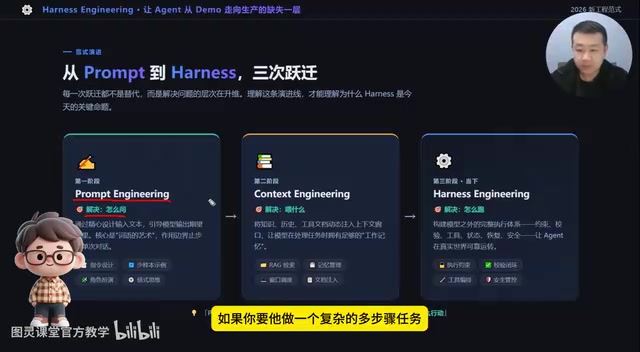
To understand the value of Harness Engineering, you need to see the three major leaps in AI application development paradigms. Each evolution addressed the core bottleneck left by the previous stage.
Stage One: Prompt Engineering (2022-2023)
During this stage, everyone was studying how to communicate clearly—writing instructions for the model, setting roles, adding few-shot examples, and using Chain-of-Thought to guide step-by-step reasoning. The core focus was optimizing input—essentially "the art of words." Prompt Engineering solved the problem of how to ask.
But no matter how well-crafted your Prompt is, its scope of influence is limited to a single conversation turn. You ask once, it answers once, and that round is over. When you need it to perform a complex multi-step task, Prompt Engineering starts to fall short.
Stage Two: Context Engineering (2023-2024)
People began realizing that optimizing how you ask isn't enough—you also need to feed the model the right information. Technologies like RAG (Retrieval-Augmented Generation), memory management, and dynamic document injection emerged. The core idea was dynamically injecting knowledge, conversation history, and tool documentation into the model's context window, giving it sufficient "working memory." Context Engineering solved the problem of what to feed.
But Context Engineering still focused on a single context window—what to input to the model this time. It didn't answer a more fundamental question: how does a multi-step, multi-turn Agent task reliably run as a whole?
Stage Three: Harness Engineering (2025-2026)
Harness Engineering solves the problem of how to run—not how to ask, not what to feed, but how the entire AI Agent system runs, stays stable, recovers from failures, who can do what and can't do what, how many tokens have been spent, and whether tasks have truly been completed.
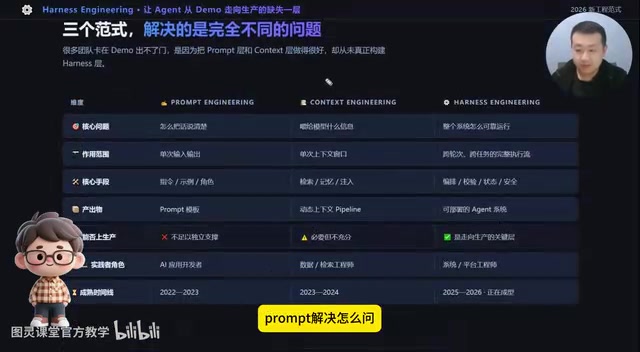
The relationship between the three paradigms can be understood this way: Prompt Engineering teaches AI how to listen, Context Engineering teaches AI what to know, and Harness Engineering teaches AI how to act. These are entirely different levels, each one closer to real production scenarios than the last.
The Six Core Components of a Harness
You can think of a complete Harness as an "exoskeleton" wrapped around the model, providing it with structural support. This exoskeleton contains six core components:
1. Task Orchestration Engine
Breaks a complex goal into a sequence of subtasks, coordinates concurrent execution across multiple Agents, and manages dependency relationships and priorities between tasks. Real production tasks are never solved with a single Q&A exchange. Many tasks follow the pattern: "do A first, A's result determines whether to proceed to B, while C and D can run in parallel"—all this scheduling logic is managed by the task orchestration engine.
2. State and Memory Management
Persists critical state across conversation turns, distinguishes between short-term working memory and long-term knowledge storage, and supports state snapshots and rollbacks. What has the Agent done? What step is it on now? This information needs somewhere to be stored, needs to be queryable at any time, and when things go wrong, it needs to be possible to roll back to a previously correct state.
3. Tool Call Adaptation Layer
Provides unified encapsulation of interfaces to external APIs, databases, code executors, and other tools, with standardized input validation and return value parsing. When the model says "I want to call this tool," the Harness translates that call into actual system operations, then safely returns the results to the model. All the glue code and validation logic in between is what the tool call adaptation layer handles.
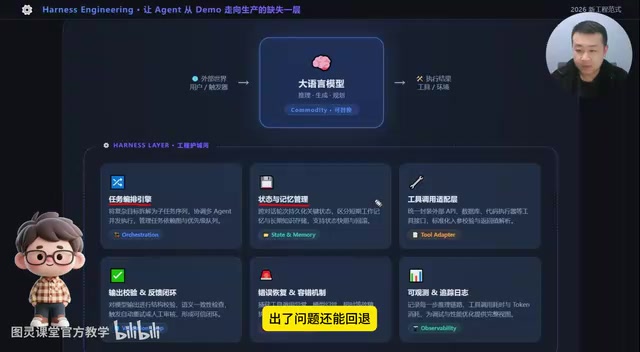
4. Output Validation and Feedback Loop
Model output can't be used directly—it needs validation first: Is the structure correct? Is there semantic consistency? Are there hallucinations? If it fails, automatic retry is triggered or the case escalates to human review. This "validate + retry" feedback loop is a particularly critical part of the Harness. Without it, model output in a production environment is a ticking time bomb.
5. Error Recovery and Fault Tolerance
Tool call timeouts, garbled model output, external API failures—these situations are extremely common in production environments. The Harness needs to catch these exceptions, execute degradation strategies or resume from breakpoints, while reporting alerts. An AI Agent without fault tolerance mechanisms won't survive a day in production.
6. Observability and Tracing
Logs record every step of the reasoning chain, the latency of each tool call, token consumption, and task completion rates. Without observability, you have no idea what the Agent is doing, and when problems occur, you don't know where to start investigating. Observability is the eyes of the Harness.
Security Controls and Execution Runtime: Two Foundational Pillars
Beyond the six core components, Harness Engineering has two foundational support systems that serve as the bedrock for stable operation of the entire architecture.
Security Control Layer
- Permission Authentication: Mandatory permission verification before every tool call—denied if unauthorized
- Sandbox Isolation: Code execution and external access run in controlled environments to prevent escapes
- Prompt Injection Protection: Prevents malicious content from hijacking Agent behavior through inputs
- Audit Trail: Complete operation logs to meet enterprise compliance requirements
Execution Runtime
- Timeout Control: Every subtask has a TTL (Time-To-Live) to prevent infinite loops
- Token Budget Management: Dynamic consumption tracking—truncate or compress context when exceeded
- Retry Strategy: Exponential backoff with circuit breaker mechanisms to handle downstream service jitter
- Health Monitoring: Real-time awareness of Agent running status with automatic degradation on anomalies
Why the Harness Is the Moat, While Models Are Just Commodities
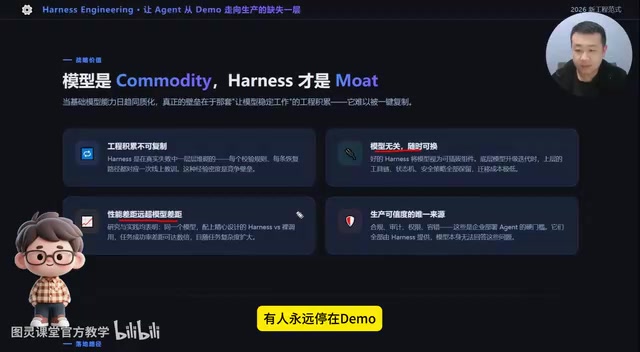
Today, foundation models are getting stronger and increasingly converging—everyone uses similar interfaces. In other words, models are becoming infrastructure (Commodity)—anyone can use them, and it doesn't matter much which one you use.
But the Harness is different. A Harness is built up layer by layer through real production failures—every validation rule corresponds to a production incident, every recovery path corresponds to a system crash. This density of experience can't be replicated by reading documentation, nor can it be obtained by switching to a different model. This is the real technical moat.
Moreover, a good Harness is naturally model-agnostic—when the underlying model changes, the Harness's toolchain, state machines, and security policies all remain intact, with minimal migration cost. Conversely, if your Harness isn't well-built, switching to a better model is just rearranging deck chairs.
A practice-validated conclusion: With the same model, the gap in task success rate between a carefully designed Harness and bare API calls can be several-fold—and the more complex the task, the larger the gap.
Harness Engineering in Practice: Four Key Actions
1. Draw the Execution Graph Before Writing Code
Before getting hands-on, map out the Agent task decomposition graph, tool dependency relationships, and state transitions—document constraint boundaries in structured format. The root cause of the vast majority of production failures is "started coding before thinking it through." This is the starting point of Harness Engineering.
2. Engineer Every Failure
Every time an AI Agent makes an error in production, add a systematic layer of protection to the Harness—not by modifying the Prompt, but by adding validations, improving retry logic, and strengthening state recovery capabilities. The Harness is fed by failures—it's not designed perfectly from the start.
3. Make Everything Visible and Measurable
An unobservable Agent is a black box. Add structured logs for every step of the reasoning chain, trace tool call chains, token consumption, and task completion rates. Without observability, everything else is built blindly.
4. Security Is Not the Last Step
Permission authentication, sandbox isolation, and injection protection aren't last-minute checks before launch—they are first principles that must be embedded from the very beginning of design. The cost of deferring security is the collapse of trust in the entire system.
Summary
Harness Engineering isn't a newly invented concept—it's the first systematic engineering answer to the age-old question of "why can't AI Agents make it to production."
Remember this formula: Model (responsible for thinking) + Harness (responsible for execution) = Production-grade Agent System
And this line: The model is the engine; the Harness is the entire car. You wouldn't throw a bare engine onto the road and expect it to drive.
Next time you see an Agent demo, try asking: where's its Harness?
Related articles
Deep Dive into AI Agent Skill Design: …
Deep Dive into AI Agent Skill Design: Engineering Practices from Anthropic and Perplexity
A deep dive into Skill design philosophy from Anthropic's Claude Code team and Perplexity's Agent team, covering the Tax Test, Gotchas Flywheel, progressive disclosure, and Eval-First practices for building high-quality AI Agent skill systems.
Deep Dive into OpenAI's Official GPT-5…
Deep Dive into OpenAI's Official GPT-5.6 Prompting Guide: The Shift from Manual to Automatic
A deep dive into OpenAI's official GPT-5.6 Sol prompting guide: conciseness-first, outcome-oriented design, autonomy boundaries, tool routing, and reasoning intensity tuning.
 Deep Dives
Deep Dive into How OpenClaw (Open-Source Crayfish) AI Agent Works
Deep analysis of OpenClaw AI Agent internals: System Prompt, tool calling, SubAgents, Skill system, memory, and Context Engineering explained.