Harness Engineering: The Core Methodology for Advanced AI Programming

Why Harness Engineering — not just prompt skills — is the key to directing AI on enterprise-grade projects.
AI coding tools haven't made programmers obsolete — but they have raised the bar for what great developers do. This article examines four recurring pain points in AI-assisted coding (code rot, context amnesia, token costs, and stubborn bugs), traces the evolution from Prompt Engineering to Context Engineering to Harness Engineering, and explains why systematic constraints and human guidance are essential for delivering complex, production-grade software with LLMs.
Don't Let the "Programmers Are Obsolete" Narrative Mislead You
Over the past two years, the explosion of AI coding tools has left many developers feeling anxious. The internet is flooded with takes from content creators claiming things like: "I have zero technical background, but I built a complete project using Claude Code, Codex, and Cursor" or "Programmers are about to be fully replaced by AI." This kind of content generates a lot of anxiety — but as developers with a solid technical foundation, we need to think critically about these claims.
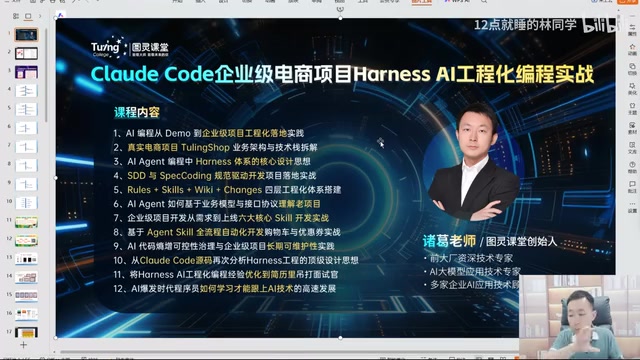
According to analysis by a senior architect on Bilibili (a veteran of JD.com and Vip.com who has led hundreds of enterprise-scale LLM projects in recent years), the "zero-background, full project" narrative simply doesn't hold up. Look closely at what these creators actually show, and without exception it's always a small-scale demo: a simple cross-border e-commerce webpage, a wrapper tool, a digital utility, or a mini-game. You'll be hard-pressed to find a single non-technical person who used AI tools alone to complete a genuinely complex enterprise-grade project — like a bank's core banking system or a distributed, high-volume data platform for a major tech company.
The reason is simple: if zero experience could truly replace programmers, why don't software companies just have product managers write requirement docs and hand them to AI? Why do major tech firms still maintain massive engineering teams? The answer is self-evident.
The real conclusion is this: over the next five to ten years, the people who thrive in every industry will be mid-to-senior professionals who are both technically skilled and proficient with AI tools. Neither capability alone is sufficient.
Four Core Pain Points of AI Coding Tools
Anyone who has used tools like Claude Code or Codex on real projects has likely run into the same recurring issues. These pain points are precisely why "zero-background complex projects" remain out of reach.
Code That Gradually Turns Into a "Big Ball of Mud"
Many developers report that after letting an AI coding tool iterate for a while, the overall code quality degrades sharply — the structure becomes chaotic and hard to maintain, ultimately turning into an unreadable, unmaintainable mess. The larger the project and the longer the iteration, the worse it gets.
This has a deep technical explanation: AI models lack persistent memory of the overall architecture when generating code. Each iteration tends to apply local patches rather than performing global refactoring. As patches accumulate, the cyclomatic complexity and coupling of the codebase keep rising, eventually exceeding the model's effective comprehension range, creating a vicious cycle. This is fundamentally different from a human engineer's instinct to refactor once technical debt reaches a breaking point — an AI has no "I've had enough" threshold. It simply keeps piling new chaos on top of existing chaos.
Amnesia and Hallucinations from Insufficient Context
A model's context window refers to the maximum number of tokens it can process in a single inference pass. Early GPT-3 had a context window of just 4K tokens. Today's mainstream models like Claude 3.5 have expanded to 200K tokens, and GPT-4o supports 128K. Yet even so, the full codebase of a mid-sized enterprise project can easily run into hundreds of thousands of lines — far beyond any model's context limit. More critically, as the context fills up, the model's "attention" gets diluted. The industry calls this the "Lost in the Middle" phenomenon: the model's ability to process information in the middle of the context window drops significantly.
When a project grows complex enough that the AI can no longer hold the full picture, it starts to "forget" earlier agreements or hallucinate — fabricating interfaces and logic that don't exist. The result is output that completely misses the mark. This also explains why the amnesia and hallucination problems grow worse as projects scale up.
Staggering Token Consumption
Tokens are the fundamental unit of billing and processing for large language models — roughly 1 token equals about 0.75 English words or 0.5 Chinese characters. Take Claude 3.5 Sonnet as an example: input tokens cost around $0.003 per 1K tokens, and output tokens cost around $0.015 per 1K tokens. AI coding burns through tokens far faster than ordinary conversation, because programming tasks require passing full code files as context (heavy input tokens), and the generated code is also lengthy (heavy output tokens). More critically, in a multi-turn iteration workflow, each round re-ingests the accumulated context, causing token consumption to grow at roughly a quadratic rate.
Completing a moderately complex feature across a full chain can easily cost tens of dollars. For enterprise projects that require ongoing iteration, this cost compounds quickly — making it impossible to ignore even for well-funded organizations. This is the fundamental reason why enterprise-level AI coding projects must manage context with precision.
Stubborn Bugs That Keep Getting Worse
Perhaps most critically: when AI encounters a complex bug, it may attempt fix after fix and still fail to resolve it — sometimes making things worse with each attempt. For someone without a technical background, this means the project is permanently stuck. A skilled developer, on the other hand, can work through multiple rounds of interaction, supply additional context, and provide precise guidance to eventually solve the problem in collaboration with AI.
This is exactly where professional developers' value lies — AI is an assistant, not a replacement.
The Three Stages of AI Engineering Evolution
To understand how these pain points can be addressed, it helps to trace the evolution of AI engineering paradigms. AI-assisted programming has gone through three distinct stages.
Stage 1: Prompt Engineering
This was the hottest concept right after ChatGPT launched. Prompt engineering emerged from systematic research in academia and industry following GPT-3's release in 2020 — early studies found that rephrasing the same question could produce outputs varying in quality by several times. Techniques like Chain-of-Thought, Few-shot Prompting, and Role Prompting were proposed and validated in quick succession.
However, prompt engineering has a fundamental limitation: it remains stateless single-turn or short multi-turn interaction. At its core, it's about how to "ask" a large model questions — phrasing your request clearly and interacting in a back-and-forth format. This is the most basic mode of use. It cannot manage complex state across hundreds of interactions in a large-scale engineering project, and this limitation directly gave rise to context engineering.
Stage 2: Context Engineering
As problems grew more complex, simply asking questions wasn't enough. Consider this example: if you ask AI to "write a technical article in the style of a specific instructor," the model has no idea what that style looks like — what it produces will inevitably miss the mark.
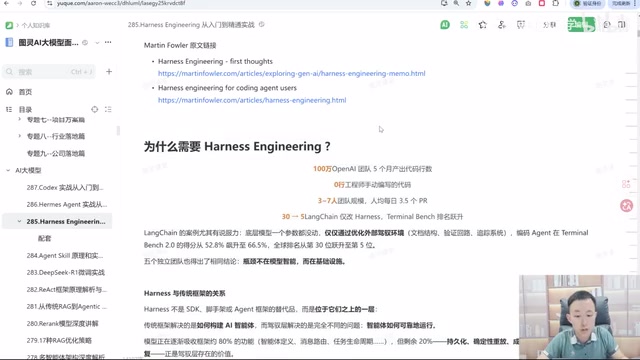
The fix is to provide context — feed the model a collection of that instructor's past articles so it can learn the style before you issue the instruction. The results improve dramatically. The same principle applies in coding: rather than simply saying "help me build CRUD functionality for a shopping cart," you first provide code standards and reference snippets so the AI understands your coding style before it starts writing.
Currently, an estimated 95%+ of developers — whether using Claude Code, Codex, or Cursor — are still operating at this stage.
Stage 3: Harness Engineering
This is the most current paradigm and will remain the mainstream approach for the next two to three years. When we need AI to complete Agent-level complex tasks, a small amount of context is far from sufficient. It requires substantial constraints, combined with continuous interaction, feedback, and correction from the developer throughout the process — precise, granular control — to successfully complete something highly complex.
What Is Harness Engineering?
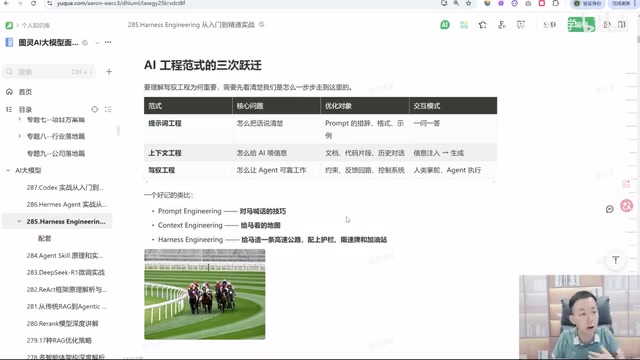
The word "harness" originally refers to the equipment fitted on a horse — the reins, bridle, and other control apparatus. As a metaphor, it translates perfectly: a large language model is like a powerful, spirited horse — enormously capable but difficult to direct. The harness is the set of "reins" that lets you command it precisely — tools that let you steer it left, right, and control its speed.
Expressed as a formula:
Harness (constraints / prompts / tools) + LLM + Human direction = Agent
The concept of an Agent is worth unpacking. Unlike single-turn Q&A, an Agent has a full perceive-plan-execute loop: it can call external tools (search engines, code executors, databases), dynamically adjust its next action based on execution results, and continuously track task goals until completion. Typical architectures include the ReAct (Reasoning + Acting) framework and the AutoGPT pattern. However, Agents face serious challenges in real-world engineering: uncertainty in task decomposition, cascading errors in tool calls, exponentially growing costs, and intermediate states that are difficult to debug — all of which make most Agent demos unstable in enterprise-grade scenarios.
This is precisely the core value of Harness Engineering: through systematic constraints, rules, and feedback mechanisms, it keeps AI producing stable output in complex enterprise projects — directly addressing the pain points discussed earlier: messy code, context amnesia, and stubborn bugs.
Interestingly, despite the Harness concept having circulated online for some time, very few companies have actually deployed it at scale in production. There are now teams that have shipped Harness-based engineering across multiple enterprise projects, and this tutorial series will use real e-commerce project code as its foundation for hands-on instruction — not just abstract theory.
Learning Recommendation: Work Backward from Practice
The vast majority of Harness tutorials online focus on conceptual explanation, piling up terms like "rules," "constraints," and "entry points" — and after listening, most people are still confused and forget it all within a few days.
A more effective learning path is to start from hands-on practice and actual code. Using a familiar e-commerce business as the vehicle, diving directly into real project code, and understanding Harness concepts through doing. Once you've worked through a real implementation, going back to the theoretical documentation will feel like everything clicks into place.
For developers who want to stay competitive in the AI era, mastering Harness Engineering means graduating from "knowing how to prompt AI" to "being able to direct AI through enterprise-grade complex engineering" — and that is exactly the core capability that will remain valuable over the next five to ten years.
Key Takeaways
Related articles

Alibaba Launches Happy Shrimp: AI-Powered One-Click Complete Song Generation
Alibaba launches Happy Shrimp, an AI music generation tool that creates complete songs with lyrics, melody, arrangement, and vocals from natural language descriptions. In-depth analysis of its core features, differentiation from competitors like Suno, and industry impact.
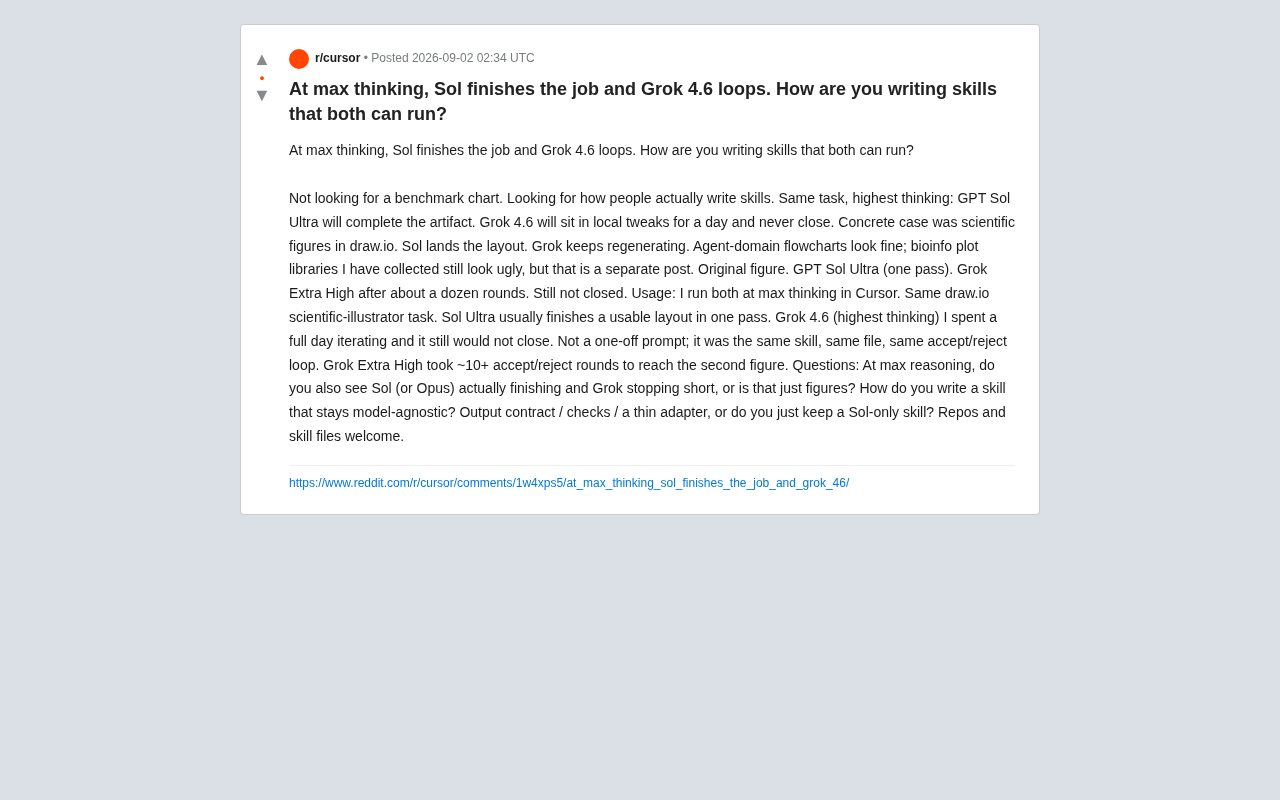
GPT Sol Ultra vs Grok 4.6: Real-World Task Completion Benchmark in Reasoning Mode
Developer benchmark reveals GPT Sol Ultra completes draw.io scientific diagrams in one iteration while Grok 4.6 fails to converge despite maximum reasoning mode, exposing that reasoning depth ≠ task delivery capability.

OpenAI Authorship Dispute: The Battle Over Academic Boundaries in the AI Era
OpenAI disputes authorship with mathematician Tristan Buckmaster over Navier-Stokes research, raising ethical questions about AI involvement in science.