Harness Engineering: The Core Methodology for Enterprise-Grade AI Coding

Harness Engineering is the core methodology enabling enterprise-grade AI coding to reach production.
AI coding has evolved through three stages: prompt engineering, context engineering, and Harness Engineering. This article explains how enterprises use engineering frameworks to harness LLMs—solving hallucination, non-standard code, and intelligence degradation—so AI-generated code can be deployed directly to production.
From Prompt Engineering to Harness Engineering: The Three Leaps of AI Coding
The first wave sparked by ChatGPT introduced everyone to "prompt engineering." But today, the core methodology that truly enables enterprise-grade AI coding to be put into practice has already evolved into the stage of "Harness Engineering." This represents a critical leap from "demo showcase" to "productivity tool."
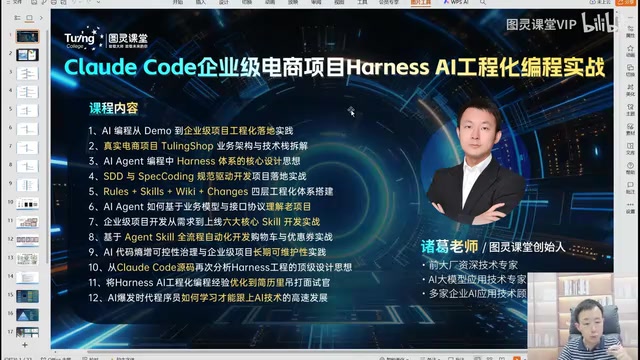
According to a technical open course shared on Bilibili, the presenter has a background as a senior architect at major companies like JD.com and Vipshop, and currently focuses on helping enterprises deploy large model projects. He states bluntly: at top-tier companies like Anthropic and OpenAI, over 90% of code is already written by AI large models. For developers still relying on purely hand-written code, this figure is undoubtedly a strong signal.

The Evolution Logic Across Three Stages
To understand Harness Engineering, we first need to clarify the technical evolution of AI-assisted coding.
Stage One: Prompt Engineering. This was the mainstream paradigm in the early days, essentially a "question-and-answer" interaction model—the clearer the problem description, the more accurate the AI's answer. This stage even gave rise to the role of "prompt engineer," but it only applies to simple tasks with clear boundaries.
Stage Two: Context Engineering. As task complexity increased, simply asking questions was no longer enough. It became necessary to supply the AI with sufficient background information, code context, and business rules. Only by feeding the model enough corpus and context can you produce high-quality results.
Stage Three: Harness Engineering. This is the current cutting edge of enterprise-grade AI coding, specifically designed to harness complex, large-scale, production-level software project development—and it is the methodology this article focuses on.
Why "Beginners Going From Zero to One" Can't Build Enterprise-Grade Projects
There are many success stories circulating online about "building projects with AI from zero experience," which have caused anxiety among some professional developers. But the presenter offers a calm assessment: the common feature of these cases is that they are small projects with simple business logic and low technical barriers.
The Core Gap Between Simple Demos and Enterprise-Grade Projects
What non-technical people build with AI is usually a web page, a small tool, or a proof-of-concept demo. But real enterprise-grade projects are fundamentally different:
- Extremely complex business logic: such as internal enterprise ERP systems and large-scale management systems
- Very high technical requirements: microservices, distributed systems, high-concurrency architectures
- Extremely small margin for error: code must be deployed directly to production environments
The key dividing line lies in problem-solving ability. When AI coding hits a bottleneck—dozens of rounds of interaction with the large model still fail to make progress—if the developer lacks a technical background, the problem will remain stuck forever. This is precisely the boundary of the "beginner from zero to one" narrative.
The Three Core Pain Points of AI Coding
In actual engineering practice, using AI coding commonly encounters three types of problems:
- Hallucination: AI generates code that looks reasonable but is actually wrong
- Non-standard code: generated code has messy style and doesn't conform to engineering standards
- Intelligence degradation: as the number of conversation rounds increases, the quality of the model's output declines
The Harness Engineering methodology is precisely designed to systematically solve these pain points.
Harness Engineering: An Engineering Framework for Controlling AI
The original English meaning of "harness" is a set of straps and fittings used to guide and control an animal; mapped to the engineering context, it means "to control" or "to drive." The core idea of Harness Engineering is to use a complete set of engineering frameworks and workflows to effectively "harness" AI large models to complete complex production-level tasks, rather than letting the model run free.
From Concept to Practice: What Truly Matters
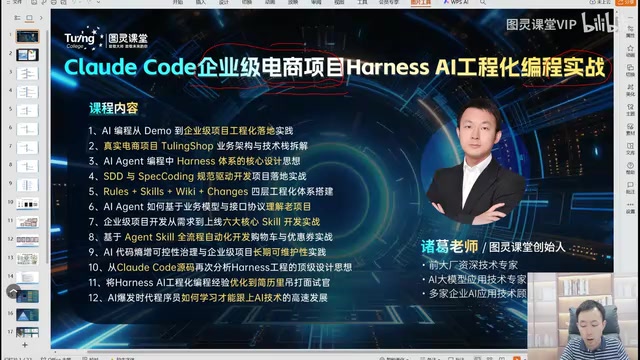
The presenter specifically points out that most content explaining Harness on the market "stays at the conceptual level"—after listening, you get a general idea, but when you actually start working, you still don't know where to begin. What truly matters is presenting this methodology through hands-on practice combined with real enterprise-grade projects.
This course chose an e-commerce project as the practical case, because e-commerce business is widely familiar and requires little explanation of business logic. But the methodology itself is universal—as long as it's an enterprise-grade large project, the application logic of Harness Engineering remains consistent.
A Pragmatic Choice of Tech Stack
At the toolchain level, this practical session adopts a fairly representative combination:
- Development environment: Claude Code + VS Code
- Backend model: China's Zhipu GLM (latest version)
The choice of Zhipu GLM over Claude's native model was due to network restrictions in the classroom demo environment. But this choice itself reveals an important point: Using Claude Code paired with Zhipu GLM can already produce high-quality output. If an enterprise can access Claude's large model and advance projects following the Harness Engineering methodology, the results will only be better.
The value of Harness Engineering doesn't depend on any specific top-tier model, but on the methodology system itself. Even a "suboptimal" model combination can produce production-ready code within the correct engineering framework.
The True Positioning of Developers in the AI Era
Faced with the reality that "80% to 90% of code is written by AI," will developers be eliminated? The answer is no.
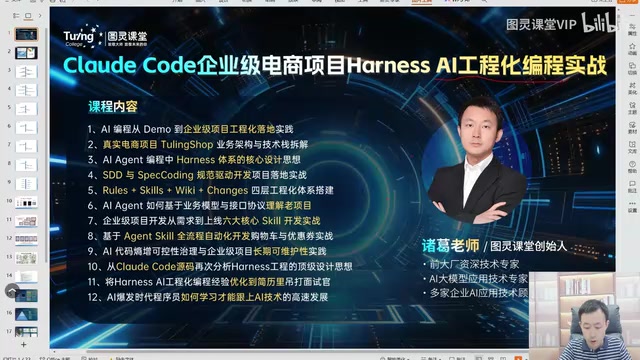
The presenter emphasizes: even if AI takes on the vast majority of code-writing work, "humans still have a great deal of irreplaceable work to do." In the Harness Engineering workflow, the human role undergoes a fundamental shift—from "code writer" to "AI controller." Architecture design, requirements decomposition, quality review, and solving difficult problems that AI cannot break through still require solid technical fundamentals.
This also explains why technical ability becomes even more critical in the AI era: it determines the ceiling of how well you can harness AI. Non-technical people are limited by AI's capability boundaries, while technically skilled people can take over, correct, and break through when AI gets stuck.
Conclusion
Harness Engineering represents a mature paradigm for enterprise-grade AI coding. It goes beyond simple prompt interaction and context supplementation, building an engineering system capable of harnessing AI to complete complex production-level projects.
For enterprises and developers, understanding and mastering this methodology means: true competitiveness lies not in "knowing how to use AI," but in "being able to harness AI" to deliver high-quality enterprise-grade software that can go directly into production. In today's world where AI handles a large amount of coding work, engineering capability and technical depth are precisely the most irreplaceable value that human developers offer.
Related articles

Disaster and Glory of the Apollo Program: The History We Must Revisit Before Returning to the Moon
From the fatal Apollo 1 fire to Apollo 8's daring lunar orbit to Apollo 11's successful landing—revisiting the disasters, fears, and compromises of the Apollo program and their lessons for today's return to the Moon.

Netflix Trust Exercise Turns Into Firing Trap: Where Are the Boundaries of Corporate Trust?
A Netflix employee was fired after sharing private info in a trust exercise. We analyze the risks of corporate trust exercises and how employees can protect themselves.

AMD CDNA5 Architecture Deep Dive: Technical Evolution and the AI Computing Competition Landscape
Deep analysis of AMD's CDNA5 architecture covering Chiplet packaging upgrades, HBM memory evolution, and low-precision compute optimization, examining how AMD challenges NVIDIA's AI chip dominance.