Harvard Discussion Reveals Why Chinese AI Is Betting on Open Source

Chinese labs are intensively releasing open-weight models, making open source a pragmatic strategy for the second tier to acquire users.
In a Harvard discussion, Nathan Lambert judged that open-source models have become an unstoppable force, yet attention within the AI community remains too low. Chinese labs (DeepSeek, Kimi, GLM, Qwen, etc.) have formed the world's most concentrated camp of open-weight models, driven by DeepSeek's ideology and other labs' pragmatic strategy of using open releases to acquire users as second-tier players. The R1 release and agent capability breakthroughs are two key nodes. Licensing is diverging, with more companies setting revenue thresholds to seek a share of the inference market. The post-training stack has become the path for open-source models to enter enterprises, but the distillation controversy and whether the six-month gap matters remain open questions.
Open-source models are becoming a force that cannot be ignored
In a discussion at Harvard University, Nathan Lambert, a senior researcher in the open-source model field, shared his observations on China's AI ecosystem. His core judgment is that open-source models have already become an "unstoppable force"—more and more institutions are able to train models, the participating continents are becoming broader, and new waves of investment will keep coming. He even said bluntly that attention to open-source models within the AI community is "a bit too low."
This judgment holds especially true in the context of Chinese AI. DeepSeekAd, Kimi, GLM, Qwen, MiniMax, Xiaomi... a group of Chinese labs have intensively released open-weight models over the past few years, forming the most concentrated force in the global open-source AI landscape. Nathan Lambert's observation is that behind this there is both ideological motivation and very pragmatic business calculation.
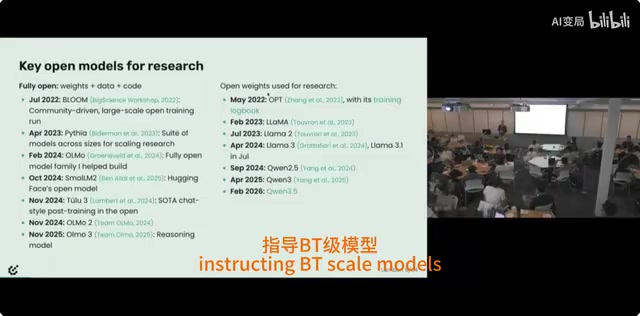
Open weights are not the same as open source: a compressed discussion
To understand China's open-source choices in AI, we must first clarify the layers of "openness." Lambert reminds us that a few years ago the biggest debate in the open-source model community was "what counts as an open-source model." Today the discussion has become somewhat more pragmatic: models like the Llama series and Chinese models whose weights can be downloaded directly belong to "open-weight models"; truly open-source models release all the data and code used for training.
The latter is extremely important for scientific research. Many PhD students conduct research on fully open models, but Lambert points out an interesting fact: such fully open models "historically have come from the United States rather than China," and represent investment in basic research infrastructure. The mainstream choice of Chinese labs is open weights—weights are downloadable and details are not disclosed, but that is enough to allow the ecosystem to spread quickly.
Licensing is another easily overlooked dimension. Most DeepSeek models use the MIT license, and GLM did so until recently as well, so users can use them freely. But more and more companies are beginning to set "revenue thresholds": deploying Kimi or GLM 5.2 on your own infrastructure requires a separate agreement. Lambert believes this is an experiment by Chinese companies trying to secure a share of revenue from the U.S. inference market, and export controls and entity lists will bring great uncertainty to such commercial cooperation.
Open-weight model refers to a model whose parameters can be publicly downloaded and that allows users to deploy and fine-tune it themselves, but whose training data, training code, and complete training process are usually not disclosed. It is fundamentally different from an open-source model in the strict sense: the latter follows the open-source definition and requires releasing training data, code, and reproducible training details. Open weights lower the barrier to use and allow the ecosystem to spread quickly, but they cannot satisfy academic research's need for reproducibility and transparency. Therefore, open weights are often viewed as a commercial strategy tool rather than research infrastructure.
Copyleft license is a licensing mechanism in the free software movement that requires modified derivative works to be released under the same license terms, thereby ensuring free circulation. In contrast, permissive open-source licenses (such as MIT and Apache 2.0) allow derivative works to be used in closed-source ways. The divergence in license choices within the open-source AI community is essentially a continuation of these two philosophies: whether to prioritize downstream freedom or to prioritize expanding adoption.
Why do Chinese labs choose open source?
This is the core question of the entire discussion. Lambert's explanation is multi-layered and not driven by a single motive.
Ideology: the special case of DeepSeek
Lambert believes DeepSeek "is very likely ideologically sincere"—it truly believes in the path of open-source superintelligence. He uses one detail as evidence: behind DeepSeek is a quantitative fund, and the founder is already wealthy enough that he "doesn't need to make money." But this does not mean DeepSeek has no commercial returns; revenue data from its inference service shows that this business is quite substantial.
Pragmatism: the only play for the second tier
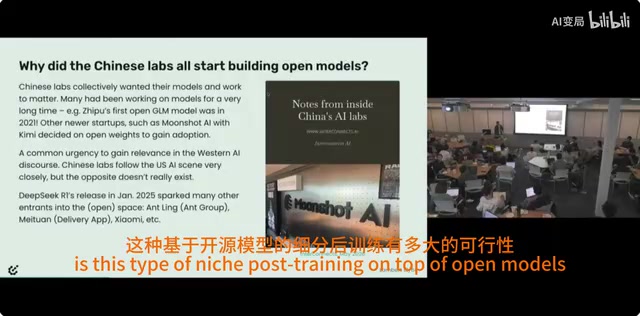
For other Chinese labs, Lambert's judgment is more sober: "As a second-tier player, the only way to get others to use our model is to release it openly, push costs to the lowest possible level, and put it in as many hands as possible." This sentence points to the commercial logic of open source in China—not sentiment, but a necessary means of acquiring users.
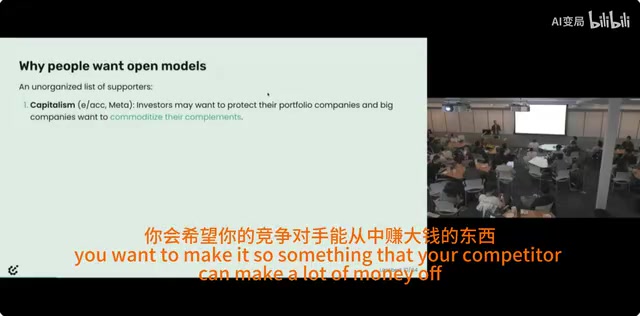
He attributes this to a more general law of the tech industry: "commoditizing the complement." Meta's calculation in open-sourcing Llama was to make AI cheaper so that it could earn more from businesses such as recommendation engines and chatbots; VCs embrace open weights because they missed out on investing in OpenAI and now hold a pile of complementary products that need cheap intelligence. The logic of Chinese companies is similar, only their situation is more urgent.
Ecosystem inflection points: R1 and the agent moment
There are two key nodes on the timeline. The first is the summer of 2025, when Lambert observed that "there are so many Chinese labs doing these models" became a common perception; many teams already had large technical teams, and after DeepSeek R1 was released they decided to build LLMs, launching large models within six to nine months.
The second node is after R1, when AI truly went mainstream in China—previously China had not gone through the stage in the United States where "every website adds a chatbot." A more recent leap is agent capability: in the agent wave driven by Claude Code, open-source models such as GLM 5.2 and Kimi K3 began to have "genuinely usable" open agent behavior, directly igniting an economic boom and also bringing the cybersecurity risks that are being debated today.
Agent capability refers to a model's ability not only to generate text but also to plan autonomously, call tools, execute multi-step tasks, and interact with the external environment. Compared with traditional chat models, agent models require stronger reasoning, tool use, and error recovery capabilities. The emergence of products such as Claude Code has pushed this direction forward, and the maturation of open-source models in agent behavior means users can deploy AI systems capable of executing complex tasks on their own infrastructure, which is significantly attractive to enterprises and developers and also brings new security and regulatory challenges.
Building their own intelligence: another kind of open source at Meituan and Ant
Lambert specifically mentions a category of Chinese players: Meituan (similar to DoorDash) and Ant Group (China's largest fintech company). Their approach is to train a general model and open its weights, then fine-tune it for their own agent scenarios—essentially "owning their own intelligence." Open weights let more people understand and build on their technology stack, while they would have had to build models to support their own products anyway, so open-sourcing may not affect the cost calculation.
The sustainability of this model is "questionable," because open weights themselves do not make much money, but for these companies what they save is the huge API fees they would otherwise pay to companies such as DeepSeek. Lambert also reminds us that Chinese enterprises have traditionally had a low willingness to pay for software, and the development path of the SaaS market is very different from that in the United States, which will affect the monetization space for open-source models.
The post-training industry and the distillation controversy
How do open-source models enter enterprises? Lambert believes the path is post-training. He observes that "every needle lab is converging on a combination of open-source compute, data, RL environments, evaluation, and post-training stacks," because this is how open models reach enterprises with proprietary data—enterprises that are unwilling to hand their data to frontier labs. He does not think most of these companies will succeed; what is truly scarce is rigorous evaluation design and post-training integration capability.
Regarding the accusation that "Chinese models are just distilling American models," Lambert acknowledges that this is a "big issue," but he also emphasizes that Chinese labs are "very good at building models." He prefers to direct the question in another direction: as frontier model capabilities continue to improve, does a six-month gap still matter? His judgment carries a slightly philosophical tone—"I don't think intelligence can go to infinity."
Post-training refers to the process of adapting a pretrained foundation model to a specific task or domain through supervised fine-tuning, reinforcement learning, preference alignment, and other methods. For open-source models, post-training is the key path for enterprises to combine proprietary data with open weights: enterprises do not need to train a model from scratch; they only need to do post-training on open weights to obtain customized capabilities while avoiding handing data to frontier labs. A post-training stack usually includes data management, compute resources, reinforcement learning environments, evaluation systems, and integration tools, and its maturity directly determines whether open-source models can be implemented in enterprise scenarios.
Model distillation refers to training one model (the student model) on the outputs of a powerful model (the teacher model), so that the student model can approach the teacher model's capabilities at lower cost. In the context of open-source AI, the distillation controversy concerns whether Chinese open-weight models have extensively used outputs from U.S. frontier models as training data, thereby narrowing the capability gap at lower cost. This practice is technically widespread, but it involves license terms and data-use ethics, and therefore has become a focus of competition and policy discussion.
A fragmented and hard-to-coordinate community
The open-source AI community is not monolithic. Lambert lists multiple motivations for supporting open models: capitalism and competition, belief in scientific progress, security considerations against concentration of power, and the freedom claims inherited from the free software movement. These people "often argue fiercely with me on X even though I am also an open-source supporter." This decentralization brings the benefit of intellectual diversity, but it also makes it difficult for the community to form a united front on policy recommendations.
He also tells a piece of open-source history: the free software movement gave rise to copyleft licenses, which require modified works to remain freely circulable, and many companies are unwilling to accept this downstream constraint; open source was a more pragmatic compromise. This history still has reference value for understanding today's license disputes in open-source AI.
The competitive landscape is still changing rapidly
Lambert uses Zuckerberg as an example to illustrate how fast this field changes: a blog post explaining why open models are the way forward became, one year later, a personal superintelligence memo saying "we actually won't be that open."
China is also reshuffling. Xiaomi is the lab named as "on the rise," having recruited Luo Li (phonetic) from DeepSeek to lead it, and its open-weight model has topped the Artificial Analysis index for several months. MiniMax is considered the most "BenchMax" Chinese lab, where product success may be more important than the model itself. And DeepSeek, with its latest model, has "returned to the top"—extremely cheap and very capable.
Lambert closes with a sense of urgency: this week there may be another new top model with trillions of parameters released, layered on top of already more than enough risk discussion. For Chinese AI's open-source choice, this is both an opportunity and an economics question that has not yet been answered.
One-line Summary
Chinese labs are intensively releasing open-weight models, and open source has become a pragmatic strategy for the second tier to acquire users.
Paragraph Summary
In a Harvard discussion, Nathan Lambert judged that open-source models have become an unstoppable force, but attention within the AI community is still too low. Chinese labs (DeepSeek, Kimi, GLM, Qwen, etc.) have formed the world's most concentrated camp of open-weight models. Motivations include DeepSeek's ideological drive and other labs' pragmatic strategy of using open releases to acquire users as second-tier players. The R1 release and breakthroughs in agent capability are two key nodes. Licensing is diverging, with more companies setting revenue thresholds to seek a share of the inference market. The post-training stack has become the path for open-source models to enter enterprises, but the distillation controversy and whether the six-month gap matters remain open questions.
Related articles

Nothing CMF Buds 2A Drops to $17.89 on Black Friday: A New Low for ANC Earbuds
Nothing CMF Buds 2A wireless earbuds Black Friday deal: just $17.89 on Amazon, about $11 off retail and a record low. ANC earbuds at an entry-level price.

When AI Creation Gets Accused of "Spitting": Hacker News Heats Up Over the Glaude Controversy
A Hacker News post, "Spitting in the Face of Glaude," sparks debate on AI creation transparency and attribution ethics. This analysis examines the blurred creator identity behind the controversy and offers practical advice for AI content production.

Akai Embraces Custom Firmware: MPC Sample 1.4 Lets Users AI-Program Their Sampler
Akai embraces the modding community with MPC Sample 1.4 firmware, supporting vibe-coded custom firmware and effects. We analyze the impact of this open strategy on music hardware and AI-assisted programming.